
When clinical psychologist Lata Hemchand, PhD, began her private practice in Bangalore, India, almost four decades ago, she viewed her homosexual patients the way she was taught to at one of India’s top training institutions—as sexual deviants. The treatment? Conversion therapy.
Parents often pushed their gay or lesbian children into treatment, asking that they be made straight, remembers Hemchand. “The fear of losing their families and social status was so strong that clients themselves would say, ‘I want to get out of this,’” she says. Hemchand would show provocative photos of nude or scantily clad men and women, then administer a small shock to the client’s wrist whenever a same-sex photo appeared. After 10 or 15 sessions, she would assess whether the client had developed an aversion to figures of their own gender, and then help him or her further develop that aversion.
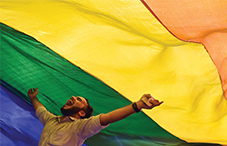
Now both Hemchand and India have changed. For Hemchand, it was a certificate course on sexuality and culture at the University of Amsterdam that she completed in 2000—and close personal contact with members of the LGBTQ community there—that changed her mind, transforming her into one of India’s most LGBTQ-friendly therapists. For India, the change came with a Supreme Court rulingopens in new window in September 2018 that decriminalized homosexuality.
The court’s decision overturned part of a 19th-century law introduced by the British and known as Section 377 that made sex “against the order of nature” a crime punishable by life in prison. (The law had been overturned in 2009 but was reinstated in 2013.) While the judges focused their arguments primarily on the importance of individual autonomy, nondiscrimination and privacy, they pointed repeatedly to the American Psychiatric Association’s 1973 decision to remove homosexuality from its list of mental disorders. The judges also cited several APA documents, including APA’s amicus brief in the U.S. Supreme Court case that decriminalized same-sex sodomy in the United States in 2003.
While rarely enforced, Section 377 has had serious consequences for India’s LGBTQ community. The law has left individuals open to harassment, beatings and blackmail. Some have been forced into loveless, sexless marriages; other couples have run away together or even died by joint suicide. “There are even horrific cases of what’s called ‘corrective rape,’ in which lesbians are raped by men with the intention of turning them into heterosexuals,” says Kanika K. Ahuja, PhD, an associate professor of psychology at Lady Shri Ram College for Women at the University of Delhi.
While the ruling is a good first step, it’s not enough, say Indian psychologists. “Society is still not really accepting,” says Hemchand. “That’s the sad part. We still have a lot of work to do.”
Providing treatment
Despite the longtime ban, in some ways acceptance of homosexual behavior is deeply rooted in Indian culture, says Ahuja, citing as examples the positive depictions of same-sex activity in the 2,000-year-old Kama Sutra and in the 1,000-year-old erotic sculptures at the Khajuraho temples. “Homosexuality began to be frowned upon when the British Raj banned homosexual relations under Section 377 in 1861,” says Ahuja. But while Indian society is willing to accept homosexuality in certain groups—especially among creative professionals in the world of fashion or film—homosexuality overall is highly stigmatized, she says.
Today, being gay in India can mean being rejected by family, being ostracized by the community and even facing violence. In a small qualitative study, psychologists Apoorva B of Manipal University and Elizabeth Thomas, PhD, of Christ University in Bangalore found that parents often reacted to daughters’ coming out by denying their sexuality or trying to use violence to change them (Journal of Psychosocial Researchopens in new window, Vol. 11, No. 2, 2016).
And when Sharanya Rao, a PhD student in clinical psychology at The George Washington University in Washington, D.C., examined the impact of the law on the mental well-being of sexual minorities in India, she found that the perceived impact of Section 377 and the stress of concealing their true selves led to increased depressive symptoms and a diminished sense of belonging (Psychology of Sexual Orientation and Gender Diversityopens in new window, online first publication, 2018). The law, says Rao, had “a very real impact in terms of how people see themselves being accepted by their country.”
Throughout the long fight against the ban, Hemchand and other practitioners have worked to raise awareness, joining demonstrations, educating colleagues and issuing proclamations of support.
Unfortunately, many psychologists and other mental health professionals still share the wider society’s heterosexism. While those in larger cities tend to show more sympathy toward these clients, in smaller towns and rural areas, it’s largely a different story, Hemchand says. She estimates that 10 to 20 percent of mental health professionals nationwide still attempt to convert their clients.
As a result, many LGBTQ Indians have been reluctant to seek therapy for fear that therapists either wouldn’t understand their issues or would be actively hostile toward them, says Sadhana Vohra, PsyD, a private practitioner in Delhi who has been a pioneer in LGBTQ-friendly therapy in India. Now a growing number of psychologists are following Vohra’s lead, and LGBTQ groups are circulating lists of gay-friendly therapists like her. “Even when homosexuality is a crime, you can still be encouraging of clients who belong to that community,” says Vohra. “You can still be supportive of them and help them find ways to survive.”
Changing attitudes
Changing families’ attitudes is a key priority for clinical psychologist Richa Vashista, a research interventionist at the Humsafar Trust, a nonprofit organization in Mumbai and Delhi that provides counseling, health-care services and advocacy for the LGBTQ community. Vashista has co-authored “Strengthening Bridges: A Manual for Counselors to Support Parents of LGBTQ” to guide mental health professionals in supporting parents.
“When children come out, the parents often blame themselves or feel guilty,” says Vashista. “The mother usually blames herself, thinking something happened during pregnancy that her child turned out this way.” The manual outlines helpful responses to this and other parent questions, such as what to tell their friends or why their children can’t just marry and live secret lives.
Catching the next generation before they develop anti-LGBTQ attitudes is another priority for Indian psychologists, says Ahuja, who has developed an intervention to “subvert heteronormativity” among college students.
Using a scale she developed to measure Indian attitudes toward homosexuality (Journal of Homosexualityopens in new window, Vol. 64, No. 14, 2017), Ahuja tested a three-part intervention: an educational presentation offering facts about homosexuality and its longtime presence in Indian culture; an exercise in which participants imagine they are members of a persecuted minority; and a session based on the contact hypothesis in which students interact with a gay man and a lesbian woman. Ahuja and her colleagues found that the intervention increased empathy and improved attitudes toward homosexuality in participants (Journal of Homosexualityopens in new window, online first publication, 2018).
“We really need more such forums to talk about homosexuality and to give the opportunity for homosexuals to share their experiences,” says Ahuja, noting that Indians’ attitudes are typically shaped by media depictions of homosexuals as buffoons.
Such interventions need to happen at every level, adds Vashista, who provides trainings on sexual orientation and gender identity at schools, corporations and other venues. At workplaces, for example, Indians still face enormous pressure to conform. “A client comes and tells me, ‘I have to live a lie and pretend to be someone else at work,’” she says. “It takes a mental toll on them.”