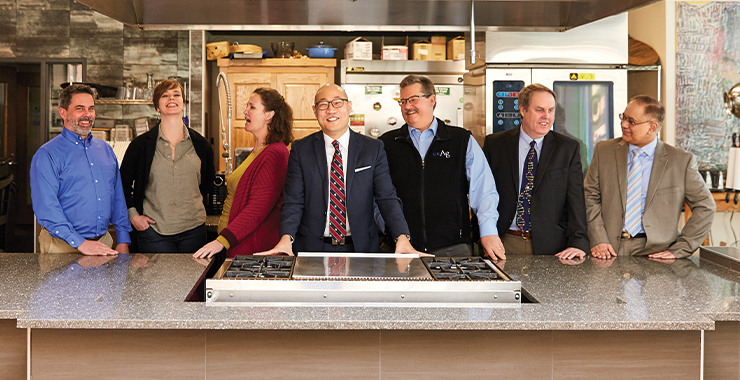
At the annual International Society of Neurogastronomy Symposium, chefs go head to head to create delicious dishes—but it’s not your average cook-off. These culinary creatives team up with experts in neuroscience, psychology, food technology and medicine to prepare foods that will delight judges with taste impairments or dietary restrictions.
At the inaugural symposium in 2015, the judges were cancer patients whose chemotherapy treatments had dramatically altered their senses of taste and smell—and thus, their enjoyment of food and nutritional intake. To overcome such gustatory challenges, the teams relied on factors like texture and temperature to emphasize key flavors. In 2018, the chefs and scientists in attendance worked together to design tasty desserts that were suitable for judges with diabetes, using tricks like bright red colors and fruity aromas to suggest sweetness without sugar.
The competition is just a slice of a much bigger pie: a new multidisciplinary movement dedicated to understanding gastronomy in the context of brain and behavior. Food scientists have studied flavors for many years, of course, while marketers have long considered the importance of the shape of a bottle or the color of a logo on food packaging. But what’s new is that experts in widely divergent fields are coming together to provide a more complete picture of the physiology and psychology of flavor perception. The long-term plan: to harness the power of flavor to improve the health of people and the planet.
“It sounds a bit all over the place, but the pillars are strategically set,” says Dong (Dan) Han, PsyD, a clinical neuropsychologist and associate professor of neurology at the University of Kentucky and one of the principal founders of the International Society of Neurogastronomy. Han has stepped easily into the role of liaison between disparate worlds. “The point is to get food scientists, agricultural researchers, neuroscientists, psychologists and other clinical providers together to come up with an interdisciplinary science, and then have the chefs, distillers and other culinary professionals deliver what we find,” he says.
Many chefs are already on board with the idea. “It feels perplexing talking about black truffles and promoting indulgence on one side, while on the other side, being genuinely concerned about eating conditions for people who have eating disorders or cancer,” says Frédéric Morin, a co-founder of the international society and chef/co-owner of the acclaimed Montreal restaurant Joe Beef. Neurogastronomy gives chefs a new, more socially conscious way to practice their craft, he says.
Launching a new field of study isn’t easy, especially when it extends from neuroscience labs to agricultural research stations to restaurant kitchens. But if anything can bridge gaps in science and society, it’s a great meal. “Enjoying food is something everybody can get excited over,” Han says.

Flavor in the brain
Han’s journey to the science of flavor took an indirect route. His first career was as a high school administrator in Chicago public schools. Feeling burned out, he decided to pursue a second career, earning a doctorate from the Adler School in Chicago followed by a clinical neuropsychology fellowship at the University of Wisconsin–Madison.
Working at hospitals in the University of Kentucky’s health-care system, Han assessed patients with a range of neurological problems, including stroke, epilepsy, dementia, traumatic brain injury and Parkinson’s disease. “I noticed a lot of these people suffered from smell and taste issues that really affected their quality of life,” he says. “But there really wasn’t much in the way of treatment plans to address those conditions, either medically or psychologically.”
Then, in 2006, he read an article in Nature by Gordon Shepherd, MD, DPhil, a professor of neuroscience at the Yale University School of Medicine. Shepherd’s article called for a new science combining the molecular biology of olfaction, the biochemistry of food preparation and the neuroscience of sensation and perception (Natureopens in new window, Vol. 444, No. 7117, 2006). He called this integrated science “neurogastronomy” and argued that it could have implications for diet and public health. “Flavor perception is created by the brain,” Shepherd says. “In order to understand our choices in gastronomy, we need to understand the role that our brains play.”
Han took Shepherd’s call to action as a personal challenge. “Without flavor, quality of life is diminished pretty significantly. Psychologically, it takes a huge toll,” Han says. “As clinical psychologists, we might look at how that’s affecting someone in terms of psychological distress, but seldom do we explore the mechanism.”
Over the next few years, Han gave more thought to Shepherd’s ideas. While at a conference in Montreal, he and some other neuropsychologists went to Morin’s Joe Beef restaurant for dinner. It was the end of the night, and Morin came out from the kitchen to greet diners. Morin started chatting with the scientists, and mentioned he’d just read Shepherd’s 2010 book “Neurogastronomy: How the Brain Creates Flavor and Why It Matters.” “He invited himself down to discuss olfactory neurosciences, and a few drinks later, we said, ‘Let’s get the scientists, clinicians and culinary professionals together for a meeting of the minds,’” Han recalls. “The rest is history.”
Han and Morin started sketching plans for the first neurogastronomy meeting. Meanwhile, Han was also collaborating with his University of Kentucky colleague Tim McClintock, PhD, a professor of physiology who studies the neurogenomics of olfaction and invented an assay for studying odorant receptors. McClintock happened to know Shepherd, and from there the pieces of this new science started falling into place.
Soon other clinicians, researchers and culinary professionals had joined the cause. The University of Kentucky has a large college of agriculture, and when scientists there heard about Han’s effort, they wanted in, too. “It made perfect sense to connect the psychological science of flavor perception with sustainability issues in agricultural technology,” Han says. “If we can understand the mechanism of flavor, we could potentially make healthier, cheaper, smaller carbon-footprint products that would be desired as much as sugar is.”
The International Society of Neurogastronomy officially launched in 2015, and by the following year it had secured funding from the Smell and Taste Division of the National Institute on Deafness and Other Communication Disorders of the National Institutes of Health. At the annual symposium, clinicians, scientists and food experts come together to talk shop—and to fire up their skillets to put their science to the test.
Understanding flavor
There’s a reason so many fields converge in the science of neurogastronomy: Flavor perception is surprisingly complex. When you lick an ice cream cone or bite into a potato chip, your mouth is flooded with flavor. The experience might feel like it’s happening on your tongue, but that’s an illusion, McClintock says. “In some way, every sense is part of this thing we call flavor,” he explains. “Neurogastronomy is about understanding what flavor is.”
The process starts even before you take a bite. You smell the food’s aroma and see its shape and color, as well as the appearance of the plate or bowl. Once it hits your taste buds, the food stimulates flavor receptors that detect tastes such as salty, sour, sweet, bitter and savory (also known as umami). You perceive the feel of the food in your mouth—the smooth creaminess of the ice cream, the rough snap of the chip. Meanwhile, you’ll listen for the satisfying rustle of the bag and crunch of the chip.
While all that’s happening, aromas from the food are carried through the inside of the mouth up into the nose, in a process called retronasal olfaction, which has a big effect on flavor. Though the exact number is debated, scientists have estimated that 75 percent or more of what we think we taste we’re actually smelling, says Charles Spence, PhD, a professor of experimental psychology at the University of Oxford who studies multisensory perception, and is also among the founders of the neurogastronomy movement. “The sense of taste is the least interesting part of tasting,” he says.
Spence’s research reveals how input from our ears, eyes and fingertips influences the taste of foods. He’s shown that yogurt, for example, is perceived as denser and more expensive when tasted with a light plastic spoon rather than a weighty metal one (Flavouropens in new window, Vol. 2, No. 21, 2013), and eating chocolate while listening to musical compositions with soft, smooth notes makes the chocolate seem creamier (Appetiteopens in new window, Vol. 108, No. 1, 2017).
Such findings have applications beyond being mere curiosity pieces. Spence, for example, has taken a critical look at hospital food (Flavouropens in new window, Vol. 6, No. 3, 2017) and is working with a children’s cancer hospital in Spain to improve the flavor of food for patients whose senses of taste and smell have been altered by chemotherapy. In Montreal, Morin has been working with nutritionists, psychologists and others to host meals for mixed martial artists, who must track calories closely and weigh in before competitions—and often have strained relationships with food as a result. Morin hopes his efforts will help change the way the athletes think about the meals they eat. “Food should be a reward, but it’s a problem for so many people,” he says.
Flavor blockers
Han and McClintock, too, are connecting the dots from the basic science of the senses to practical applications. In one new project, they’re exploring whether they can block flavors in tobacco smoke. “There’s a lot of literature on smoking cessation, but little is focused on flavor. There’s an actual flavor to tobacco smoke,” Han says. As an ex-smoker himself, he knew that nicotine withdrawal was only part of what made quitting difficult. “I also missed the actual taste. Over the years it had become associated with the reward circuits in my brain,” he says.
He and McClintock are identifying molecules that block the flavor and taste receptors that respond to the compounds in tobacco smoke. The idea was inspired by the miracle fruit, a berry that contains a protein that activates sweet taste receptors when sour flavors are present, making sour foods taste sweet. If you chew a miracle berry and then bite a lemon wedge, it will taste like sugary lemon candy.
This principle could be used in a variety of ways, McClintock says. “There are lots of things we’d really prefer not to be able to detect.” Take the durian, the stinky Asian fruit banned in some locales because of its pungent odor. Blocking its aroma could inspire more people to eat this nutritious fruit. Modulating people’s flavor experiences could guide them toward healthier choices for their bodies—and the planet. Agricultural scientists can help identify healthy, eco-friendly food choices, while psychologists, chemists and physiologists can figure out how to get people to eat them. Imagine sucking a lozenge that could make grains from nutrient-dense, sustainably grown plants taste and smell better than your favorite wheat pasta.
If some of these goals seem lofty, Han isn’t worried. “People as a whole are resistant to change, but zeitgeist shift occurs regardless,” he says. Just look at Americans’ relationship with sushi. In the 1970s and 1980s, eating raw fish and seaweed was seen as adventurous, if not eccentric. “Now it’s almost as normal as eating a burger,” Han says. “Even if it doesn’t happen in my generation, as long as the movement is shifting flavor priorities to something that’s healthier and sustainable, I think we’re doing our jobs.”
When Shepherd urged his colleagues to take a broader look at the science of flavor, he didn’t anticipate a clinical psychologist would end up leading the charge—or that so many chefs would join him. “It’s now truly multidisciplinary in a much broader way,” he says. He’s pleased to see how far the fledgling field has come. “Flavor is at the heart of much of our concern about healthy diets, and our food choices also have a direct effect on climate and the environment. This is a timely way to address the critical role that flavor plays in these very complex problems.”
Han’s background has armed him with skills that come in handy when cultivating this wildly interdisciplinary field. As a clinician and an academic with training in perception and neuroscience, he can slip easily into different professional worlds. Perhaps most important, his experience as a psychologist allows him to help those from different groups better understand one other. “My psychology training helps me to socially engineer conversations between different personalities and cultures,” he says.
The field is in its infancy, so those connections are still being made. Agricultural scientists, physiologists and psychologists aren’t exactly frequent collaborators—at least, not yet. But at the University of Kentucky, food policy courses and dietetics courses have begun incorporating neurogastronomy into the curriculum, Han says. “When these agriculture and nutrition students see for the first time how psychological flavor perception works, you hear a lot of ‘oohs’ and ‘aahs.’”
Those light bulb moments are helping to shape the next generation of researchers—and Han sees that as progress toward a more integrated science of flavor. “There will be 9 billion people to feed by 2050,” he says. “To promote better human health at the individual level, and address the sustainability issue at the macro level, we have to get everybody to the table, pun intended.”
“Psychologists on the Team” is a regular feature in which the Monitor explores the work of psychologists on interprofessional teams.