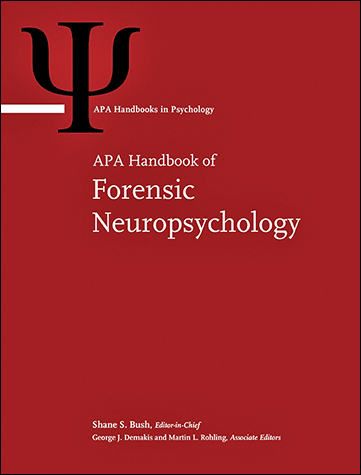
APA Handbook of Forensic Neuropsychology
ISBN: 978-1-4338-2694-8Available formats
Part of the landmark APA Handbooks in Psychology® Series from APA
The APA Handbook of Forensic Neuropsychology covers the scientific and clinical neuropsychological advances and their application in forensic contexts.
The application of clinical neuropsychology to forensic questions and issues is growing at a tremendous rate. This handbook covers the scientific and clinical neuropsychological advances and their application in forensic contexts.
To accomplish this goal, the handbook:
- presents the theoretical, statistical, and ethical foundations of forensic neuropsychology
- describes current assessment measures and procedures employed in forensic neuropsychology, with an emphasis on their empirical evidence base
- integrates recently published empirical literature involving commonly encountered disorders and special populations
- describes reporting, admissibility, and testimony issues involving neuropsychology in forensic matters
- describes future directions involving the intersection of clinical neuropsychology and legal matters
Editorial Board
About the Editor-in-Chief
Contributors
Series Preface
Foreword
Introduction
I. Theoretical, Statistical, and Ethical Foundations
- Fundamental Forensic Statistics: Statistics Every Forensic Neuropsychologist Must Know
Martin L. Rohling, Bradley N. Axelrod, and Jennifer Langhinrichsen-Rohling - Ethical Practice in Forensic Neuropsychology
Shane S. Bush and Joel E. Morgan
II. Assessment Measures and Procedures
- Beyond the Tests: Record Review, Interview, and Observations in Forensic Neuropsychology
Joseph W. Fink - Selection of Tests and Batteries for Forensic Neuropsychological Evaluations
Glenn J. Larrabee - Symptom and Performance Validity Assessment in Forensic Neuropsychology
Justin B. Miller, Bradley N. Axelrod, Christian Schutte, and Jeremy J. Davis - Neuroimaging Techniques in the Courtroom
L. Stephen Miller and Cutter A. Lindbergh
III. Disorders and Special Populations
- Mild Traumatic Brain Injury
Martin L. Rohling, Jennifer Langhinrichsen-Rohling, and Bradley N. Axelrod - Moderate to Severe Traumatic Brain Injury
John H. King, Summer N. Rolin, and R. Brock Frost - Assessment of Psychiatric Disorders in Forensic Neuropsychological Evaluations
Chriscelyn M. Tusssey, Beth Caillouet Arredondo, and Paul M. Richards - Evolution, Forensic Implications, and Future of Somatic Symptom Disorders
David E. Hartman - Chronic Pain and Neuropsychological Assessment
John E. Meyers
IV. Special Topics and Populations
- Veteran's Disability Examination: Considerations for Neuropsychologists
Joshua E. Caron - Neuropsychological Evaluations in Disability Determinations
Robert L. Heilbronner and Shane S. Bush - Civil Capacities
George J. Demakis and Eric G. Mart - Competency to Stand Trial and Criminal Responsibility in Forensic Neuropsychology Practice
Loren E. Mallory and Michelle R. Guyton - Diversity Considerations in Forensic Neuropsychology
Shelley Peery, Desiree A. Byrd, and Adriana M. Strutt
V. Neuropsychology in the Courtroom
- Forensic Neuropsychological Reports
Stephen S. Meharg - Admissibility of Neuropsychological Evidence
Gerald Young - Neuropsychological Testimony
Robert L. Heilbronner - Forensic Neuropsychology and the Legal Consumer
Emalee J. W. Quickel and George J. Demakis
VI. Future Directions
- Technology and Computerized Assessments: Current State and Future Directions
Dustin Wahlstrom - Education and Training in Forensic Neuropsychology
Michelle Hoy-Watkins, Shane S. Bush, and Joseph J. Sesta
Index
Shane S. Bush, PhD, ABPP, is director of Long Island Neuropsychology, PC. He is also a neuropsychologist with the VA New York Harbor Healthcare System. He is board certified in clinical neuropsychology, rehabilitation psychology, clinical psychology, and geropsychology.
He has been awarded fellow status by APA (Divisions 12, 18, 20, 22, 40, and 42). He is a past president and fellow of the National Academy of Neuropsychology. He has also held elected positions or served as a committee member for the American Academy of Clinical Neuropsychology, American Board of Professional Neuropsychology, American Board of Geropsychology, and multiple APA divisions.
He has served as an editorial board member of Applied Neuropsychology, Archives of Clinical Neuropsychology, Clinical Gerontologist, Ethics and Behavior, Journal of Forensic Neuropsychology, Journal of Head Trauma Rehabilitation, Journal of Pediatric Neuropsychology, Psychological Injury and Law, and The Clinical Neuropsychologist.
He has presented on issues relevant to forensic neuropsychology at national and international conferences. He has more than 130 publications, including more than 15 books; six special issues of journals; more than 90 articles, book chapters, and encyclopedia entries; and 13 position papers for professional organizations, many of which were directly relevant to the practice of forensic neuropsychology.
In 2014 he was presented with the Outstanding Supervisor of the Year Award by the Department of Psychiatry at Stony Brook University Medical School.
He is a veteran of both the U.S. Marine Corps and Naval Reserve.
The APA Handbook of Forensic Neuropsychology is an authoritative and well-written book that contains a wealth of information for a diverse readership. The handbook is highly recommended for clinical neuropsychologists who have or will venture into the arena of forensic neuropsychology.
—PsycCRITIQUES
A welcome addition to the literature and will be of benefit not only to clinical neuropsychologists who work in the forensic area but also to attorneys whose work involves clinical neuropsychology.
—SirReadaLot