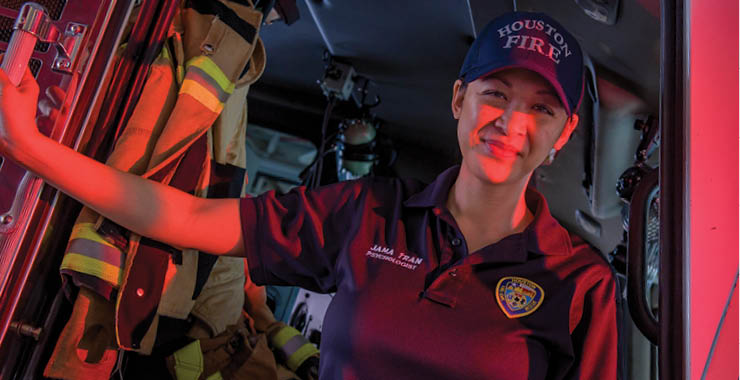
Like the firefighters she serves, Houston Fire Department psychologist Jana Tran, PhD, works whenever duty calls. As one of two psychologists in the department, Tran's main role is to serve as the mental health first responder to firefighters who may be in distress after responding to a lethal fire or a difficult 911 call, such as the death of a child. Tran meets firefighters wherever and whenever they need her—at their homes, at the hospital or fire station, or even on the scene as they are responding to a stressful event.
"The idea of a traditional clinic with office hours doesn't work with firefighters. To earn their respect, I must always be readily available," says Tran, who always keeps an extra uniform with her and drives a Houston Fire–issued emergency vehicle with lights and sirens, so she can answer calls quickly.
Tran is now in her fourth year at Houston Fire, which is one of only three fire departments in the country, along with those in Austin and Los Angeles, to have full-time psychologists on staff. The stress of firefighters' work goes far beyond battling fires: They spend about 85 percent of their time responding to emergency medical service calls that can involve suicides, abuse, shootings, car accidents and other distressing incidents that can take a toll on these men and women. Tran's research shows that many Houston firefighters develop depression and post-traumatic stress from their work that puts them at an increased risk for suicide—a revelation that has led the city's fire department to focus more on this population's mental health.
The Monitor asked Tran about what it's like to work for the fire service, how she's addressing firefighters' mental health concerns and how she got her job.
What do you do for the fire department?
I am on call 24/7 along with my colleague, Dr. Sam Buser. The two main situations we respond to are firefighters in crisis, such as someone who is having suicidal thoughts, and critical incidents, the calls that firefighters respond to that are so stressful and traumatizing that they could potentially lead to post-traumatic stress disorder. For those, he and I work closely with a team of firefighters who are trained to do peer support. We meet with crews that have gone out on difficult calls, as well as offer one-on-one peer support that typically leads to a crisis assessment or a therapy referral.
I also consult daily with the department's command staff and fire chiefs who need advice on how to help a firefighter they are concerned about. Sam and I provide individual, family and couples therapy to firefighters, but we try to spend most of our time outside the therapy room. We supervise an advanced doctoral-level practicum, enabling our four trainees from the clinical and counseling psychology programs at the University of Houston to provide most of the therapy services so that we can respond to emergencies and develop prevention programs. That enables us to be more visible to the other firefighters by, for example, attending academy graduations, promotion ceremonies, funerals and other important fire service events.
I also work closely with four faculty members at the University of Houston to conduct research on the mental health needs of the department.
How do you assist with a critical incident?
Typically, when I get word that a crew has been out on a difficult call, I wait until they are back at the fire station and have changed and showered and then I visit with them and work alongside the peer support team. Everyone clarifies their roles at the event and offers a short narrative on when they arrived at the scene and what happened next. When the firefighters hear others' experiences, it can be very therapeutic. A lot of what keeps people stuck after they experience a trauma is not being able to fully process all the events, and that can lead to their questioning some of the actions they took. While the research on the use of this type of intervention is mixed, our approach is voluntary and includes robust professional oversight and individual follow-up. These meetings destigmatize asking for help, and through them, firefighters become much more willing to seek further care.
At the end, my role is to provide psychoeducation on the normal responses to stress and trauma. I tell them they will likely have intrusive memories and disrupted sleep, and that they might be irritable with their spouse or partner. I also tell them there is no magic timeline for these symptoms to stop, but that if it has been a couple of weeks or a month or two and they still are thinking about that call, they should check in with me to see if they're OK.
What types of trauma are they experiencing?
The calls that affect firefighters the most are ones that involve kids. They often are on the scene after children have drowned, and they see kids who have been physically or sexually abused on some of their 911 calls. They also respond to a lot of suicides; I worked with a firefighter who has seen more than 36 suicides. Deaths that involve an element of injustice or unfairness hit firefighters particularly hard, such as children who die in a motor vehicle accident. Many firefighters say that the most difficult calls involve transporting a critically injured patient who in one moment is conscious and talking with them, and then suddenly dies under their care. The natural outcome is for the firefighters to feel that as a rescuer, they have failed.
Most people don't realize firefighters also respond to shootings. They are often showing up to very dangerous scenes with no weapons or bulletproof vests, and those events can be very stressful. And then of course there's the danger of going into a fire. Firefighters also respond to natural disasters, like Hurricane Harvey. While rescuing victims all around Houston, many firefighters worried about the safety of their own families. Another type of incident that is difficult for them to process is a line-of-duty death of a fellow firefighter. Those deaths are few and far between, but they awaken the firefighters' own sense of mortality.
Our research shows that the primary concerns that firefighters can develop as a result are depression and PTSD and that these are also the highest predictors of suicide in our members.
How are you targeting those concerns?
We deliver a two-hour PTSD prevention program called Operation Lifeline to all 4,000 fire service members. The program includes a video that features some of our firefighters and health professionals describing the signs and symptoms of PTSD and discusses how they address the stigma associated with it. During that training, we speak to them about medication options, evidence-based treatments for PTSD and how to get connected with services. We also have a suicide prevention program called Courage in Despair; every crew learns about depression and suicide, and we have posters, magnets, brochures and other psychoeducational materials in every station that highlight the signs and symptoms of suicide and how to get help. We're currently collaborating with faculty from the University of Houston and Florida State University to develop a web-based program for suicide prevention based upon psychologist Thomas Joiner's interpersonal theory of suicide, and we've received two grants from the Criminal Justice Division of the Office of the Governor to train more peer support members and conduct another suicide and PTSD prevention program.
How did you get this job?
I was hired for my experience in trauma psychology and treating PTSD; I am trained in the gold-standard, evidence-based treatments for PTSD. I went to graduate school for counseling psychology at the University of Houston and did the majority of my practicum training at the Michael E. DeBakey VA Medical Center in Houston. That's where I fell in love with trauma work. I did rotations in the WISER program, an acute inpatient program targeting women with PTSD secondary to military sexual trauma, and the ROVER inpatient program for men with combat trauma. I then went to the Bay Pines VA Healthcare System in Florida for internship in 2012, because they have a nationally recognized residential treatment program for military sexual trauma.
But trauma psychology hurts. It offers an amazing sense of meaning and purpose, but I also grieve with clients and have been vicariously traumatized by clients. So, once I had completed my trauma fellowship in 2014, I felt a little burnt out, and I went backpacking to Southeast Asia. My grandmother on my mother's side lives in Saigon, so I visited her and then used her home as base while I traveled alone for several months to Singapore, Thailand, Malaysia and Cambodia. It was one of the most empowering experiences I've ever had. When I came back to Houston in late 2014, I decided I would do something different from working for the VA. My mentor from the Houston VA saw the job opening for Houston Fire and told me I was the perfect person for that job.I interviewed with Sam and he offered me the job the next day.
What keeps you motivated?
One of my passions is being an advocate for female firefighters, and I am now developing a program to support them. There are only 150 women out of 4,000 firefighters in Houston—low numbers compared with the military and law enforcement. The fire service needs to do a better job of recruiting and retaining women, but the biggest hindrance to this is sexual harassment and gender discrimination. Some of the issues they face are specific to firefighting, such as having ill-fitting gear, but they also report not getting the same types of opportunities to prove themselves that men do. I don't know if I have the perfect solution yet, but I am in a position of power where I have a voice and can ask these women what they are going through and what we should do.