The nation’s capital is a city beset with health disparities based on socioeconomic class and race. Black residents are twice as likely to die of coronary heart disease as white residents, for example, and six times more likely to die of diabetes, according to a Georgetown University report (Georgetown University School of Nursing & Health Studies, 2016). Similar patterns hold for the incidence of cancer and stroke, among other health conditions.
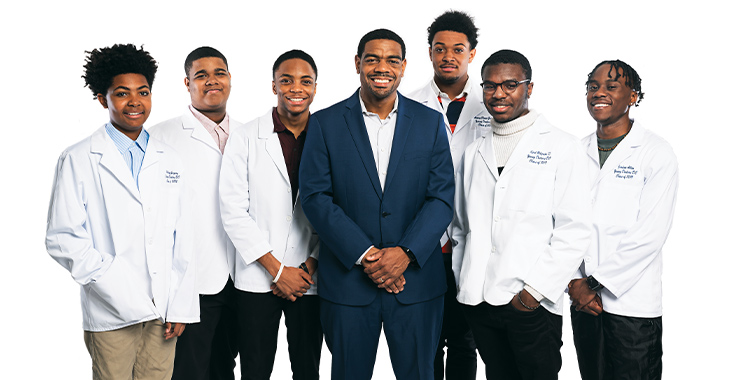
Malcolm Woodland, PhD, is pushing back using one of the community’s strongest resources: its youth. Woodland, a clinical psychologist, is the co-founder of Young Doctors DC, a mentoring program for black and Latino high school boys in southeast Washington that aims to encourage these youths to pursue health careers. Participants start the free program in ninth grade, attending Saturday and summer programs and shadowing health professionals in every area of care, from surgery to psychology. The teens, who remain in the program throughout high school, also give back to the community by running health fairs in their neighborhoods.
"It’s one thing if I pass a health message to a patient, or if a doctor does," Woodland says. "But it’s really different if it’s coming from your own kids."
Woodland, who also serves as the deputy director and interim chief psychologist of the Child Guidance Clinic at the Superior Court of the District of Columbia, launched the program with Brent Stephens, MD, and clinical psychologist Adrian Thompson, PhD, in 2013, securing initial funding from the DC Social Innovation Project. To date, 10 boys have graduated from the program, eight of whom have gone on to secondary education. This year’s class will graduate five more students, all of whom have been accepted to college.
The Monitor asked Woodland about what the students gain from the program, what impact the Young Doctors have had in their community and what comes next.
What does a student’s experience in Young Doctors DC look like?
It’s a mini medical school. The program generally starts for kids after the summer of their ninth grade year. The kids live on the campus of Howard University for four weeks and come back every summer until they graduate. They spend their mornings in didactic lessons generally taught by psychology doctoral students and medical students, from public health to anatomy to mental health.
In the afternoons, they’ll have writing lab. Rising seniors are working on their college applications, and younger students are working on sharpening their writing skills. On days they’re not in writing lab, they shadow health-care professionals, so they’re observing surgery, working in a family practice, in the emergency room, or shadowing a forensic mental health expert in court.
During the academic year, on Saturdays, they come back to Howard and engage in some of those didactic lessons. We have a lot of guest speakers from the community. One of the biggest pieces, sprinkled throughout the year, is we go back into communities where the kids come from. We’re taking people’s blood pressure, testing for vascular disease, taking blood sugar levels and doing a lot of community health work.
What were the challenges in getting Young Doctors DC started?
The big challenge is still there, in that our program is totally free. We didn’t want it to be anything else but free because I want it to be available to the kids who are most vulnerable, and who otherwise wouldn’t have opportunities. The kids also get a stipend for being in the program in the summer and in the Saturday Academy throughout the year.
One of the biggest difficulties is just funding the program. We have too many applicants for the number of slots we have, yet we don’t want to whittle folks off. We want to grab them, engage them and give them the skills that they need.
What impact have the students had?
We once did a health fair in the parking lot of the building where one of our Young Doctors lives, so everyone was coming up to him like, "Hey, son! What are you doing?"
It’s nice, because the other kids and parents see the kid in the white jacket with the stethoscope around his neck. He becomes a real healing body who people in the neighborhood go to when something is wrong. That is just not a way that black and brown boys are often understood in their neighborhoods.
We had another young man whose neighbor came to him and told him she wasn’t feeling too well. He did a really excellent job helping her. He got me on the phone and he sat with her while she got her physician on the phone, and it turned out there was a problem with her medication.
Another piece is just giving these kids ways to attain their goals. When a 14-year-old says, "I want to be a physician," a lot of times they have no idea what that really means. The Young Doctors really understand now what kind of programs they need to be in, what schools they need to be in. They’re really thinking about all the steps they need to take to be competitive.
What are your future plans for the program?
We’re always interested in having more people in the program, whether in terms of volunteering or funding and support.
Our goal is to really grow young people and grow that next wave of health-care professionals, but part of this work is making sure these students care for their neighbors. And I want folks to know just how much these young people have to offer.
For more information, see www.youngdoctorsdc.orgopens in new window, or reach Dr. Woodland at Malcolm.Woodland@dcsc.gov.