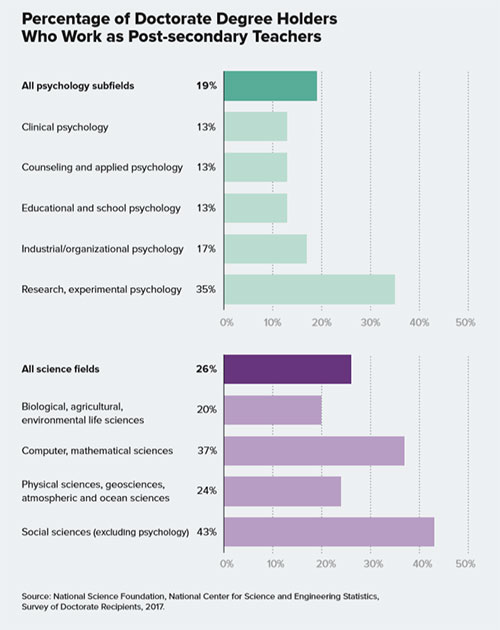
- Approximately one in five psychologists with a research doctorate work primarily as college and university professors, according to a 2017 survey from the National Center for Science and Engineering Statistics. The survey found that 19% of employed holders of psychology research doctorates reported that the best description of their occupation was post-secondary teachers/professors in science fields.1
- The proportion varied by psychology subfield and was higher in research fields than in health service psychology fields, which typically train psychologists for practitioner roles.2 Approximately 35% of research and experimental psychology doctorate holders reported themselves as post-secondary teachers in a science field, compared with only 13% of those in educational and school psychology, counseling and applied psychology, and clinical psychology.
- The proportion across all psychology subfields (19%) was lower than the proportion across research doctorate holders in science fields overall (26%).
Want more information? See CWS’s interactive data tools at https://www.apa.org/workforce/data-tools/index or contact cws@apa.org.
1National Science Foundation, National Center for Science and Engineering Statistics, Survey of Doctorate Recipients, 2017. Retrieved from https://ncsesdata.nsf.gov/doctoratework/2017/index.htmlopens in new window (Table 48). A research doctorate requires the completion of a dissertation or equivalent project and is not primarily intended for the practice of a profession. The use of NSF data does not imply NSF endorsement of the research, research methods, or conclusions contained in this report.
2Psychology doctorate subfields were formulated and reported by NSF. General psychology and other psychology doctorates were included in "all psychology subfields" but are otherwise not shown here. See https://ncsesdata.nsf.gov/doctoratework/2017/#tabs-2opens in new window for more information on how psychology subfields (Table A-2) were defined by NCSES.