
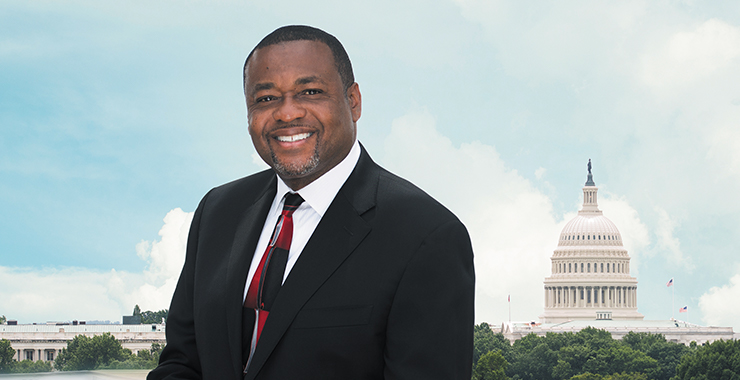
Hundreds of psychological scientists, practitioners, technology industry leaders, policymakers, students and others will gather next month in Washington, D.C., for APA’s second annual Technology, Mind & Society (TMS) Conference, Oct. 3–5. The three-day event will bring together some of the world’s leading experts on the human aspects of artificial intelligence, big data, cybersecurity, virtual reality, robotics, health-care technology, biotechnology and more.
It’s not always obvious to members of the public that psychology plays a key role in these areas. But as psychological scientists and practitioners, we know that psychology is a STEM discipline that can contribute to advancing technological innovation as well as to understanding the impact of technology on the human experience.
In this issue of the Monitor, we highlight the work of two TMS 2019 keynote speakers. Skip Rizzo, PhD, is a clinical psychologist who has been a leader in the virtual reality field for decades. As the director for medical virtual reality at the University of Southern California Institute for Creative Technologies, he has developed treatments for post-traumatic stress disorder, traumatic brain injury and other disorders, offering interventions that wouldn’t have been possible even just a few years ago (see Real treatments in virtual worlds). Val Shute, PhD, of Florida State University, studies how video games can be used to help students learn math and science concepts and to assess learning in unobtrusive ways. Her game “Physics Playground” is just one of a growing number of psychologically savvy video games that harness games’ power for social good (see Games with impact).
TMS is just one way that APA is raising the visibility of psychology’s roles in areas beyond health care. The association’s Office of Applied Psychology, which launched in February, is focused more broadly on how psychology can help solve real-world issues in areas as diverse as business, engineering, education, law, natural and built environments, and sports—as well as technology.
The Office of Applied Psychology is an example of how we are showcasing how psychology can make a positive impact on critical societal issues and helping the public understand the important and diverse roles psychology can play.