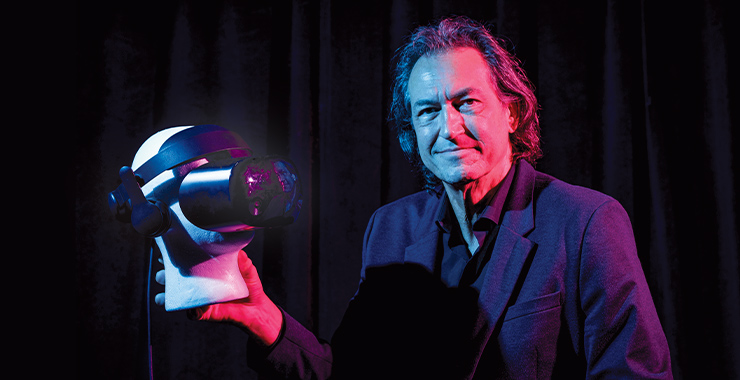
A door opens, you walk into a small closet and suddenly the walls start moving in and the door slams shut, trapping you inside. You’re sitting quietly in a lobby when a stranger enters the room, then another and another as your anxiety intensifies. While you’re on patrol in a small Afghan village, machine-gun fire suddenly erupts, and explosions send debris flying.
These aren’t scenes from the latest releases for your living-room game console. Instead, they’re virtual reality (VR) scenarios created as safe, fully programmable spaces in which therapists can immerse their patients as they work together to overcome phobias, improve social skills and recover from traumatic events.
The first research on the use of VR to treat a psychological issue—fear of heights—was published nearly 25 years ago (Rothbaum, B.O., et al., American Journal of Psychiatryopens in new window, Vol. 152, No. 4, 1995), and VR has been used to replace imaginal or real-life exposure to threatening stimuli in the treatment of more than two dozen phobias since then. But it’s only in the past few years that the technology has advanced enough and the cost has dropped enough to position VR to begin making its way into more research labs and therapists’ offices. Technological advances have also allowed researchers to begin crafting therapeutic VR programs for an expanding number of conditions, including post-traumatic stress disorder (PTSD), addiction and autism.
“There are tremendous opportunities to do great things with VR,” says Skip Rizzo, PhD, research professor in gerontology and psychiatry at the University of Southern California (USC). “It’s what we’ve dreamed about in psychology—a controlled stimulus environment where you make things happen, monitor patient responses, and activate emotions in ways far beyond what we could ever do in a clinical office.”
Full immersion therapy
The VR environments of the 1990s and early 2000s didn’t look much like the real world. But Rizzo and other VR therapy pioneers found that despite its impoverished graphics, the tool was highly effective for treating many phobias, such as fear of flying and heights. “It didn’t have to be an exact replica of reality for patients to show increased heart rate or sweaty palms as they were, say, riding up a virtual glass elevator,” says Rizzo, who directs the Medical Virtual Reality (MedVR) lab at USC’s Institute for Creative Technologies.
But the rudimentary graphics got in the way of treating other mental health problems, researchers found. “Treating anxiety disorders and PTSD with VR really requires full immersion to put the person in the right context,” Rizzo says.
Today, that type of full immersion is possible, and it’s Rizzo’s specialty. Along with his team of computer programmers, graphic artists, interface designers, engineers, software engineers, artificial intelligence (AI) experts and big-data analysts, Rizzo has designed some of the most elaborate virtual environments used in clinical practice.
One such virtual environment, called Bravemind, is a VR exposure (VRE) therapy tool Rizzo developed to assess and treat PTSD that is currently in use at approximately 100 sites around the United States. Traditional treatment involves the gradual, repeated “reliving” of a traumatic event in the patient’s imagination under a clinician’s care. Some patients, however, are unwilling or unable to imagine themselves back into their traumatic pasts. Bravemind offers a way to overcome this avoidance tendency. The software allows clinicians to gradually immerse patients into virtual combat scenarios that reflect their specific traumatic experiences in a controlled, stepwise fashion. Clinicians can then monitor the intensity of the patients’ stress responses via fMRI brain imaging and psychophysiological assessment techniques. The Institute for Creative Technologies is starting to roll out the software to Department of Veterans Affairs (VA) offices and other nongovernment treatment centers, free of charge, while the SoldierStrong foundation has offered to donate the hardware.
Rizzo, along with Emory University School of Medicine psychology professor and VRE therapy pioneer Barbara Rothbaum, PhD, ABPP, and their team have shown that patients with PTSD who were unresponsive to prolonged exposure therapy using their imaginations often responded successfully to VRE therapy using Bravemind (American Journal of Psychiatryopens in new window, Vol. 171, No. 6, 2014). They have since reported that VRE therapy is also effective for treating PTSD stemming from military sexual trauma (Loucks, L., et al., Journal of Anxiety Disordersopens in new window, Vol. 61, 2019). In that study they did not attempt to recreate the subjects’ sexual assaults—no VR assailants were used—but rather attempted to match the assaults’ context and setting cues, including sounds and lighting.

Now, Rizzo and his colleagues, with funding primarily from the Department of Defense, are exploring ways that VR could be used not just to treat PTSD, but to prevent it. One of Rizzo’s latest creations, Stress Resilience in Virtual Environments (STRIVE), aims to build resilience in soldiers before they are deployed by immersing them in up to six different emotionally engaging narrative simulations. “They go on short missions, and something bad happens—seeing an Afghan child die or watching one of their guys get shot,” Rizzo says. A virtual human mentor then delivers a brief resilience training session.
“My vision is that when you go to boot camp, they give you your requisition, your gun, your helmet, your backpack, and your Oculus Go headset preloaded with a bunch of STRIVE and other training episodes,” says Rizzo, who is also working on a version of STRIVE for the Los Angeles Police Department, another group at high risk of developing PTSD.
VR for addiction, autism and pain
Other conditions that benefit from VR’s ability to recreate countless specific environments include substance use and addiction. One of the more effective tools for treating substance use has been cognitive-behavioral therapy (CBT), in which the patient and clinician confront high-risk situations and practice coping skills in a safe environment. “Some researchers have gone so far as to build full bars in their labs, but participants know they’re in an office or lab setting, which really weakens the transfer of learning to real-world situations,” says Patrick Bordnick, PhD, MPH, LCSW, dean of the Tulane University School of Social Work. “Not only that, but you’re limited to this single environment that’s expensive to build and staff.”
Looking for a flexible, cheaper alternative, Bordnick stumbled onto VR. “I was initially intrigued, but everything I saw was so cartoonish and artificial,” he says. He eventually came across a group of researchers who had contracted with a VR company to film real people in front of a green screen and superimpose them into a computer-generated VR party setting to help patients confront social phobias. Bordnick asked the company for a version in which the actors and actresses were smoking and drinking. He then went on to commission a host of other VR environments where people smoke, such as the interior of a car and the exterior of an office building.
In their first study using VR, Bordnick and his colleagues, funded by the National Institute on Drug Abuse, compared virtual smoking cues with neutral cues and found that the VR smoking cues elicited cravings similar to those seen in traditional studies with real-world cues (Addictive Behaviorsopens in new window, Vol. 29, No. 9, 2004). In a follow-up treatment study, Bordnick found that VR-based skills training significantly bolstered patients’ confidence in resisting smoking in high-risk situations and increased abstinence six months post-treatment (Research on Social Work Practiceopens in new window, Vol. 22, No. 3, 2012). Other research groups have found VR to be effective in eliciting addiction-related urges in opioid and crack cocaine dependence as well as gambling (Maples-Keller, J.L., et al., Harvard Review of Psychiatryopens in new window, Vol. 25, No. 3, 2017).
A couple of years ago, Bordnick’s virtual party environment inadvertently sparked a new research direction for the social work professor. His youngest daughter, who has autism spectrum disorder (ASD), was hanging out in his lab and asked to try on a VR headset. He loaded up a PG-rated rendering of the party where all the alcoholic beverages were swapped out with soda and water. “I couldn’t believe it; she began walking right up to people, which she doesn’t do in the real world,” recalls Bordnick. Now, he is working to secure funding to study VR’s utility for teaching social skills to children and adults with ASD.
Other researchers are exploring the utility of VR environments for treating ASD as well. People with ASD generally have difficulty maintaining eye contact with others. However, VR systems can iteratively tweak faces in a way that puts people with ASD more at ease. Individuals with ASD can also use VR to practice increasingly more challenging social interactions in a less anxiety-producing platform. Despite these advantages, VR-based therapies are only starting to be used to treat autism, including in a recent study in which participants with high-functioning autism who completed a VR training session demonstrated significant gains in emotional recognition, understanding the perspectives of others and the ability to problem solve (Didehbani, N., et al., Computers in Human Behavior, Vol. 62, 2016).
Rizzo’s virtual battlefield and Bordnick’s virtual parties aim for photorealism, but other researchers are exploring the possibilities of more fantastical virtual worlds. SnowWorld is a virtual arctic environment populated by snowball-tossing snowmen, penguins and woolly mammoths. There is nothing true to life about it, and that’s the whole point, according to its designer, University of Washington psychology professor Hunter Hoffman, PhD. While VR in most therapeutic contexts helps patients face their fears, SnowWorld uses VR for the opposite effect—it gives burn patients a place they can temporarily go to escape the excruciating pain that comes with cleaning and treating their wounds (Annals of Behavioral Medicineopens in new window, Vol. 4, No. 2, 2011).
“VR keeps their minds off the pain, but also distracts them from ruminating on unhelpful thoughts, like catastrophizing and worrying,” Hoffman says. “While in VR, the patient doesn’t have enough mental resources left to take part in these negative psychological behaviors.”

Hoffman explains that VR engages the same attention-distraction mechanisms as watching a movie or listening to music (Gold, J.I., et al., CyberPsychology & Behavioropens in new window, Vol. 10, No. 4, 2007). But VR combines video, audio, haptic and motion sensory input to create an immersive experience. As a result, it’s a much more profound stimulus, partly because it blocks out the real world, so patients don’t notice the disquieting sights and sounds typically found in hospital rooms. “VR is in a class by itself when it comes to effectiveness for distraction-based pain control,” says Hoffman, whose team also has had promising results using VR for other types of painful situations, including pediatric dental visits, pediatric venipuncture and spinal cord injury.
Spreading the word
As researchers continue to push the boundaries of what’s possible in VR treatment, more established treatments—like those for fear of flying and other simple phobias—are becoming more common and accessible. In early 2016, two new VR headsets came on the market: the Oculus Rift and the Samsung Gear. Priced under $400, these computationally powerful, high-resolution devices signaled a turning point in the feasibility of widespread implementation of VR in the clinic.
“For years the helmet was a big limiting factor,” Hoffman says, referring to older helmets’ weight and the mess of cables tethering them to external computers. “All the improvements from 1990 to 2016 can’t match what we’ve seen in just the last three years. It’s just jaw-dropping, the billions of dollars being pumped into virtual reality.” Those improvements have translated into a vastly better user experience, with less motion sickness, increased frame rate, faster tracking systems and lightweight hardware. The result, according to Rizzo, is that more VR companies have entered the mental health field in the past three years than in the 20 years prior. Also, the number of research articles on VR has increased dramatically over the past few years.
Beyond the improved graphics and lowered cost, other developments are helping increase VR’s reach into the field of psychology, including Hoffman’s recent creation of an fMRI-compatible headset and integration with neurofeedback and biofeedback tools to monitor the ongoing effects of immersive stimuli in order to optimize them in real time.
“Now that we’ve got the technology where it needs to be, and the software is continuously improving, the key is getting it incorporated into clinical practice,” Bordnick says.
A 2016 survey of 185 cognitive-behavioral therapists suggests VR has a long way to go. Fewer than 4% of respondents frequently used VRE therapy, with only about 10% reporting occasional use, despite the fact that more than a third of all respondents said they used VR in other contexts such as gaming (Lindner, P., et al., Frontiers in Psychologyopens in new window, Vol. 10, No. 186, 2019). But, overall, attitudes about VR were positive. And although VR therapy has been used mostly in CBT applications, clinicians seem to be aware that the technology can be extended to a wide variety of conditions, not just anxiety disorders and phobias.
As for the cost to patients, in general, therapy sessions with VR cost the same as regular sessions, and sessions are billed the same through insurance companies. In some cases, the overall cost of VR therapy is less because the therapist does not have to travel to exposure sites such as a bridge or an airport, according to Rizzo.
“A growing number of interdisciplinary research teams are gaining experience and becoming savvier about how to use VR for clinical therapy,” Hoffman says. “As more clinical evidence becomes available, demands for VR in clinical psychology services will grow for the subset of treatments that have been empirically validated.”
As VR use becomes more ubiquitous, many psychologists caution that VR is just a tool, and not a substitute for an experienced therapist.
“No matter how good these things get, you’d still want a therapist involved,” Rizzo advises. “But maybe you only need four office visits rather than 15 because the therapist can manage the rest of the sessions virtually [with the patient practicing on their own with a headset at home], which is really one of the goals of VR—making clinical treatment accessible to more people.”