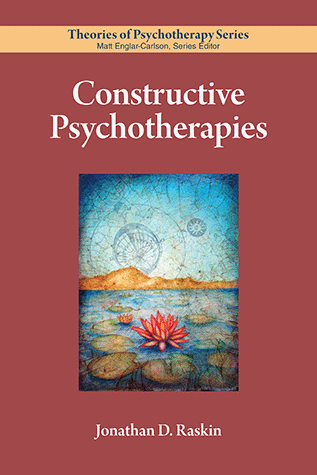
Constructive Psychotherapies
ISBN: 978-1-4338-3995-5- It is a helpful guide for anyone needing a course on constructivist therapies …What spills out from the start of this book is the high level of respect that this book shows for client thinking, their behavior, and their stories. It is fresh and authentic. It makes sense, and I believe it can make anyone a better therapist for having read it.—Doody's Reviews
Part of the bestselling Theories of Psychotherapy® Series from APA
This book examines the history, theory, practice, and empirical evidence for constructive psychotherapy.
Human beings exist within a context that is constructed by our language, worldview, and the stories we tell. Alone and in concert with one another, we construct meaningful understandings of the world. Because the invented nature of our reality is so often forgotten or overlooked, we can easily find ourselves trapped in prisons of our own making. Constructive theories are therefore useful to psychotherapists, who work with clients at the intersection between constructed meaning and experiential reality. Constructive therapies enable therapists to disrupt and reinterpret the meanings clients assign to their experience, and then initiate reconstruction processes that can open clients up to new possibilities.
Chapters in this volume describe the history and theory of constructivism and constructive psychotherapy, examine the key therapeutic aims and techniques of constructive therapy, provide a nuts-and-bolts description of the therapy process, and summarize the empirical evidence for the effectiveness of this therapy.
Acknowledgements
- Chapter 1. Introduction
- Chapter 2. History
- Chapter 3. Theory
- Chapter 4. The Therapy Process
- Chapter 5. Evaluation
- Chapter 6. Future Directions
- Chapter 7. Summary
Glossary of Key Terms
Suggested Readings and Resources
About the Author
References
Jonathan D. Raskin, PhD, earned his BA from Vassar College and his PhD in counseling psychology from the University of Florida. He is a professor of psychology and counselor education at the State University of New York at New Paltz, where he currently serves as interim associate provost for academic advising. In addition to his many journal articles and book chapters on constructive therapies, Raskin is author of Psychopathology and Mental Distress: Contrasting Perspectives (2nd ed., Bloomsbury). In 2020-21, Raskin served as president of the Society for Humanistic Psychology (Division 32 of APA). He previously served as coeditor of the Journal of Constructivist Psychology. Dr. Raskin is a licensed psychologist with an active private practice.
People experience life through frameworks of meaning they create for themselves—both singly and collectively. With this fundamental postulate, Jonathan D. Raskin lucidly, comprehensively, and sometimes irreverently cuts through the fog of abstraction that often obscures the genuinely novel and exciting contributions a constructive approach makes to the practice of psychotherapy. Synthesizing developments in personal constructivism, coherence theory, social constructionism, narrative therapy, and contextual approaches, this deceptively compact and engagingly readable book invites the reader to imagine how a vast range of human struggles can be dissolved in a heartbeat through a shift of stance or framing. Dozens of diverse case vignettes vividly conjure the transformative power of language and relationship to challenge and change how clients configure their worlds and, with this, themselves. I recommend this volume to all therapists yearning to infuse new vision into their work by experimenting with the principles and procedures of Constructive Psychotherapies.
—Robert A. Neimeyer, PhD, coeditor, Journal of Constructivist Psychology; Director, Portland Institute for Loss and Transition, Portland, OR
Dr. Raskin has succeeded where many others have failed. He has given constructive psychotherapy a clear, vibrant, contemporary voice. In lucid prose, with the use of helpful case examples, Raskin crystallizes how constructive theory and practice combine to simplify and amplify the work of today’s clinicians. Others who have attempted this feat have either drifted into abstract philosophy or provided a reductionistic list of disconnected clinical suggestions. For my money, Raskin’s eminently readable narrative provides the coherent guide for which we have long been waiting.
—Jay Efran, PhD, Professor Emeritus of Psychology, Temple University, Philadelphia, PA