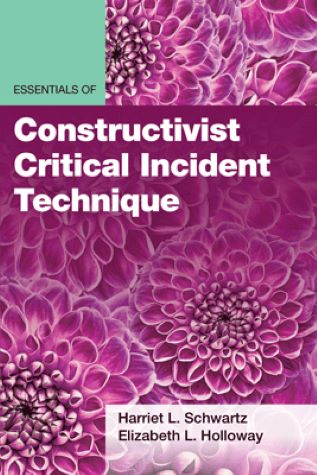
Essentials of Constructivist Critical Incident Technique
ISBN: 978-1-4338-4050-0This book is a step-by-step guide to designing and realizing a constructivist critical incident (Constructivist CIT) study. This qualitative methodology explores critical moments in people's lived experiences.
The authors offer the first comprehensive overview of Constructivist CIT, a structured, yet flexible methodology used to explore lived experience and improve practice and process by studying critical or meaningful moments and experiences.
The authors introduce Constructivist CIT in relation to its well-established parent method Critical Incident Technique, which has been used widely in the social sciences, health care, and business. Readers will learn how to ensure the trustworthiness of their study’s design, collect and analyze the data, and write up and submit their study for publication.
An intuitive method, Constructivist CIT is an accessible method for novice researchers as well as seasoned scholars expanding their qualitative repertoire.
Series Foreword
- Chapter 1. Contextual Foundations of Critical Incident Technique
- Chapter 2. Establishing Methodological Integrity
- Chapter 3. Designing the Study
- Chapter 4. Collecting Data
- Chapter 5. Analyzing Data
- Chapter 6. Deepening the Analysis
- Chapter 7. Writing the Manuscript
- Chapter 8. Variations on the Method
- Chapter 9. Conclusion
Exemplar Studies and Reviews
References
About the Authors
Index
Harriet L. Schwartz, PhD, is a professor of relational practice and higher education in Antioch University’s PhD in Leadership and Change program. Her scholarly interests include teaching as relational practice, emotion and teaching, and qualitative research methods, particularly critical incident technique and grounded theory. The author of Connected Teaching: Relationship, Power, and Mattering in Higher Education (Stylus, 2019), Harriet is a leader in applying Relational Cultural Theory (RCT) in education.
She serves as lead scholar for education as relational practice and on the leadership team for the International Center for Growth in Connection. Along with numerous journal articles, Harriet has published two New Directions for Teaching and Learning sourcebooks, coediting Teaching and Emotion and editing Interpersonal Boundaries in Teaching and Learning. Harriet worked in student affairs for many years before transitioning to a faculty career. Along with teaching in leadership programs on the master’s and doctoral levels, she has also taught in counseling, student affairs, and education graduate programs.
Elizabeth L. Holloway, PhD., professor emerita of Antioch University, has over 35 years of experience as a research scientist, practitioner, and consultant in clinical supervision, relational practice, and respectful workplaces. She has held professorships at the Universities of California, Utah, Oregon, Wisconsin, and Antioch University. During her academic career, Elizabeth has achieved distinction for her research and practice, including a Fellow of APA, a Diplomate of the American Board of Professional Psychology, and a recipient of the American Educational Research Association Research Award for Counseling.
Her methodological expertise includes discourse analysis, grounded theory, narrative inquiry, critical incident technique, and case study design. She has authored or coauthored eight books. A recent update of her original supervision model, Essentials of Supervision: A Systems Approach (with accompanying film), was published in 2016 (Chinese version in press). Her most recent work with co-author Harriet Schwartz introduces a constructivist approach to Critical Incident Technique methodology. Elizabeth teaches workshops on her model of clinical supervision and building respectful workplaces worldwide.
This book is a “must-have” text for any researcher who is engaging with the Critical Incident Technique. It is skillfully crafted to be useful to novice and experienced researchers alike. I wish the authors had written it years ago when I first discovered the delights (and the complexities) of this most interesting research approach.
—Caroline Bradbury-Jones, PhD, Bangor University, Wales, UK; Professor at School of Nursing & Midwifery, Medical School, University of Birmingham, England
Learn to deconstruct complex experiences and understand the turning points that shaped them. This accessibly written book is your guide to applying Critical Incident Technique, providing a clear step-by step framework and practical examples to support researchers, students, and academic supervisors uncover valuable research findings.
—Dr Stephanie Finan, Assistant Professor Psychotherapy, Dublin City University, Dublin, Ireland; BA, University of Galway, Galway, Ireland; MSc, Dublin City University, Dublin, Ireland, DPsych, Dublin City University, Dublin, Ireland
Flanagan offered researchers relatively few rules for the use of his critical incident technique. Schwartz and Holloway’s presentation of the constructivist critical incident technique (a slight variant of Flanagan’s approach), provides researchers with the guidance they have needed while still preserving the flexibility that has been a hallmark of the approach. This practical and engaging book is one I wish I had had years ago!
—Rodney Goodyear, PhD, Emeritus Professor, both University of Southern California (USC), Los Angeles, CA, and University of Redlands, Redlands, CA, United States