Qualitative Research in Psychology
Available formats
Also available from
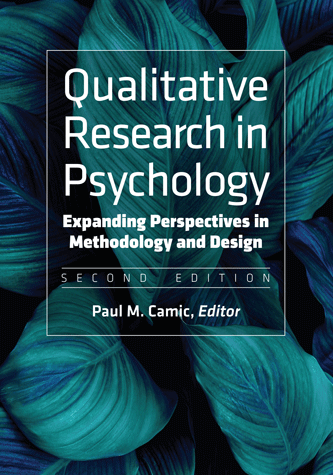
Qualitative methods of research contribute valuable information to our understanding and expanding knowledge of psychological phenomena.
This updated edition of Qualitative Research in Psychology builds upon the groundwork laid by its acclaimed predecessor, bringing together a diverse group of scholars to illuminate the value that qualitative methods bring to studying psychological phenomena in depth and in context.
A range of techniques, guiding paradigms, and rich case examples are explored, demonstrating qualitative methodologies as alternative and complementary to quantitative methods, as a means of exploration and theory building, and as a means of developing and evaluating complex behavior-change interventions.
Thoroughly updated chapters reflect advances in this dynamic field. New authors and chapters describe emerging methodologies, qualitative meta-analysis, and how qualitative methods can contribute to a wider psychological approach to research. Pragmatic issues, such as how to choose a method or combination of methods to suit the research question and study design, how to determine the ideal sample size, and how to balance journal space limitations with the need for transparency in describing the study, will be valuable to all readers.
Preface to the Second Edition
Paul M. Camic
Part 1. Laying the Foundations: The Pluralistic Approaches of Qualitative Inquiry
- Going Around the Bend and Back: Qualitative Inquiry in Psychological Research
Paul M. Camic - Choosing a Qualitative Method: A Pragmatic, Pluralistic Perspective
Chris Barker and Nancy Pistrang - Narrative in Qualitative Psychology: Approaches and Methodological Consequences
Michael Bamberg - Information Power: Sample Content and Size in Qualitative Studies
Kirsti Malterud,Volkert Siersma, and Ann Dorrit Guassora
Part 2. Methodologies for Qualitative Researchers: Helping to Understand the World Around Us
- Participation, Power, and Solidarities Behind Bars: A 25-Year Reflection on Critical Participatory Action Research on College in Prison
Michelle Fine, Maria Elena Torre, Kathy Boudin, and Cheryl Wilkins - Doing Narrative Research
Michael Murray - Discursive Psychology: Capturing the Psychological World as it Unfolds
Jonathan Potter - Interpretative Phenomenological Analysis
Jonathan A. Smith and Megumi Fieldsend - Situational Analysis: Mapping Relationalities in Psychology
Rachel Washburn, Adele Clarke, and Carrie Friese - What Lies Beneath? Eliciting Grounded Theory Through the Analysis of Video-Recorded Verbal and Nonverbal Interactions
Colin Griffiths - Under Observation: Line Drawing as an Investigative Method in Focused Ethnography
Andrew Causey
Part 3. Developing and Expanding Qualitative Research
- Into the Ordinary: Lessons Learned From a Mixed-Methods Study in the Homes of People Living With Dementia
Emma Harding, Mary Pat Sullivan, Keir X. X. Yong, and Sebastian J. Crutch - Using Qualitative Research for Intervention Development and Evaluation
Lucy Yardley, Katherine Bradbury, and Leanne Morrison - Qualitative Meta-Analysis: Issues to Consider in Design and Review
Kathleen M. Collins and Heidi M. Levitt
Paul M. Camic, PhD, is emeritus professor at Canterbury Christ Church University and honorary professor of health psychology at the Dementia Research Centre, University College London. He has taught qualitative research methods for over 25 years and has published widely using a range of quantitative and qualitative methods. His research interests include the arts, health, and well-being, focusing on older people, those with mental health problems, and those with dementia.
He was founding co-editor of the journal Arts & Health from 2009 to 2018 and coeditor of the Oxford Textbook of Creative Arts, Health, and Wellbeing (published in 2015). He is a Professorial Fellow of the Royal Society for Public Health, and his research on the use of museums and art galleries to address problems of social isolation and loneliness has won awards from Public Health England and the Royal Society for Public Health, as well as a Museums and Heritage Award for Best Educational Initiative.