Reality TV has followed people looking for love, fame, lifestyle makeovers and more. Now, add to that list people looking for a job. The new A&E series “The Employables” follows people diagnosed with autism spectrum disorder and Tourette syndrome as they search for work.
The show highlights what can be a difficult process—the camera sometimes lingers on hiring managers’ faces frozen in uncomfortable expressions as job seekers struggle with verbal tics or stammer to get words out. But the overall message of the show is empowering: Be upfront, find the right fit and there’s a job out there for you.
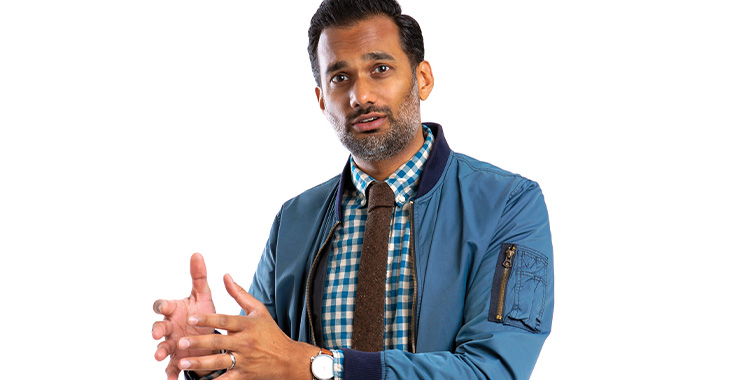
One of the keys to the success of the job seekers is Ali Mattu, PhD, a clinical psychologist at the Columbia University Clinic for Anxiety and Related Disorders and assistant professor of psychiatry at Columbia University Irving Medical Center. Mattu administers psychological assessments to help the job seekers identify their strengths. James, for example, a 36-year-old Tennessee man with Tourette’s, turns out to have an “off the charts” verbal IQ—and learning that information empowers him to find a job as a museum tour guide that fits his skills and doesn’t exacerbate his tics.
Mattu is no novice in front of the camera, having hosted his own YouTube show (“The Psych Show”) for four years. He’s also been a regular guest on national news shows discussing mental health and has even participated in the occasional comic-book convention panel (the psychology of “Star Trek,” anyone?).
For Mattu, these appearances are all in the service of “giving psychology away.” With “The Employables,” he hopes to do so on a broader scale than ever before.
How did you get involved with “The Employables”?
The production company Optimum reached out to me after discovering some of my YouTube videos. They were interested in individuals who were experts in Tourette’s and autism and who had the spirit of helping people understand their strengths and empowering them to realize that they have talents inside of them.
I watched videos of the BBC version, and I fell in love with the show. I thought that this could make a big difference, not only in the lives of the people involved in the show but also for anyone who might be watching at home. It immediately became something that I wanted to be part of.
Why is outreach an important aspect of your work?
The further I’ve gone in my career as a psychologist, the more I’ve realized that it’s very difficult to access someone like me. There are a lot of barriers to seeing a psychologist or anyone in the mental health field. Stigma can get in the way, access can get in the way and then there are financial barriers.
It also can be very difficult to access information about psychology. We all build papier-mâché cells in elementary school, and that’s the basis of biology. We learn about physical health, chemistry and physics. But mental health, not so much.
What was it like to film the show?
The most similar experience I’ve had to being on set for “The Employables” was the time I spent working on inpatient hospital teams. Being successful in the hospital meant knowing your role, as well as the roles of other professionals and being able to communicate across disciplines. My days on hospital units also bounced back and forth between being very busy and waiting for the next thing to happen.
It felt very similar on “The Employables.” To have a successful shoot, I had to quickly learn who was on site, what their role was and how we could work together to get the shoot done. I also had to know when to step back, let the rest of the team do their job and know when it was my turn to step back in.
I had done TV before, but never anything that lasted this long. What I learned about longer shoots is there’s a lot of preparation for shots to be set up, a lot of action to get the shot and then more downtime as the next shot is prepared.
What did you learn about barriers to employment for the job seekers?
I talked with a lot of job seekers about how it’s not their fault that they are experiencing these difficulties and that it is their responsibility to learn how to manage their symptoms. Many had pursued jobs that were a poor fit for the things they struggled with, whether that’s experiencing autism and being in an environment that is heavily verbally and socially biased, or having Tourette’s in an environment where there are a lot of stimuli that make it harder to manage tics.
The big challenge is also the people who make the decision to hire. Organizations, employers—this is where I really believe this show is going to make a big difference. We’ve thought a lot about diversity in the workplace as it relates to different aspects of identity, like race and ethnicity. Now, I think we’re beginning to see diversity as it relates to neurodiversity.
How can we educate the public about interacting with neurodiverse individuals?
We need honest representations of these conditions, and that is what “The Employables” is doing. You see James’s story, and you see him explain to a group of children on a tour, “I have Tourette’s and you might see me engage in some tics, so if you do, don’t worry about it.” Not only is that something that’s helping him, I think it’s also helping viewers to understand that Tourette’s is just something that’s out there. It’s modeling a healthy way to talk about this.