More than 6% of U.S. adults have alcohol use disorder, according to the National Institute on Alcohol Abuse and Alcoholism—that’s more than 15 million people. Odds are, you know some of them.
Yet even though alcohol misuse is common, many people are unaware of the treatment options—even health-care providers. Behavioral treatments play an important role for many people, but they aren’t the only choice. Several prescription medications have been approved to treat alcohol use disorder. While they aren’t perfect, they can help people resist the urge to drink. Still, the medications aren’t well known or widely prescribed, says Lara Ray, PhD, a professor of clinical psychology at the University of California, Los Angeles (UCLA) who studies the clinical neuroscience of alcohol and tobacco addiction, and a 2017 recipient of an APA Distinguished Scientific Award for an Early Career Contribution to Psychology.
To find treatments that work for more people, Ray’s UCLA Addictions Lab integrates clinical psychology, pharmacology and neuroscience to explore the underlying mechanisms of addiction and how medications might upend them. She uses a range of methods including neuroimaging, behavioral genetics, measures of inflammation and pharmacological tools to understand addiction.
Her hope is to push the science of addiction out of the lab and into the world, where it can make a difference in people’s lives. “I’m passionate about filling [the gaps] in knowledge, but also trying to put forth the science we have so that people can start to benefit now, and not 30 years from now,” she says.
Thinking clinically
Ray became interested in alcohol dependence early in her training. After finishing her undergraduate degree in psychology at San Diego State University, she took a job at the University of California, San Diego, helping with a study of the genetics of alcohol use disorder. “I was interviewing families who had a loved one affected by alcoholism, and I could see the impact of this disease on the individuals and their families,” she says.
She went on to earn a PhD in clinical psychology at the University of Colorado Boulder in 2007, where she studied the effects of the drug naltrexone on alcohol sensitivity. Naltrexone is perhaps more commonly known as a medication to treat opioid dependence, but it is also approved for treating alcohol use disorder. After a clinical internship and postdoctoral fellowship at Brown University Medical School, Ray joined the UCLA faculty in 2008. Today, she continues to study naltrexone and other medications for treating alcohol dependence and other substance use disorders.
At first glance, medication development might not seem like a natural fit for a clinical psychologist—but Ray explains why it’s important that psychologists play a role in such research. “In my lab, I try to put the ‘clinical’ in ‘clinical neuroscience,’” she says. “I’m committed to thinking clinically about who’s likely to benefit from a treatment, how it’s delivered in the real world and what clinicians need to know to be more effective in their treatment of addiction.”
Naltrexone works by blocking receptors in the brain that are involved with cravings and feelings of reward. It’s an effective tool for some heavy drinkers, but a literature review by Ray and her colleagues found that the effect sizes in studies of naltrexone treatment are relatively modest (CNS & Neurological Disorders—Drug Targetsopens in new window, Vol. 9, No. 1, 2010). One likely reason for that? Not all types of alcohol use disorder are governed by the same brain mechanisms.
Broadly speaking, people with alcohol use disorder fall into two categories. “Reward drinkers drink to feel good and get a lot of positive reinforcement from drinking,” Ray says. Relief drinkers, by contrast, drink to ease withdrawal symptoms or counteract negative mood. “We think the relief drinkers are further into their addiction, or came to their addiction through a different pathway,” she says. “These two distinct pathways may be useful clinically to identify the best treatment options.”
Some research suggests naltrexone might work better in those who are driven by reward rather than relief, Ray says. In current work, her team is exploring whether they can find a way to measure that reward drive through patient self-report, and validate the measure through neuroimaging. “We’re trying to deliver something that’s clinically useful,” she says.
Disentangling drinking and smoking
She’s also investigating whether combining naltrexone with other medications can be helpful for people who both drink alcohol and smoke cigarettes. About 25% of regular smokers are also heavy drinkers, and people who drink more have a harder time quitting cigarettes. Using both substances increases the risk of developing functional impairments and several types of cancer, beyond using one or the other alone.
To learn more, Ray and colleagues enrolled 130 non-treatment-seeking men and women who drink heavily and smoke in a double-blind controlled laboratory trial. Some participants took naltrexone, and others received varenicline (also known as Chantix), a prescription medication for smoking cessation. A third group received both medications, and a fourth took a placebo. The team found that the combination of the medications was more effective than either drug alone at reducing cravings for both alcohol and cigarettes, and those in the combination group used less alcohol and smoked fewer cigarettes during the two-week study period (Psychopharmacologyopens in new window, Vol. 231, No. 19, 2014). When participants were presented with smoking-related stimuli, those in the combination group showed decreased activation in the anterior cingulate, a region of the brain associated with cognitive processes including reward-based decision-making (American Journal of Drug and Alcohol Abuseopens in new window, Vol. 41, No. 1, 2015).
Following from those experimental studies, Ray and her lab team designed a trial to further study the medications, this time in 274 heavy-drinking smokers who were seeking treatment for substance use. Participants were randomly assigned to receive 14 days of either naltrexone, varenicline or both, in addition to counseling for smoking and drinking. Ray’s team followed the participants for 26 weeks to measure smoking prevalence and alcohol consumption. They’re just wrapping up the trial now, but hope the study will help clarify the role of these medications in smoking cessation and alcohol use.
There are many more open questions about how to address the combined use of alcohol and tobacco, says Ray’s third-year clinical psychology graduate student ReJoyce Green, whose research focuses mostly on tobacco use. If someone smokes and drinks alcohol, is it best to try to quit both at once? Or should the person focus on one habit at a time? If so, which one? “There are high rates of co-use between these substances, and there’s a lot of demand to disentangle these behaviors,” Green says.
A route to the real world
Like the study of smokers and drinkers, many of Ray’s projects follow a trail from controlled laboratory studies to real-world clinical trials. “I like to start with an experimental psychopharmacology approach,” she explains. In the lab, she can control whether participants smoke, how much they drink, if they take the medication as prescribed. “We do very controlled experiments to understand whether a treatment might be useful. If we find support, we move forward into clinical trials that can hopefully change the way treatments are delivered in the real world,” she says.
In another example of that trajectory, she and her team are studying a drug called ibudilast, which is not yet approved in the United States, though it’s used in Asia to treat asthma. Ibudilast is a neuroimmune modulator that decreases inflammation—not only in the lungs but also in the brain. Chronic alcohol use leads to sustained neuroinflammation throughout the brain, Ray explains. That neuroinflammation, in turn, may contribute to alcohol-seeking behavior.
In a controlled laboratory study of people with alcohol use disorder, she found that ibudilast reduced overall alcohol cravings and improved mood when participants were exposed to stress- and alcohol-related cues—particularly in participants with symptoms of depression. She also found that when participants were administered alcohol, “the medication really seemed to blunt the rewarding effects of alcohol, especially in people who have some level of depressive symptoms,” she says (Neuropsychopharmacologyopens in new window, Vol. 42, No. 9, 2017).
Now, she’s enrolling patients for a 12-week clinical trial of ibudilast that will assess whether the medication reduces drinking. Ray’s team will also investigate biomarkers of inflammation in the blood and the brain. If the trial shows that ibudilast is more effective than a placebo at controlling alcohol cravings and use, Ray says, such biomarkers might one day be used to identify which patients are most likely to respond to the treatment.

In one component of that project, postdoctoral researcher Erica Grodin, PhD, is leading a two-week study comparing patients randomized to receive ibudilast with those randomized to receive a placebo. She’ll collect daily diary information from participants about their alcohol cravings, drinking behavior, activities and mood. She’ll also measure brain activity with fMRI while participants view pictures of alcoholic and nonalcoholic drinks. “We want to see if ibudilast is able to dampen that reward response to alcohol-related images,” Grodin says.
Through these studies, the team hopes to explore the medication from many angles: Will the treatment reduce drinking? Improve mood? Change markers of inflammation? Alter the brain’s response to alcohol cues? The goal isn’t just to find an effective treatment, but to understand how it works. “The idea is to really understand the mechanisms behind any clinical outcomes we see,” Ray says.
Treating patients and training students
Ray’s commitment to improving outcomes for real people extends to her clinical work. She spends a half day each week seeing patients and overseeing clinical graduate students who treat patients in the UCLA Addiction Medicine Clinic. She has also treated patients as a psychologist in a primary-care setting. “That has really shaped my understanding of how care is delivered on the front lines,” she says.
That hands-on experience also helps her guide students to view their research through a human lens, says graduate student Aaron Lim. In his four years in the lab, Lim has gotten used to learning—and juggling—a lot. “The research has been pretty fast paced, but the diversity of projects has made me a better addiction researcher and a better clinician, too,” he says.
The UCLA Addictions Lab is a bustling place. In a typical year, Ray works with about five graduate students, 10 undergraduates, a postdoc or two, and often some neuroscience graduate students who split their time between her lab and others on campus. She also has four or five full-time staff who help run the studies—many of whom are recent UCLA graduates who plan to apply to graduate school or medical school. “So, I see them as folks I’m mentoring as well,” Ray says.
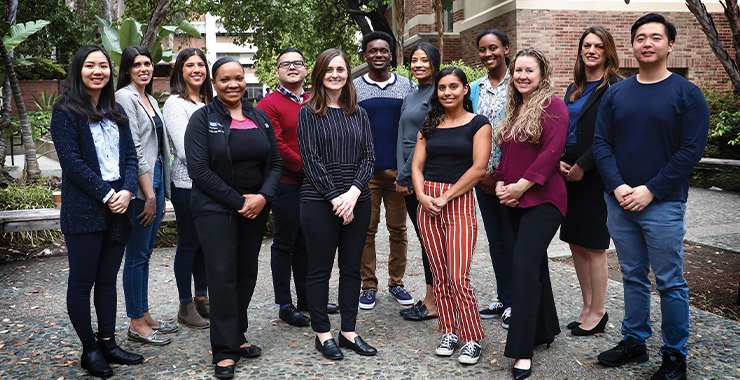
These days, she’s able to offer more mentoring, thanks to her 2018 Midcareer Investigator Award in Patient-Oriented Research from the National Institute on Alcohol Abuse and Alcoholism. The award supports her efforts to conduct patient-centered alcohol research while carving out more time to guide students, postdoctoral fellows, psychiatric residents and junior faculty. With support from the award, for instance, she developed a summer program for undergraduates from underrepresented groups who are interested in addiction science.
Ray tries to model for her students that an academic career can be extremely satisfying. “Academic life isn’t always conveyed in the most positive way, but I think I have a fantastic job. We get paid to think and test hypotheses and talk to and train smart people every day,” she says. “There are a lot of wonderful perks in this job.”
But it’s not just about the perks. Ray is driven to answer important questions about addiction, and more broadly, about the human mind. “I’m especially interested in pursuing concepts of habit, reward learning and constructs of relief or negative reinforcement,” she says. “One of the big questions that I’m hoping to answer in the long term is: Which principles from addiction neuroscience translate generally to the human condition—and how can we use them to improve clinical care?”