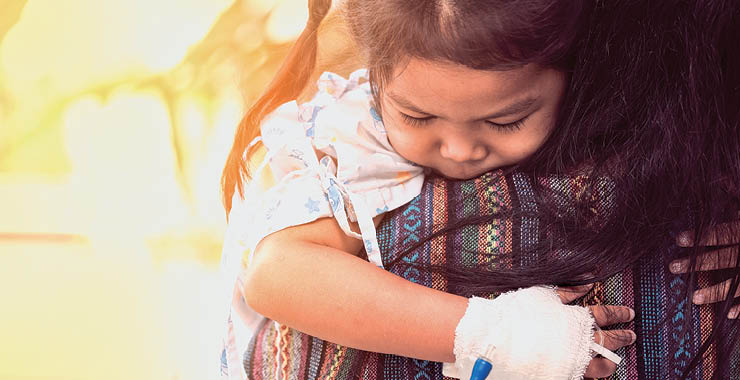
As an expert on pediatric pain, Christine Chambers, PhD, knew there was a body of good psychological science on how children experience pain and how best to manage it. But when it came time for her own children to undergo routine procedures like blood draws and injections, she realized those findings were lost in translation.
“All of this wonderful research gets published in psychological journals and presented at conferences, but it doesn’t automatically filter its way to patients who need it,” says Chambers, a psychologist and core faculty member at the interdisciplinary Centre for Pediatric Pain Research at Dalhousie University in Halifax, Nova Scotia, Canada. “I realized that my own children weren’t benefiting from this science that I had dedicated my career to.”
That’s why Chambers decided to launch It Doesn’t Have to Hurt, an initiative to disseminate the best science about children’s pain. Partnering with a Canadian media company, she was soon sharing research findings with an audience of more than 6 million Canadian parents, educating them about pediatric pain through blog posts, YouTube videos, Instagram images and Twitter Q&As. This year, she unveiled a related initiative, Solutions for Kids in Pain (SKIP), a nonprofit organization that promotes the research not only to patients and parents but also to health-care professionals and policymakers. “We want to intervene at every level in the system,” she says.
Back in the lab, her team continues research projects to understand the developmental, psychological and social factors that influence a child’s pain, whether that is discomfort caused by a routine needle stick or a serious condition such as chronic pain or cancer pain. The team also devotes time to studying the most effective ways to disseminate their findings. Whether Chambers is writing a grant proposal or composing a tweet, she’s guided by one clear mission: improving pain assessment and management in children.
“Many of the children I work with have significant illnesses, and it’s a tough space to be in. But that’s also what makes the work so rewarding. They need our support—and they need our science,” she says.
Research hub
The Centre for Pediatric Pain Research encompasses researchers and clinicians from multiple specialties, including psychologists, physicians and nurses. “Halifax is a phenomenal place to do this research,” says Chambers’s former student Kathryn Birnie, PhD, now a clinical psychologist at Alberta Children’s Hospital in Calgary. “Pain is medically complex. It’s important be able to work closely with people from other disciplines who can look at these problems through a different lens.”
Chambers began studying pediatric pain as an undergraduate at Dalhousie and continued that research while earning a PhD in clinical psychology from the University of British Columbia. Early on, she saw children in clinical practice while also conducting research. But eventually, she moved into research full time. Her lab is typically home to three to five clinical psychology graduate students, as well as a postdoctoral fellow, several undergraduates and some paid research staff. Most of her funding comes from the Canadian Institutes of Health Research and the Networks of Centres of Excellence.
Chambers has studied both acute and chronic pain in children, from a variety of angles. As psychologists know, pain isn’t just a physiological reaction. It’s a complex experience that’s influenced by factors including memory, emotion and social learning. Over the years, a prominent theme in her research has been exploring how family members—especially parents—shape children’s pain experiences.
Though it sounds counterintuitive, Chambers has found that when parents reassure children during painful medical procedures—such as by telling them, “It’s OK”—children report greater distress. “It’s better for parents to distract their children than to reassure them,” she says.
To better understand why that is, she and her team filmed 100 children ages 5 to 10 and their parents as the children received a shot or had blood drawn. Then they asked the children to watch and respond to video clips of their parents’ spontaneous reassurances and distractions during the procedure. The researchers found that children rated parents as more fearful and less happy when they were being reassuring than when they were distracting their children (McMurtry, M., et al., Painopens in new window, Vol. 150, No. 1, 2010). The bottom line? A parent’s well-intentioned “Don’t worry” may communicate that the child has something to fear.
Chambers and her team have also looked at the role siblings play in children’s pain experiences. The team used a common laboratory model of pain, the cold pressor task, which involves the participant putting a hand into ice water and leaving it there as long as he or she can. The 8- to 12-year-old participants undertook this challenge while their siblings looked on. When the observing siblings were encouraging or more focused on the pain, the participants reported more pain and fear. When siblings talked about something else to distract the participants from the pain, however, the pain was less intense (Schinkel, M.G., et al., Painopens in new window, Vol. 159, No. 8, 2016).
“Siblings were actually much more in tune and attentive to their siblings’ pain than we expected them to be, but it was far better for siblings to distract them when they were in pain than to reassure them,” she says. “Distraction is a really powerful intervention.”
Patients as partners
The lab’s research also extends to chronic pain in children. With her current PhD student Perri Tutelman, for instance, Chambers is exploring pain in childhood cancer survivors. “One of our first surprising findings was just how much pain cancer survivors were experiencing. We knew that children who were under active treatment would have a lot of pain, but we were really surprised to see how much pain the cancer survivors reported,” Chambers says.
To better understand their burden, Tutelman interviewed 10 childhood cancer survivors and their parents. Three themes emerged, Tutelman says. Many children reported that their perception of pain was different after childhood cancer—some experienced pain more intensely than they had before cancer, while others felt their pain tolerance had increased, and still others experienced less pain as a result of chemotherapy-induced nerve damage. New pains were often interpreted by children and their parents as a threat of disease recurrence. And all of those interpretations occurred within the broader context of the ways in which the children and their parents viewed their cancer experience, Tutelman found (Psycho-Oncologyopens in new window, online ahead of print, 2019). “Pain is a changed experience for children after cancer,” she says.
Now, she’s drawing on those themes to guide the development of a quantitative experiment that will explore how children’s early experiences of cancer pain might affect them later in life. To do so, she’s employing a technique known as quantitative sensory testing, which measures how the nervous system responds to thermal or mechanical stimuli. “We hope to understand patterns of sensory processing in childhood cancer survivors,” Tutelman says—such as whether the children’s cancer experiences cause sensory changes that make them more or less sensitive to pain.
The lab often uses such mixed-methods approaches, Chambers says. Rather than relying solely on self-report questionnaires, she incorporates a variety of behavioral observational methods and physiological measures, and often combines them.
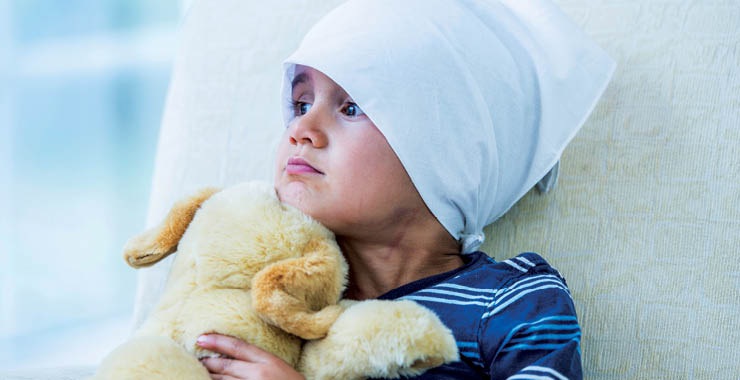
Another outside-the-box idea that Chambers has embraced is to engage pain patients (and their parents) not just as participants but as partners in the research. She’s established a youth advisory committee to provide input for SKIP and has invited parents to offer guidance and strategy advice, even including them as co-investigators on grants. Chambers also included a patient partner as a member of Tutelman’s dissertation committee. “This co-creation model is a new thing for most psychologists,” Chambers says. “But by engaging those who benefit in the research from an early stage, we have a much greater opportunity to have impact.”
Making shots less scary
For most children, needle pain is one of the most common types of pain that they will experience. Though needle sticks are common and relatively quick, the pain they create can contribute to needle phobia. Some research suggests that up to 10% of adults avoid vaccinations as a result of such fears. While that’s concerning from a public health standpoint, it’s also frustrating, Chambers says, given that there are multiple evidence-based treatments to reduce vaccination pain—treatments that still aren’t routinely used (Birnie, K., et al., Clinical Journal of Painopens in new window, Vol. 31, Suppl. 10, 2015).
Hoping to change that, she worked with a multidisciplinary team of experts led by Anna Taddio, PhD, a professor of pharmacy at the University of Toronto, to develop clinical practice guidelines to reduce pain during vaccine injections (Canadian Medical Association Journalopens in new window, Vol. 187, No. 13, 2015). Chambers and her colleagues found evidence to support a variety of tactics for reducing vaccination pain, including breastfeeding or giving sugar water to infants during vaccinations, having the patient sit up instead of lie down, using a topical anesthetic, giving the most painful injection in a series last, and educating clinicians and parents about such pain-reduction techniques.
Such factors are critical, since the memory of pain can affect one’s future pain experiences, as Chambers and her former student Melanie Noel, PhD, found. They studied children ages 8 to 12, and discovered that when children remember previous pain as more severe, they experience future pain as more intense (Painopens in new window, Vol. 153, No. 8, 2012). “It’s not so much how much pain children have from an injection, but how much pain they remember having, that impacts their subsequent experiences,” Chambers says. “That finding opened our eyes to the importance of what we can do before, during and after a procedure so that children don’t develop distorted memories of pain.” Noel, now an associate professor at the University of Calgary, has continued this line of research, exploring how parents can talk to their children about medical procedures to avoid creating overinflated memories of pain.
Promoting science
Chambers says one of her strengths is her willingness to take risks, whether by engaging patients as partners or by embracing novel dissemination efforts. When she began the It Doesn’t Have to Hurt campaign, she partnered with a parenting website called The Yummy Mummy Club. “It didn’t sound very credible, and a lot of people were skeptical. But the way we were trying to get research out there wasn’t working. I thought we should do something different,” she says.
As it turned out, parents were hungry for accessible advice grounded in science. In the first year, they had over 130 million content views. That success paved the way for Chambers to launch SKIP, a nonprofit based at Dalhousie University in partnership with Children’s Healthcare Canada that aims to deliver science-based recommendations about children’s pain management to children, parents, health professionals and policymakers.
Chambers’s goal isn’t just to push her own findings to the public. “SKIP is a knowledge mobilization network with hubs around the country that’s meant to make it easier for other researchers [to disseminate their findings] as well,” she says. “They don’t have to go out and develop these relationships themselves, because we already have a mechanism to do that for them.”
Chambers recalls a statistic that said it takes 17 years, on average, for the results of research to find their way to the front lines. “I think about that a lot, because it took me about 20 years to get to a point in my career where I had the credibility, the connections, the knowledge—both generated and synthesized—to be in a place where I could do this,” she says. “But we can’t wait 20 years for every researcher to get to that point.”
If psychologists and other researchers aren’t willing to push the science out, Chambers says, someone else will—and too often, that someone is a celebrity “influencer” promoting pseudoscientific advice.
“We need to be brave and put ourselves out there because our science isn’t helping anyone when it’s hidden away in journals,” she says. “If we want to continue to have science funded, we need the public to actually see and feel the results of our research.”