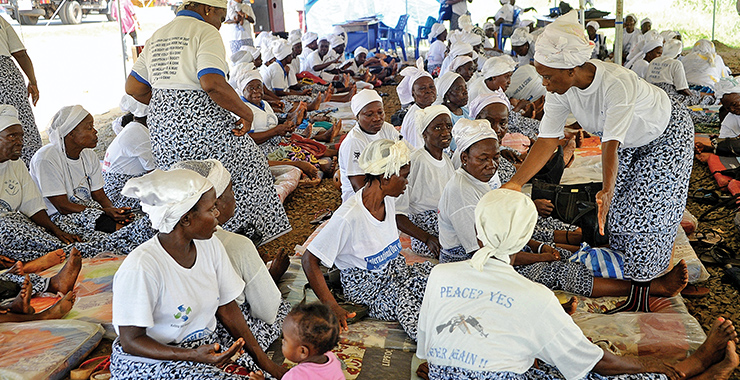
Starting in 1989, Liberia suffered through nearly 15 years of brutal, back-to-back civil wars. An estimated 150,000 women and girls—up to 15% of the population—experienced sexual and gender-based violence (SGBV), including rape and other assaults, during that time (Liberia Armed Violence Assessmentopens in new window, 2012).
Stirred to action, a diverse group of activists united to form the Women of Liberia Mass Action for Peace movement in 2003, staging nonviolent protests to condemn the ongoing violence and turmoil that had devastated the economy, infrastructure and civil society.
Women across the country even launched a sex strike, abstaining from sexual activity with their partners until peace talks were initiated—and their efforts worked. The group later helped mediate negotiations among the three warring parties, leading to a formal resolution of peace.
“When women are more involved in peacemaking, peace agreements tend to last longer and countries are less likely to use violence to resolve a future conflict,” says Gianina Pellegrini, PhD, a psychologist at Saybrook University in Oakland, California, who studies women’s role in international peacemaking.
According to research by Laurel Stone, assistant director of policy studies at the University of Notre Dame’s Kroc Institute for International Peace Studies, peace agreements in which women have a larger say are 35% more likely to last at least 15 years than peace agreements made without women (Social Science Research Networkopens in new window, 2014). But United Nations (U.N.) dataopens in new window show that women make up just 2% of mediators and 8% of negotiators in major peace processes worldwide.
To help correct this imbalance, the peace agreement that Liberian women helped negotiate in 2003 included targets for increasing the representation of women in government and prosecuting sex crimes that occurred during the wars. Within three years, the country had chosen Ellen Johnson Sirleaf as the first elected female head of state in Africa.
Despite such triumphs, reports of SGBV in Liberia remain high. So, 10 years after the conflict ended, Pellegrini launched a study for her 2015 doctoral dissertation at Saybrook University to assess Liberia’s efforts to promote gender equality and identify areas for improvement.
“Liberia’s peace agreement was one of the first in the world to include gender-specific policies,” says Pellegrini, whose work with refugees and trauma victims inspired her focus on peace psychology. “My question was whether those policies actually worked.”
Pellegrini’s efforts are part of a larger and increasingly coordinated effort among psychologists, political scientists and others to mobilize women to help foster peace in conflict zones and to combat violence against women during conflicts. There now exists “a deeper global understanding of the centrality of women to the establishment and maintenance of global peace,” according to political scientist Sarah Taylor, PhD, of the International Peace Institute in New York City.
But, she adds, “more research and evidence-based recommendations are needed,” making efforts like Pellegrini’s particularly important.
Reducing sexual violence in Liberia
Perpetration of SGBV is rooted in gender norms based on unequal power dynamics, according to the UNHCR, the UN Refugee Agency, and is particularly common during conflicts, when warring parties aim to instill fear and gain control of communities.
“One way to gain dominance is to attack the basic fabric of society, and oftentimes that’s women and girls,” Pellegrini says. “Women are humiliated, shamed and violated as a way to control men.”
During the civil wars in Liberia, soldiers raped women in front of their husbands or forced children to perpetrate sexual violence against their own family members. Men and boys were also targeted, but the extent of such crimes is less known because men and boys are less likely to report sexual assaults.
The regionally, ethnically and socially diverse group of women who fought back did so peacefully. In addition to the sex strike, they wore white to symbolize peace and began documenting SGBV and other human rights violations. And when Liberia’s peace negotiations nearly failed, women entered the building where the talks were taking place, barricaded the doors and prevented men from leaving until they reached an agreement, which earned them an ongoing role in mediating the talks.
“Mediation, compromise and nurturing others tend to be strengths and values associated with women, while men are often more competitive,” says Marc Pilisuk, PhD, a peace psychologist and professor emeritus at the University of California, Davis, and the University of California, Berkeley, who teaches transformative social change at Saybrook University and sat on Pellegrini’s dissertation committee. “This helps explain why women’s involvement in peacemaking has been so effective.”
Following the women’s involvement in postwar government and negotiations, Liberian leaders established a Ministry of Gender, Children and Social Protection (MoGCSP), created a national action plan to address SGBV and added specialized units to the police department and the Ministry of Justice to handle gender-based violence. They also established a truth and reconciliation commission and passed an anti-rape law to strengthen penalties for those convicted of rape, including life imprisonment in some cases. In addition, they stipulated that at least 30% of the candidates on all future election ballots must be women.
Pellegrini’s 2014 research found that Liberia had taken key steps toward meeting the goals outlined in its 2003 peace agreement to reduce sexual violence and support survivors. More than 50% of people reporting SGBV received medical care, and new support programs and awareness campaigns were beginning to shift attitudes toward such violence.
But after speaking with government employees, people working for nongovernmental organizations and women involved in the Mass Action for Peace movement, Pellegrini also learned that the country had fallen short of some of its targets.
For instance, safe homes and “one-stop” centers created for survivors lacked the space and resources to accommodate all those in need. And a nationwide shortage of skilled psychosocial counselors, health-care providers and legal advocates made staffing such centers a challenge.
Pellegrini also found that while victims felt empowered to report SGBV under the new anti-rape law, Liberia’s judicial system was ill-equipped to handle the growing caseload. Few perpetrators ever appeared in court, and understaffing, bribery and exorbitant legal fees crippled the system.
“The problems around gender-based violence still exist in Liberia,” says Deddeh Kwekwe, coordinator of the gender-based violence unit in the MoGCSP. “We might not be shooting people down, but the attitudes toward women and the barbaric things that happen still feel like war,” she says, citing a 2018 incidentopens in new window in which three women accused of witchcraft were forced to parade naked in the Liberian county of Sinoe.
T. Debey Sayndee, director of the Kofi Annan Institute for Conflict Transformation at the University of Liberia, lauds the efforts of psychologists like Pellegrini, but he says Liberia has an urgent need for more concrete action.
“I think research that creates awareness on this issue is very helpful,” he says, “but ultimately I believe that strengthening the justice system is the best way to deal with these issues head-on.”
Models for other countries
Women’s growing role in peacemaking offers an avenue for change, maintains psychologist Steven Handwerker, PhD, DDiv, founder and CEO of the International Association for the Advancement of Human Welfare, a nonprofit focused on sustainability and peacebuilding around the world. He helped develop a paradigm that researchers can use to understand and amplify grassroots efforts such as Liberia’s Mass Action for Peace movement, called the integrative constructive peace process (ICPP).
The ICPP uses a four-step process to effect change: listening to diverse voices through interviews and women’s circles; determining common needs in the community, both acute and chronic; communicating those needs through marches, protests, petitions and other means; and conducting regular follow-up and evaluation activities to determine what works and what doesn’t.
Handwerker has used the ICPP framework to inform the implementation of his Humanitarian Sustainability Initiative in Haiti, which consolidated a series of efforts to rebuild the country following natural disasters and civil unrest.
In Honduras, peace psychologist Cecilia Yocum, PhD, uses a similar paradigm to support the Mercy Dream Weaversopens in new window, a women’s group that has worked to decrease SGBV and improve women’s rights in San Pedro Sula, one of the world’s most violent cities.
The Mercy Dream Weavers, which formed in 1999 in the chaotic aftermath of Hurricane Mitch, hosts support groups for indigenous women who face domestic violence, gang violence and other types of oppression. Using role-play exercises, facilitators help women learn to diffuse conflict and speak out. The group has even held workshops in El Porvenir prison in northern Honduras, equipping former gang members with nonviolent conflict resolution skills.
“Many Hondurans feel they can’t improve the country at the ballot box,” after widely suspected corruption in the 2017 election, says Yocum. “Instead, women are working to strengthen grassroots efforts and build cohesion so that they can work together when the time comes to be more politically active.”
Other women’s peacebuilding efforts target SGBV perpetrated by U.S. service members stationed abroad. Monisha Rios, an Army veteran who is pursuing a doctoral degree in humanistic psychology at Saybrook University, has visited Cuba, Japan and several North American tribal communities with the organization Veterans for Peaceopens in new window to explore how residents are impacted by a U.S. military presence. In Okinawa, Japan, for instance, which has the world’s highest density of U.S. military installations, 65 marines have gone to prison for sexual offenses since 2015. But only about 3% of U.S. service members accused of rape in Okinawa are ever indicted (Mitchell, J., The Asia-Pacific Journalopens in new window, Vol. 16, No. 3, 2018).
Rios hopes to use her platform as a female veteran and social scientist to improve accountability for such crimes and believes it’s important for women to spearhead peace-building efforts. “Because we are a significantly oppressed population, we have a lot of insight into what’s wrong and have developed valuable skills for managing conflict,” she says.
Pellegrini says psychologists in particular can play an important role in evaluating and promoting such efforts. “Psychologists have a unique place within the peace movement because of their understanding of human and group behavior and why people choose violence versus peace,” she says. More research is needed on women’s role in peacemaking, she adds, especially on why peace agreements that involve women are more durable (Krause, J., et al., International Interactionsopens in new window, Vol. 44, No. 6, 2018).
Psychologists can also promote nonviolent conflict resolution throughout society—within individuals, families and organizations. One way to do so is to ensure that women play an active role in both governing and peacemaking.
“Women from all different walks of life have a voice, and research has shown us that they are natural mediators of conflict,” says Pellegrini. “When they come together and agree that violence and inequity need to stop, change can happen.”