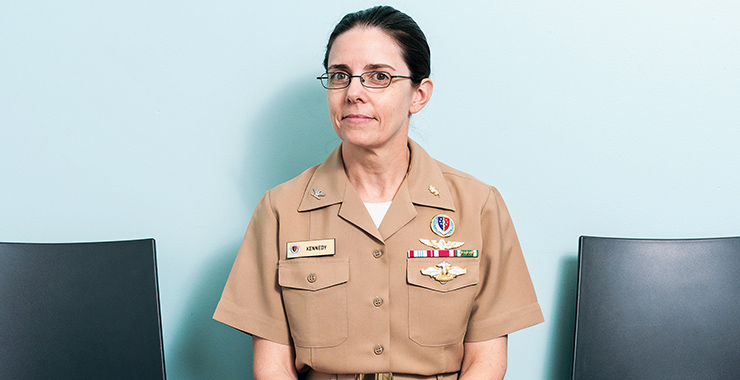
The U.S. Department of Defense (DOD) employs more than 8,000 psychologists, making it the nation’s largest employer for the profession. Of this group, more than 600 clinical and counseling psychologists and nearly 1,000 civilian employees and contractors are tasked with providing clinical care to military service members and their families. Like other clinical psychologists, this group diagnoses and treats patients with behavioral health disorders and conducts psychological evaluations. But as members of the Army, Navy, Air Force or Marine Corps, those who commission as military officers—known as military clinical psychologists—also perform such special services as advising commanding officers on unit wellness, culture and performance. And they benefit from valuable training and leadership opportunities early in their careers, says Capt. Carrie Kennedy, PhD, division chief of the Psychological Health Center of Excellence, part of the Defense Health Agency responsible for creating evidence-based protocols for psychological treatment, and the clinical psychology specialty leader for the Navy.
“It’s been a joy supporting military service members who are sacrificing so much for our country,” she says. “They are a population that’s adaptable, committed, motivated and smart.”
Separately, a handful of clinical psychologists serve members of the U.S. Coast Guard through contract work with the Department of Homeland Security.
The Monitor interviewed psychologists across each of the armed forces to learn about the opportunities, benefits and challenges of providing clinical care to the military.
Army
Over the course of a career, an Army clinical psychologist might do everything from training interns to providing marital counseling to helping a soldier recover after returning from enemy capture. The vast array of opportunities is one of the main attractions for the 240 active duty psychologists in the Army, each of whom changes roles every three to four years.
“One of the things I’ve enjoyed most about my career has been the ability to spread my wings and try a lot of different things, even some that are peripherally related to psychology,” says clinical psychologist Col. Rebecca Porter, PhD, the commander of the Army’s Public Health Command Europe.
In her role, Porter oversees epidemiologists, public health nurses, biochemists, pathologists, food inspectors, veterinarians and animal care technicians to ensure that water treatment, food processing and animal oversight at the Army’s European installations meet its public health standards. Throughout her career, she has also treated soldiers and their dependents, served as a congressional liaison and helped craft behavioral health policy for the Army.
Active duty psychologists typically enter the Army as captains through the Association of Psychology Postdoctoral and Internship Centers (APPIC) match program during their clinical internship year or through the Army’s postdoctoral residency programs. After completing the internship or residency at an Army medical center, a psychologist is typically assigned to a brigade, where he or she is responsible for the behavioral health care of up to 3,500 soldiers as part of a multidisciplinary team that includes other psychologists, social workers, counselors, a psychiatrist and a case manager.
This model, known in the Army as embedded behavioral health, is designed to increase clinicians’ cultural competence and reduce the stigma soldiers may feel at receiving mental health care by integrating providers with patients. Operating from a clinic at the brigade’s military base, psychologists split their time between providing clinical services and conducting evaluations. That can include assessing a soldier’s fitness for duty or their suitability to deploy—in addition to wellness and prevention efforts, such as promoting healthy leadership behaviors among commanding officers. Embedded behavioral health providers also interact informally with the brigade each week, observing soldiers’ field training and attending leadership meetings.
“Embedded psychologists have a deep understanding of our patients’ work environment, duties and functioning, which provides a holistic picture of their experience and gives us more avenues to help them than a traditional provider might have,” says Lt. Col. Deborah Engerran, PsyD, ABPP, the psychology consultant to the Army surgeon general. For example, a psychologist can work with commanding officers to orchestrate a leave of absence for a distressed soldier to visit a sick relative.

Career paths
After working with a brigade for three to four years, many Army psychologists shift to a post at a military hospital or clinic or receive training for a more specialized role, such as supporting special operations.
At a clinic or hospital, psychologists typically join an interdisciplinary team that provides care for soldiers as well as their spouses and children. Common concerns include interpersonal and adjustment issues, depression, anxiety and post-traumatic stress disorder (PTSD).
For instance, when Porter served as a clinical health psychologist at Tripler Army Medical Center in Hawai‘i, she collaborated with oncologists and endocrinologists to help patients with complex medical conditions make lifestyle changes and integrate new treatment plans. Later in her career, she helped develop a treatment program for chronic pain. In tandem with other health-care providers, including psychiatrists, physical therapists, anesthesiologists, dietitians, dentists, acupuncturists and yoga teachers, Porter helped construct a program focused on integrated care, psychoeducation and cognitive and behavioral coping.
After his first tour as an embedded psychologist with the 82nd Airborne Division, Lt. Col. Michael DeVries, PhD, ABPP, applied for a role within special operations and was assigned to a specialized aviation regiment. To better care for the service members in that regiment, DeVries completed additional training in advanced communication skills, job-competency analysis and airborne safety—including learning how to jump out of a plane during flight. He also studied survival, evasion, resistance and escape tactics, which enables psychologists to understand what soldiers experience behind enemy lines and to help them handle the stressors of enemy capture upon their return.
“Having the opportunity to help someone who has been through an incredibly stressful situation to return with honor, maximize their resiliency and rejoin their families and friends has been extremely rewarding,” he says.
DeVries provides clinical services for the families of special operations soldiers as well, helping family members manage the high-stress lifestyle and providing grief counseling when a soldier dies. He also uses psychological assessments to determine which soldiers are a good fit for special operations—typically those who are high in resilience, conscientiousness and adaptability—and delivers preventative services including resiliency training and executive coaching to help enhance performance.
Leadership. As their careers progress, Army psychologists assume leadership roles with increasing responsibility. In her previous role, Porter served as director of psychological health for the Army and as chief of the behavioral health division at the Army surgeon general’s office, where she worked to standardize behavioral health policies across the service, including how to staff clinics and which treatment methodologies to use. She also launched a behavioral health data platform that collects screening information from patients at every psychology session—now used throughout the military—and served as a congressional liaison on topics such as PTSD and personality disorder diagnoses.
“You have the latitude to develop new policies and programs for service members and their families that can be promulgated across the entire Army and around the world,” she says.
Engerran, who joined the Army in 2002, is now also in a senior role as the psychology consultant to the surgeon general of the Army, where she oversees the recruitment, training and talent management of all Army psychologists. She also advocates for the profession within the Army, for instance to further expand the role of Army psychologists outside clinic and hospital settings.
Other opportunities for psychologists include program director positions at the Army’s internship and postdoctoral residency programs as well as teaching positions at the Uniformed Services University of the Health Sciences (USUHS) in Bethesda, Maryland; the National Defense University in Washington, D.C.; or the Army Medical Department Center and School in Texas.
In addition to the Army’s active duty psychologists, a handful of contractors and more than 500 government civilian psychologists deliver services to soldiers and their families in hospitals, at clinics and as providers embedded with Army brigades.
How to find a job
Psychologists interested in Army careers have several options. Doctoral students studying clinical or counseling psychology in an APA-accredited program can seek a clinical internship in the service through the APPIC match program. They should concurrently connect with a medical recruiter (via GoArmy.comopens in new window) to obtain the necessary screenings and clearances to commission as an officer in the Army.
Alternative pathways to active duty include USUHSopens in new window, which offers free tuition and full salary to service members who have already commissioned with the Army, Navy or Air Force; the Health Professions Scholarship Programopens in new window, which offers tuition to second-year doctoral students who agree to commission upon completing their degree; and the Army’s postdoctoral residency programs. Licensed clinical and counseling psychologists who have completed APA-accredited doctoral programs and internships can also enter the service through a medical recruiter.
To find government civilian positions in the armed services, psychologists should visit the federal job boards at USAJOBS.govopens in new window. Various contracting companies also hire psychologists with specialties such as forensics and neuropsychology and typically advertise on websites like Indeed.comopens in new window or in the Monitor.
Upon entering the Army, all active duty medical providers attend a four-week Direct Commission Course, where they learn leadership skills and details about Army structure and missions before beginning their internship or first tour. Government civilians typically receive a shorter orientation from an immediate supervisor.
Engerran says the best Army psychologists aim to do more than just provide outstanding care.
“We’re looking for people who want to work on a team and find ways to help their patients as individuals, as soldiers and as part of the entire Army ecosystem,” she says. “This job will call on you to expand yourself beyond the traditional duties of a clinician.”
Navy
There are 187 active duty clinical psychologists in the Navy. These clinicians work in the United States and abroad in training and administrative positions or are embedded with naval surface forces, submarine forces, or special operations units as well as Marine Corps units. The Navy also employs 140 government civilian and 117 contract clinical psychologists, who primarily work in hospitals and clinics.
Common clinical issues tend to mirror what’s seen in the general population, including anxiety, depression and relational issues. PTSD resulting from combat or sexual trauma affects just under 2% of sailors, according to Kennedy of the Navy’s Psychological Health Center of Excellence. But the most common mental health diagnosis across the military health system, says Kennedy, is adjustment disorder.
“Most service members are young and living away from home for the first time. They’re also adjusting to the major changes that go along with entering the military—loss of freedom, individuality and privacy,” she says.
Young patients often complain of homesickness, trouble with a partner or doubts about choosing to join the Navy. Treatment and intervention for adjustment disorder typically involves cognitive-behavioral therapy (CBT) and mentorship from senior enlisted personnel.
An increasing number of service members are self-referring for treatment, thanks in part to organized efforts to reduce stigmas, Kennedy says. For example, military policy dictates that in certain situations, such as when personnel present with mild, transient concerns or report a sexual assault, mental health providers are not required to notify commanders about the visit.
That said, Kennedy notes that an inherent tension exists between military psychologists and their active duty patients: Psychologists not only provide support and treatment; they are also responsible for recommending limited duties or, in severe cases, medical separation.
“The military is not a place for serious mental health symptoms” such as psychotic or personality disorders, says Kennedy. “There’s a reason why serious symptoms make you unfit for duty when you’re frequently armed and other people’s lives are at stake based on your decisions and actions.”
The result is that patients may hesitate to seek help for fear of losing their job—or may even seek help disingenuously to avoid an undesirable mission, which can prove difficult for psychologists tasked with evaluating them.
“The challenge is to remain an advocate for your patient—even if you’re making a choice that they feel is incorrect —without creating an adversarial relationship,” says Mary Brinkmeyer, PhD, a civilian Navy employee and assistant training director for psychology training programs at the Naval Medical Center Portsmouth in Virginia.
Career paths
There are many training opportunities for uniformed psychologists interested in gaining specialty knowledge and skills. After her first tour overseeing outpatient mental health services and substance use rehabilitation at the U.S. Naval Hospital Okinawa in Japan, Kennedy completed a postdoctoral fellowship in neuropsychology at the University of Virginia. The arrangement, known as duty under instruction, afforded her a full salary for full-time study.
After the fellowship ended, Kennedy began a tour at the Naval Aerospace Medical Institute (NAMI) in Pensacola, Florida. Soon after, she became the first clinical psychologist to complete the aeromedical officer training program.
The rigorous six-month program, required for clinicians—including mental health providers, physicians and flight surgeons—who treat aviators, includes academic coursework on aerodynamics, aviation regulations, navigation, standard aircraft systems and the strict physical and mental health protocols required for Navy and Marine Corps aviators to attain and maintain flight status. The program also includes practical skills training such as land survival, water survival and learning to fly fixed- and rotary-wing aircraft. Though they aren’t qualified as military aviators, aeromedical officers must understand the demands of flight duty in order to make informed decisions regarding flight status for sailors and Marines.
Kennedy then deployed with a Marine medical battalion, where she worked in a combat hospital evaluating acute blast concussions in service members, served as the department head of mental health at a clinic in Bahrain, and now leads the Psychological Health Center of Excellence. She says the hardest part of her career has been the constant moving.
“It’s hard on families and on the individual—as soon as you get comfortable somewhere, you’re off again,” she says. “You do get to see some amazing places, but you’re on the move a lot. Since 1999, I’ve moved eight times and deployed twice.”
For psychologists who are not interested in active duty, contractor and government civilian positions offer more consistency. Unlike in the Army, most Navy contractors and government civilians are not assigned to embedded or operational roles. Instead, they work primarily in Navy clinics and hospitals, both in the United States and overseas.
Learning curve. Some psychologists become military contractors after serving as active duty officers. But for those who enter without military experience, the role can require some adjustment. “The military has its own language, rules and jokes—and people are very defined by their ranks and roles,” says Brinkmeyer, who became a Navy contractor in 2008 after completing postdoctoral training in pain management at the University of Florida and is now a civilian government employee. The first time she called for a patient in her clinic’s waiting room, for instance, she was met with silence when she used the patient’s first name. After a few tries, the patient informed Brinkmeyer that in the military, officers expect to be addressed by their rank and last name.
Brinkmeyer spent four years as a pain psychologist in a Navy orthopedic clinic on an interdisciplinary team with orthopedic surgeons, physician assistants, physiatrists, physical therapists, anesthesiologists and primary- care case managers. There, she offered CBT as well as psychoeducation about pain.
She then moved to the Center for Deployment Psychology in Bethesda, Maryland, part of the Henry M. Jackson Foundation for the Advancement of Military Medicine, where she worked as a contractor for two years assisting with training activities related to chronic pain.
In 2014, she became assistant training director for psychology training programs at the Naval Medical Center Portsmouth. She oversees training for a group of psychology interns who enter the Navy through USUHS and the Health Professions Scholarship Program, as well as postdoctoral scholars recruited from civilian graduate schools.
Brinkmeyer says she enjoys the diversity of her patients and trainees—more than 8% of enlisted sailors were born outside the United States—and admires their resiliency. “A number of people join the military because they’ve experienced a high degree of trauma, loss or economic instability. They’ve developed a lot of strengths to get to the point where they are today,” she says.
How to find a job
Pathways into the Navy mirror those available to Army psychologists. Government civilian opportunities are listed at USAJOBS.govopens in new window, while contract work is listed in traditional job forums such as the Monitor or Indeed.comopens in new window. Psychologists-in-training seeking active duty positions can enter through the APPIC match, USUHS or the Health Professions Scholarship Program. The Navy also offers a one-year, APA-accredited postdoc fellowship, awarded annually to three psychologists who have completed doctoral programs but are not yet licensed. Fully qualified clinical psychologists can enter the Navy directly. All those pursuing active duty roles should also connect with a medical recruiter via Navy.comopens in new window.
After commissioning with the Navy, active duty psychologists attend Officer Development School in Newport, Rhode Island. The five-week program teaches health-care personnel basic naval history, customs, policies, etiquette and essential skills such as how to put out a shipboard fire. New officers must also pass a physical readiness test that includes situps, pushups and a timed run.
Across the military, psychologists say prioritizing physical fitness can help clinicians gain the respect of those they treat. Kennedy also advises internship applicants to showcase their clinical training in evidence-based treatments for common mental health conditions, as well as their writing abilities, which are crucial for drafting clinical reports and other internal briefs.
Marine Corps
Unlike the other armed forces, the Marine Corps does not operate its own medical department. Instead, Navy clinicians provide care to Marines through Navy hospitals, clinics and embedded health-care providers. Currently, 15 Navy psychologists who have completed at least one traditional tour have been selected for specialized embedded roles, where they perform a mix of clinical, consulting and prevention duties for Marine units.
One is Lt. Cmdr. Katherine Pierce, PsyD, who deployed with a Marine unit to Afghanistan, where she assessed the readiness of Marines for combat, provided short-term treatment for minor concerns such as relationship stress and ran prevention groups for smoking cessation and sleep issues. In 2016, Pierce joined a unit at Marine Corps Base Camp Pendleton in California as an embedded psychologist.
In this role, she spends about a third of her time on traditional clinical duties: meeting with patients, diagnosing mental health conditions and providing short-term treatment for mild to moderate concerns such as anxiety or adjustment disorder. Of the 4,300 Marines within her purview, Pierce treats about 50 a month.
Another third of her time is spent on prevention and outreach across the unit, such as organizing a symposium about the effects of smoking, caffeine and stress on the brain. Pierce also conducts skills-training workshops with smaller groups, where members of her unit learn mindfulness exercises, ways to improve team dynamics and goal-setting exercises.
“We’ve found that the units that develop these skills tend to have less internal disagreements and are better able to manage the various stressors they encounter,” Pierce says.
Pierce, like other embedded psychologists, spends the final third of her time consulting with the unit’s commanding officers, which may involve reporting on a Marine’s fitness for duty or discussing more general psychological concerns within the unit.
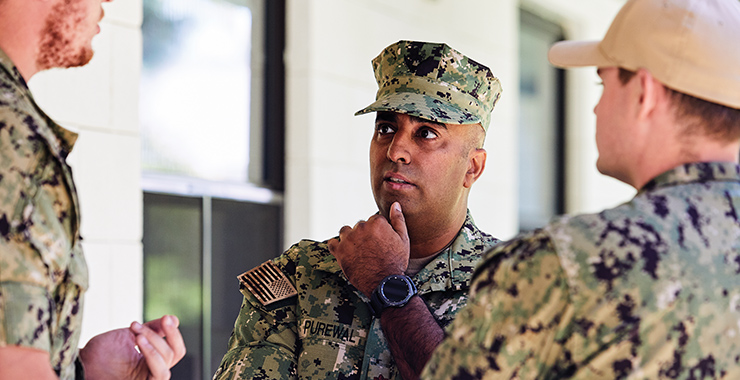
When Lt. Cmdr. Amarjeet Purewal, PsyD, another psychologist embedded with a Marine regiment, noticed a pattern of concerns about unit dynamics, he worked with command so that leadership could adapt and better meet the needs of the Marines in his regiment. He also helped implement changes in the medical separation process for Marines with mental illness and has actively worked to address an increase in suicide attempts.
“We get an inside look at a unit’s dynamics,” Pierce says, “which not only helps us more effectively treat individual patients but also allows us to aid commanders in reducing stress throughout the unit.”
Purewal says that Marine psychologists need a strong clinical foundation, as well as training or experience in industrial-organizational or community psychology to facilitate working within a complex system.
“You treat an individual, but you also consider how that person is linked to the command and the Marine Corps as a whole,” he says. “As an embedded psychologist, we’re invested in all three.”
The biggest challenge for both Pierce and Purewal has been combating the sometimes powerful stigma around mental health within the Marine Corps.
“If someone breaks a bone, the orthopedic surgeon tells the commanding officer exactly when that Marine can get back in the fight,” Purewal says. “With anxiety or depression, it might be a month, it might be six months or it might be longer—and that gray area is difficult for some to grasp.”
Building relationships within the unit is one way to gain credibility. On top of meeting with commanding officers and conducting about five patient sessions each day, Purewal shadows various groups of Marines, such as communications and motor teams, to forge personal connections and better understand their job duties. He might observe weapons training one day and accompany a platoon on a 12-mile hike the next. Pierce demonstrates her interest and commitment to her unit’s mission by attending meetings not directly related to her job duties, such as operations briefs.
Ultimately, Navy psychologists seeking embedded roles with the Marines should be flexible and open to general clinical work and a fast-paced environment.
“If you prefer a set schedule or enjoy treating one particular condition, this job probably isn’t for you,” Pierce says. “But if you’re passionate about treating a range of mental health concerns in a variety of settings, it’s an incredibly rewarding career.”
Coast Guard
With approximately 41,000 active duty members and 6,000 reservists, the Coast Guard is the smallest of the armed forces. It also has the smallest mental health-care team, with just four psychologists, four psychiatrists and one psychiatry physician assistant. All four psychologists are civilian contractors; two are stationed in New Jersey and two are at the U.S. Coast Guard Academy’s cadet counseling center in New London, Connecticut.
The Coast Guard’s model for providing health care resembles that of the other services, but Coast Guard psychologists typically only treat active duty and reserve members, not dependents. They also only conduct routine outpatient services and urgent visits; all personnel requiring inpatient care are referred to local DOD or civilian clinics.
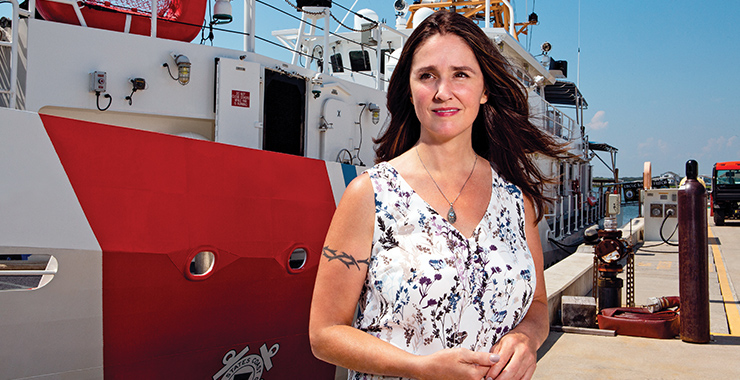
Before accepting a civilian contractor position supporting the Coast Guard’s training center in 2018, Monique Tremaine, PhD, delivered neurorehabilitation services as the director of psychology and neuropsychology at the Kessler Institute for Rehabilitation in West Orange, New Jersey. Now a contract neuropsychologist at the U.S. Coast Guard Training Center in Cape May, New Jersey, Tremaine collaborates with one psychiatrist and a team of counselors specializing in substance use and domestic violence to treat both recruits and active duty members.
Common concerns include a typical range of various life stressors—health problems, adjustment issues, relationship stress, anxiety and depression—as well as some cases of PTSD. As with other services, patients either seek mental health care, are referred for evaluation by a primary-care provider or are referred for evaluation by a commanding officer to assess whether they are fit for duty. Tremaine also performs some fitness-for-adoption evaluations, assessing prospective parents’ history of mental illness, personalities and parenting styles.
The eight-week boot camp program at Cape May trains around 4,000 Coast Guard members each year. When training begins, Tremaine and her team evaluate each recruit’s mental health history. She typically treats six to seven patients per day, about half of whom are recruits.
“Certain recruits may have difficulty adjusting to the military setting, especially if they have a history of mental health that has gone untreated,” she says. “My role is to support them through their graduation and to determine which recruits may not be fit for a military career.”
Tremaine says the rigors of training can highlight disorders that might have been minimized or underreported. For example, one man experienced a relapse of obsessive-compulsive disorder that he had believed to be managed. For those with a background of abuse, Tremaine says training can unexpectedly trigger memories of unfair treatment in the past. As a result, recruits may threaten physical aggression or experience suicidal ideation during training.
“There’s always a point, especially in the initial weeks of training, where many recruits feel lost or incapable,” she says. “Empowering them to move through those stages and seeing them through to graduation has been extremely gratifying.”
Career paths
Because all psychologists working with the Coast Guard are contractors, they do not face the relocation requirements of active duty psychologists, though some may travel occasionally to provide services in remote areas.
Despite this added stability, Tremaine says acclimating to military culture as a civilian—including memorizing ranks and learning how to address active duty members—has been the most challenging part of her job.
“I come in with experience because I’ve been in my field for 15 years, but on the other hand I’m completely new to the military. I’m still navigating that,” she says.
To help ease the transition, psychologists complete an onboarding process where they learn about military and Coast Guard policies as well as local operating procedures. During her first month on the job, Tremaine also received mentoring from the resident psychiatrist, met with the commanding officer at the training center and observed recruits in training.
For civilian psychologists considering a career in the military, Tremaine says it’s possible to encounter policies or practices that conflict with one’s personal values.
“But these conflicts are actually opportunities to ask the difficult questions that may ultimately bring about change,” she says. “Confronting the stigmatization of mental health treatment, for example, creates a path for those who need treatment to begin getting that help.”
To work with the Coast Guard, psychologists must first complete an APA-accredited graduate program and internship and obtain a license to practice. Experience treating PTSD, substance use and domestic violence—or working with uniformed service members or veterans—can help psychologists prepare to excel in such a role. Psychologists should also familiarize themselves with Department of Veterans Affairs (VA) and DOD clinical protocolsopens in new window for mental health disorders, such as the VA/DOD Practice Guideline for the Management of Posttraumatic Stress Disorder and Acute Stress Disorderopens in new window.
Finding a job
To learn more about opportunities at Coast Guard stations, psychologists can contact the Operational Medicine and Quality Improvement Division at Coast Guard headquarters in Washington, D.C. For information about openings at the U.S. Coast Guard Academy, visit the cadet counseling center online at www.uscga.edu/counseling-servicesopens in new window.
Air Force
In the Air Force, approximately 245 active duty psychologists, 20 government civilians and 75 contractors provide clinical care for more than 320,000 airmen and their families. While most of those psychologists work in Air Force clinics and hospitals, about 60 are embedded with Air Force units. Other roles include staffing the student counseling center at the U.S. Air Force Academy, in Colorado Springs, Colorado, conducting human performance research at Wright-Patterson Air Force Base in Ohio and creating and implementing policies around things like telehealth and suicide prevention at the Air Force Medical Readiness Agency.
When Col. William C. Isler III, PhD, first entered the service 23 years ago, he worked in a clinic at McChord Air Force Base in Washington state, where he treated conditions such as depression, anxiety, substance use disorder and PTSD. He also helped airmen manage marital challenges, work stress and interpersonal conflict. He then entered the Air Force’s two-year fellowship in clinical health psychology at the Wilford Hall Ambulatory Surgical Center in Texas. As part of his training, he partnered with primary-care providers, treated patients with chronic pain and conducted research on insomnia.
Continuous growth. Since completing the fellowship, Isler has held several clinical and policy leadership roles. He is now the psychology consultant for the Air Force, responsible for recruiting, retaining and assigning psychologists to specific roles. As in the other services, active duty Air Force psychologists begin a new tour every three to four years. When deciding where to place them, Isler considers three factors: the needs of the Air Force, the desires of the officer and the officer’s professional development.
“It’s nice when all three of those line up, but that isn’t always the case,” he says.
And though frequent moves can prove challenging for service members and their families, “every move stretches the officer, builds on past experience and prepares that person for greater levels of leadership,” says Isler.
Specifically, psychologists usually begin their work in the Air Force supervising two to five people, and they may ultimately hold a policy role, command a medical operations squadron of several hundred airmen or run an entire military treatment facility.
Col. Christopher Robinson, PhD, MPH, has held several such leadership roles after delivering traditional clinical services in the Air Force for more than a decade. For three years, he served as a squadron commander at a military hospital in Las Vegas, where he oversaw nearly 500 health-care providers across the facility’s outpatient clinics. Robinson has also served on the faculty of USUHS, conducted research on chronic pain and smoking cessation and led the Air Force’s alcohol misuse prevention and treatment program. He later served as the deputy director for psychological health at the Defense Centers of Excellence for Psychological Health and Traumatic Brain Injury and now oversees sexual assault prevention, suicide prevention and resilience at the Air Force’s Integrated Resilience directorate.
“Rather than focusing on an individual patient’s well-being, policy work has given me a broader reach,” Robinson says. “Now, my patient is the entire population of the Air Force.”
The emphasis on leadership in the Air Force—and across the armed forces—means that early career psychologists often receive opportunities reserved for more senior providers in the civilian sphere, according to Maj. Amileah Davis, PhD, ABPP. Within two years of completing her counseling psychology degree, Davis ran two programs: one focused on suicide prevention and the other on substance use prevention and treatment.
“None of my peers outside the military were afforded the opportunity to learn and grow that quickly,” she says.
Now, Davis is a resiliency flight commander in a special operations unit. She oversees an interdisciplinary team of medical and spiritual professionals who provide integrated care for special operators and their families. She also provides training and consultation to improve team dynamics, performance and resilience within her squadron.
To serve in special operations, Davis completed advanced postdoctoral training in several areas and obtained certifications in aeromedical psychology and survival, evasion, resistance and escape tactics to help special operators return honorably in the event of enemy capture. She regularly uses methodologies such as leadership coaching, special duty evaluation and biofeedback.
“To support my unit, I need expertise in a really wide spectrum of psychological capabilities, including aspects of clinical, industrial-organizational and sports psychology,” Davis says. “It’s a long list of skills to master, which can be a challenge.”
That said, Davis has found it rewarding to support special operators, a population she says is high functioning, incredibly skilled and willing to risk their personal safety to complete essential yet dangerous missions. And she says embedded roles like hers are a key part of the Air Force’s efforts to reduce stigma around mental health.
“Having providers embedded with the units sends a strong message that keeping ourselves healthy and well is the foundation for mission success,” she says.

How to find a job
Students ages 18 to 41 pursuing a doctorate in clinical or counseling psychology in an APA-accredited program can apply to serve in the Air Force. Common pathways include studying at USUHS, participating in the Health Professions Scholarship Program or entering one of three clinical psychology internship programs in the Air Force. Licensed psychologists who have completed an APA-accredited graduate program and internship can contact a medical recruiter to learn about active duty opportunities, while clinicians who do not wish to deploy to combat zones are good candidates for government civilian and contractor roles.
“We are looking for generalists that we can train with a military focus,” Isler says, adding that it can help to have training on evidence-based care for PTSD, concussion management, depression, anxiety, adjustment disorder, marital issues or volitional problems.
Commissioned officers complete an eight-week officer training courseopens in new window, where they study military leadership principles and conflict resolution skills. AirForce.comopens in new window and the Wilford Hall Air Force Psychology Internship Facebook pageopens in new window are good places to learn more about active duty opportunities.
“My advice to psychologists: Be open to a demanding yet very fulfilling career in the Air Force,” Isler says. “Things are always changing, so you need to be flexible. But that also offers a lot of opportunities for people interested in continuous growth and leadership.”