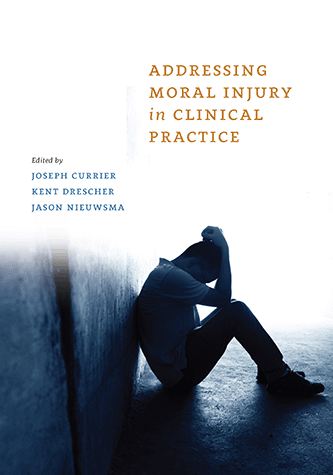
Addressing Moral Injury in Clinical Practice
ISBN: 978-1-4338-3269-7Available formats
Also available from
In this book, leading experts summarize their views of moral injury as they advance theoretical models and clinical practices to support clinicians in caring for morally injured persons.
Vivid case examples illustrate modifications to existing interventions for PTSD as well as novel approaches that have already received some scientific support.
Although this book focuses on military trauma, it is also for clinicians who address moral injury with other trauma-exposed groups such as first responders, social workers, and police officers.
Contributors
Introduction to Moral Injury
- A Cognitive-Behavioral Model of Moral Injury
- A Social-Functional Perspective on Morality and Moral Injury
- Religious and Spiritual Issues in Moral Injury
- Forgiveness as a Mechanism of Repair Following Military-Related Moral Injury
- Case Conceptualization for Moral Injury
- Clinician Issues in Treating Moral Injury
- Moral Injury, PTSD, and Prolonged Exposure
- Cognitive Processing Therapy for Moral Injury
- Acceptance and Commitment Therapy: Using Mindfulness and Values in the Treatment of Moral Injury
- Adaptive Disclosure: A Novel Evidence-Based Treatment for Moral Injury
- Impact of Killing: A Treatment Program for Military Veterans with Moral Injury
- Building Spiritual Strength: A Group Treatment for PTSD, Moral Injury, and Spiritual Distress
- Collaboration with Chaplaincy and Ministry Professionals in Addressing Moral Injury
- Future Directions for Addressing Moral Injury in Clinical Practice: Concluding Comments
Index
About the Editors
Joseph M. Currier, PhD, is a clinical psychologist who serves as associate professor and director of clinical training in the combined clinical and counseling psychology doctoral program at the University of South Alabama.
Dr. Currier has been involved in research and scholarship on moral injury for roughly a decade, during which time he completed multiple research projects with VA medical centers and other clinical or community-based settings with military veterans.
Dr. Currier has published more than 90 peer-reviewed articles on trauma, meaning making, moral injury, and interplay between spirituality and mental health.
Kent D. Drescher, PhD, MDiv, was a staff member at the National Center for PTSD for 27 years (1990–2017). During that time, he was involved in trauma research, clinical education, and clinical care for veterans suffering from PTSD and other related disorders.
He has been involved in discussions of the emerging construct of moral injury since 2007, and in recent years has been active in treatment development. He has authored more than 60 peer-reviewed articles and book chapters, many related to the intersection of trauma, spirituality, and moral injury.
He recently retired from federal service.
Jason A. Nieuwsma, PhD, is a clinical psychologist who is an associate professor in the department of psychiatry and behavioral sciences at Duke University Medical Center and serves as the associate director for mental health and chaplaincy in the Department of Veterans Affairs.
His work in the area of moral injury includes epidemiological and clinical research as well as extensive focus on integrating spiritual care and chaplaincy services with traditional mental health care services for veterans and service members.
Dr. Nieuwsma has published more than 50 articles and book chapters, and led multiple grant-funded initiatives.