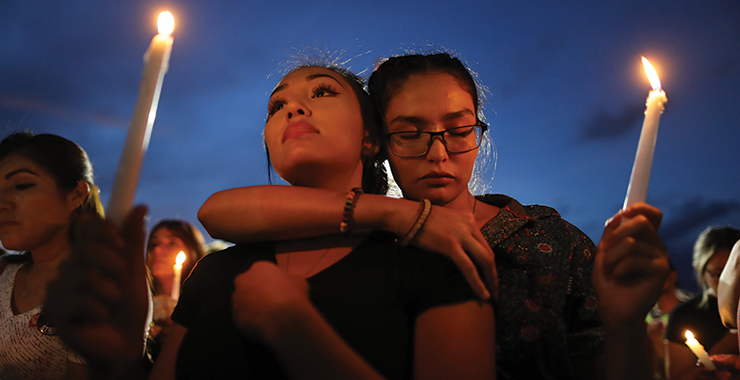
Each year, firearms claim the lives of some 40,000 Americans through homicides, suicides, mass shootings and accidents, according to the Centers for Disease Control and Prevention (CDC). And those numbers are rising: Between 2014 and 2017, gun deaths increased by 16%, while six of the nation’s 10 deadliest mass shootings have occurred over the past 10 years.
Through a range of efforts—in the community, in the media and in research—psychologists have escalated their work on gun violence prevention.
“APA and psychology are working on a number of fronts to help move the gun violence debate beyond political arguments and into the realm of public health and safety,” says APA CEO Arthur C. Evans Jr., PhD. “Psychologists are prepared to rise to this challenge using our best science, data and practice, and to collaborate with others to make these efforts even more effective.”
Psychologists’ gun violence prevention efforts rely on evidence-based arguments to underscore that:
Gun violence should be treated as a public health problem. Like other public health epidemics—for example, tobacco use and car accidents—gun violence is best addressed through public health interventions. That’s because this approach is apolitical, based on science and data, designed to foster population-level health and tailored to specific subpopulations, says clinical and forensic psychologist and attorney Robert Kinscherff, JD, PhD, of William James College. “An evidence-based public health approach allows us to specify what is likely to work, under what circumstances and with what populations,” he says.
Suicides are the most common form of gun violence (61%), followed by homicides (35%). Contrary to public opinion, mass shootings are extremely rare, comprising less than 1% of all gun-related deaths in the United States. Collectively, these factors suggest the importance of designing and funding interventions accordingly, Kinscherff and other psychologists say.
Mental illness alone does not predict gun violence. Studies show that mental illness accounts for only a small percentage of gun violence, and that people with serious mental illness are much more likely to be victims than perpetrators of such attacks.

In the media
Psychologists have been particularly vocal in the media about the need for commonsense gun violence prevention policies. In 2019 alone, APA officials and experts were quoted in thousands of news reports about the science of gun violence and the need for greater protections, including on CNN and in The New York Times. More than 2,800 news articles—potentially reaching more than 4 billion people—referred to APA’s position on gun violence.
As just one example, a statement on mass shootings by 2019 APA President Rosie Phillips Davis, PhD, ABPP, was cited by more than 300 news outlets. In August, she appeared on CNN to discuss the need to stop inaccurately blaming the nation’s gun violence crisis on mental illness—and to conduct more research into the more significant factors behind mass shootings, including fear, bigotry and social division.
“Saying that mental illness causes mass shootings is a simplistic argument, and it’s inaccurate,” she said. “We must focus on the full range of factors that contribute to mass shootings … such as bigotry and hatred.”
APA also made gun violence prevention a priority at APA 2019 in Chicago during a powerful main stage event (see video below), which was followed by a town hall in which psychologists shared their ideas for addressing this major societal challenge. “When we act boldly, when we are truthful, people listen,” said Evans. “The time for waiting is over.”
To better understand how Americans are responding to gun violence, in August APA commissioned a Harris Poll. A full 71% of Americans said that mass shootings are a significant source of stress in their lives, and a third said fear prevents them from going to certain places or events.
The findings—widely cited in the media—“sent an important message to policymakers that such tragedies have demonstrable impacts on our nation’s mental and physical health,” says APA Chief Advocacy Officer Katherine B. McGuire.
APA has also been advancing advocacy positions on Capitol Hill. Last year, APA supported congressional efforts to increase funding for research on gun violence prevention and for background checks, and sponsored congressional briefings on the damaging effects of gun violence on schools and communities. To amplify its message, APA joined forces with groups such as Giffords: Courage to Fight Gun Violence, the Violence Prevention Network and the American Academy of Pediatrics.
“It’s going to take a diverse group of organizations working together to put a stop to these senseless tragedies,” McGuire says, “and psychology needs to be at the forefront of these discussions.”
Research momentum
One of the critical strides forward on gun violence prevention has taken place on the research front. Since 1996, research on gun violence had been forestalled under the Dickey Amendment, a rider to that year’s appropriations bill that disallowed the funding of any CDC-sponsored research related to gun violence that could be used for advocacy purposes. That finally changed in 2018, when Congress gave the CDC authority to resume such studies as long as they were not specifically advocating for gun control. Now, several important research projects are underway. Among them is work by Northwestern University Feinberg School of Medicine psychologist Linda A. Teplin, PhD. She has received funding from the U.S. Department of Justice and the National Institute of Child Health and Human Development to extend the work of her Northwestern Juvenile Project, which has looked at mental health needs and outcomes of about 2,000 youth since they first entered the juvenile justice system in the late 1990s. The new research will investigate how participants’ firearm use as adolescents influenced their involvement with firearms during adulthood, as well as how parents’ firearm involvement during their own adolescence affects that of their teenage children.
Psychologists are working on a range of other projects related to gun violence, such as:
A review of 49 studies assessing the psychological effects of 15 mass shootings, which was conducted by psychologist Sarah R. Lowe, PhD, of the Yale School of Public Health, and Sandro Galea, MD, of the Boston University School of Public Health. Those most likely to experience depression, anxiety and post-traumatic stress disorder in the wake of a mass shooting were female, had previous psychiatric symptoms, were close to the attack, knew people who died in the attack and had low levels of social support, characteristics suggesting future areas for intervention (Trauma, Violence, & Abuseopens in new window, Vol. 18, No. 1, 2017).
A longitudinal analysis of 663 young Texas adults by Yu Lu, PhD, and Jeff R. Temple, PhD, of the University of Texas Medical Branch. It found that access to guns is a much stronger predictor of dangerous gun behavior than most mental health conditions, including depression, anxiety, posttraumatic stress disorder and borderline personality disorder (Preventive Medicineopens in new window, Vol. 121, 2019).
As psychologists keep working in this complex and politicized area, a public health framework will continue to serve as a valuable guide, Kinscherff underscores.
“If we take an evidence-based public health approach and weigh that against people’s assertions of interests or even rights,” he says, “then we can have a real conversation about what’s really at stake here.”