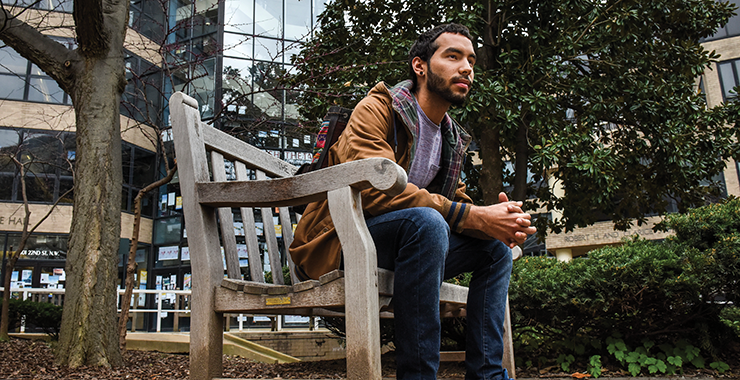
Ryan Pickering, PhD, an assistant professor of psychology at Allegheny College in Meadville, Pennsylvania, remembers feeling hunger pangs during his final exams in college. The son of a paper mill worker and an elementary school teaching assistant in rural Maine, Pickering was a first-generation college student. Because money was tight, he had selected the school’s least expensive meal plan and it wasn’t enough to carry him through the semester.
“Being hungry affected my concentration, and there were also social costs to being low income,” says Pickering, who earned a bachelor’s degree from the University of Maine at Farmington in 2008 and his psychology doctorate from the University of Maine in Orono in 2014. “I felt isolated when I couldn’t go out to eat with friends, and the loneliness became exponentially worse when I couldn’t go to the cafeteria.” He hid these difficulties from family members to avoid burdening them, which further intensified the sense of isolation.
Now Pickering, who is a member of APA’s Committee on Socioeconomic Status (CSES), is among a cadre of psychologists who are addressing the problem of food insecurity—defined as lack of access to a reliable supply of nutritious food—on college campuses. A 2018 survey of 86,000 students from 123 two- and four-year institutions throughout the United States by the Hope Center for College, Community, and Justice, showed that 45% of respondents were food insecure in the prior 30 days. Rates of basic needs insecurity were highest for students who were financially independent from their parents or guardians, identified as LGBTQ or were racial or ethnic minorities.
To better understand how the worry over where their next meal is coming from affects students, psychologist Yu-Wei Wang, PhD, research director of the University of Maryland Counseling Center, conducted a study of more than 4,900 students at her school in 2017. She found that the lack of access to food affected every variable she was testing. Compared with students who had reliable access to enough food, students who were food insecure experienced significantly higher rates of depression, loneliness and anxiety. They also had lower self-esteem and lower grade-point averages and were more likely to withdraw from the university before earning their degrees. During in-depth interviews with 23 students who grappled with food insecurity, Wang learned that unpaid internships and other training opportunities were often unrealistic because these students needed to use time outside of school to work and earn money to afford basic needs, which meant their future career opportunities could be limited.
“I also found that there was a lot of shame attached to being food insecure, and as a result, many of them don’t feel comfortable asking for help,” says Wang. Some students shared that they avoided the campus food pantry because they were afraid of being judged or thought it was for people with even greater needs.
Stigma was also a theme that emerged when Heather Bullock, PhD, a psychology professor at the University of California, Santa Cruz, and her students hosted focus groups with 91 students at the university who identified as food insecure.
The University of California (UC) system, which includes 280,000 students and 10 campuses, had published data about the rates and impact of food insecurity on its campuses, but Bullock was eager to understand the daily lives and challenges of students affected by this problem. Through focus groups, she learned about the multitude of barriers that prevent students from accessing the food they need to thrive.
“Students, for example, felt that they should be able to make ends meet on their own and shouldn’t have to use nutrition assistance programs,” Bullock says. “We need to reduce the stigma around food insecurity and increase the accessibility of these programs.”
Strategies for reducing stigma
To give students an option for free food beyond the campus food pantry, Bullock worked with campus leaders to open a nontransactional café called Cowell Coffee Shop: For the Peoples. Student volunteers run the shop—open 8 a.m. to 8 p.m. Monday through Friday and noon to 5 p.m. on Saturday—and serve coffee, tea, snacks and prepared meals free of charge for any UC Santa Cruz student. The shop, which receives funding through donations and the UC Office of the President, is also located close to the pantry in hopes of making the pantry feel more welcoming and to reduce stigma, Bullock says. Through the focus groups, Bullock also learned that students experiencing food insecurity felt overwhelmed by the application process for programs like CalFresh, California’s Supplemental Nutrition Assistance Program (SNAP), which issues electronic benefit transfer cards that are accepted by most grocery stores and many farmers’ markets for food purchases. The café offers CalFresh advising and information about other basic needs resources.
Bullock and Wang are also encouraging faculty to include a basic needs statement on course syllabi to inform students about resources on and off campus. Bullock regularly projects slides before class showing the definition and rate of food insecurity throughout the UC system and information about the university’s basic needs website—an online hub with resources for food, housing, wellness and financial security.
Although increasing awareness about resources is a step forward, Harmony Reppond, PhD, was interested in exploring how the nation’s 780 campus food pantries were meeting students’ needs. In 2016 and 2017, Reppond, an assistant professor of applied social psychology at the University of Michigan–Dearborn, and her co-researchers organized a series of summits with more than 20 food pantry directors and staff from 16 Michigan college campuses as well as legislators Reps. Sander Levin (D-Mich.) and Debbie Dingell (D-Mich.).
The attendees identified six key areas for improvement, including increased awareness of the pantries among students and more partnerships between organizations on and off campus to support the service (Analyses of Social Issues and Public Policyopens in new window, Vol. 18, No. 1, 2018).
Reppond also learned that some students were hesitant to access these services because of negative experiences with government programs in the past. “They worry that they will be asked questions about their economic situation that could potentially create red flags in other social welfare systems, like Child Protective Services if they have children,” Reppond says. By shedding light on such barriers, Reppond hopes that researchers and policymakers will be more motivated to develop solutions that help food pantries better serve students.
Levin is one legislator who took action after participating in Reppond’s 2016 summit. He co-sponsored the College Student Hunger Act of 2017, which would increase the number of U.S. students who are eligible for SNAP if it is passed. Reppond’s research also attracted the attention of the U.S. Government Accountability Office, whose leaders interviewed Reppond and later reported the fact that many students are not eligible for SNAP. Their report also recommended ways to reduce barriers to the federal nutrition program.
The state and national interest in Reppond’s research fuels her hope that more students will have reliable access to nutritious food in the coming years. She’s eager to see more psychologists leverage their scientific expertise to tackle this problem, such as by writing technical reports about studies to share with nonacademic audiences. “It’s actually something that can be fixed, and by reducing the rate of food insecurity, we can improve outcomes for students who are trying to get an education,” she says.
Pickering and the other CSES members, along with Deborah Fish Ragin, PhD, Christina Shane-Simpson, PhD, and other members of APA’s Committee on Associate and Baccalaureate Education (CABE), are developing a fact sheet and policy brief about food insecurity on campuses, as well as a symposium for APA 2020 in Washington, D.C., to bring even more attention to this issue and other poverty-related issues affecting college students.