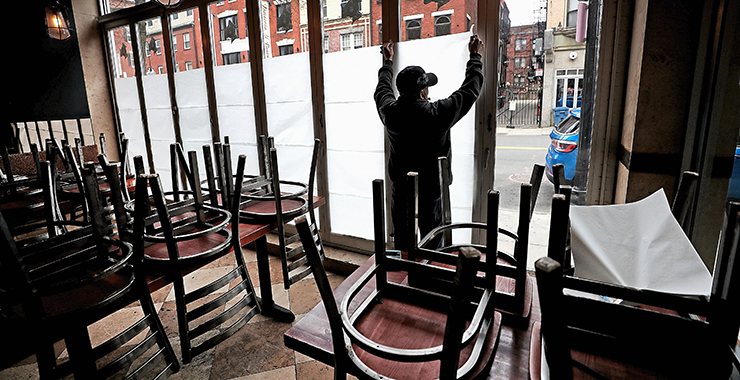
The COVID-19 crisis has shuttered businesses and led to massive numbers of layoffs nearly overnight. Americans have filed a record-breaking number of unemployment claims, according to the Department of Laboropens in new window. The U.S. Federal Reserve estimatedopens in new window that 47 million people might lose their jobs in the second quarter of 2020, translating to a 32.1% unemployment rate. That would far overshoot the peak unemployment rate of the Great Recession (10.2% in October 2009, according to the Bureau of Labor Statistics) and even of the Great Depression (24.9% in 1933).
Despite differences between this economic crisis and previous recessions, psychological research can provide some insight into the behavioral and mental health impacts of financial loss. Key findings include:
Mental health impacts can be long-lasting. An analysis of mental health data from the national, longitudinal Midlife in the United States (MIDUS) study found an overall population trend for improved mental health after the Great Recession compared with before (Clinical Psychological Science, Vol. 7, No. 5, 2019opens in new window). But this broad trend disguised inequities: Those who experienced personal hardships during the recession—whether financial, housing-related or job-related—showed an increase in panic attacks, excessive worry, depression and problematic substance use. These mental health affects persisted into 2013, well into the economic recovery.
“The COVID-19 pandemic is having rapid effects on the economy, with indications that we are entering another global recession,” says Miriam Forbes, PhD, a senior research fellow in psychology at the Centre for Emotional Health at Macquarie University, who co-authored the research. “Many people are losing their jobs, experiencing financial strain and housing insecurity in the current climate. Our research suggests that all of these experiences increase risk for long-lasting declines in mental health.”
Those mental health impacts will be uneven. Another look at MIDUS data comparing the mid-1990s to the postrecession years of 2011 to 2014 revealed that mental health, and physical health, declined along socioeconomic lines (Goldman, N., et al., PNAS, Vol. 115, No. 28, 2018opens in new window). The study focused on non-Latino whites, a group of interest due to an increasing rate of suicides, drug overdoses and other so-called “deaths of despair.”
The study found that white Americans in the 75th percentile or above in socioeconomic status showed almost no declines, and even some modest improvements, in life satisfaction, well-being, positive and negative affect and major depression. The lower a person’s socioeconomic status, the more likely a drop in these measures. Those in the 10th percentile, for example, saw the greatest increases in negative affect and the greatest declines in positive affect, life satisfaction and psychological well-being.
Health inequalities may deepen. The Great Recession also widened the health gap between the haves and have-nots. When comparing adults from timepoints before (1995 to 1996) and after (2011 to 2014) the recession, psychologist Carol Ryff, PhD, and colleagues found poorer outcomes in general health, chronic conditions, body mass index, functional limitations and physical health symptoms for the population as a whole, despite population-wide gains in educational attainment post-recession (Kirsch, J.A., et al., American Psychologist, Vol. 74, No. 7, 2019opens in new window).
As with mental health, the data also showed that the hardships of the Great Recession were disproportionately borne by those with lower educational status. “These big national shocks hit the disadvantaged segment of society the hardest,” Ryff says.
Unemployment and suicide are linked, especially for men. A population-level study of suicide in 54 countries before and after the Great Recession found there were 4,884 more suicides in 2009 than what would have been expected based on trends between 2000 and 2007. (Around 800,000 people die by suicide each year, according to the World Health Organization.) European and North and South American countries were particular drivers of the trend, as were men. In the 27 European countries studied, the suicide rate for men increased by 4.2%, while there was no increase for women. In the 18 countries in the Americas included in the analysis, suicide rates for men increased by 6.4%, compared with 2.3% for women (The British Medical Journal, Vol. 347, 2013opens in new window).
The study found correlations between suicide and unemployment in men, especially in countries that had relatively low unemployment before the Great Recession.
“The rise in the number of suicides is only a small part of the emotional distress caused by the economic downturn,” the authors, led by University of Bristol epidemiologist David Gunnell, PhD, wrote in the conclusions of the paper. “Non-fatal suicide attempts could be 40 times more common than completed suicides, and for every suicide attempt about 10 people experience suicidal thoughts.”
Purpose in life may combat financial miseries. Combating the mental health effects of a pandemic-induced financial crisis is no minor challenge. But the psychological literature does indicate sources of resilience. For example, eudaimonic well-being (purposeful life engagement and personal growth) is a protective buffer against elevated levels of inflammation among those with low educational attainment, Ryff and her colleagues have found (Health Psychology, Vol. 29, No. 6, 2010opens in new window).
The coronavirus crisis, paradoxically, may be an opportunity to find new sources of meaning, Ryff says. “It’s going to be incredibly important to follow profiles of social responsibility through this experience,” she says.