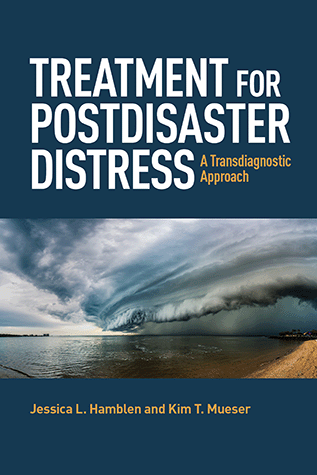
Treatment for Postdisaster Distress
Available formats
Also available from
Disasters can be an unpredictable source of complex mental health issues.
A mass casualty disaster occurs somewhere in the world on a near daily basis, and victims can have symptoms that persist over time.
Cognitive behavior therapy for postdisaster distress (CBT-PD) is a transdiagnostic approach to the treatment of a range of distressing symptoms that might not meet criteria for a specific disorder.
Over 12 to 14 sessions, the CBT-PD program provides psychoeducation about PTSD and the broad range of psychological reactions to a disaster, and teaches core skills that empower clients to take charge of their recovery: breathing retraining (to reduce hyper-arousal and anxiety), activity scheduling of pleasant and meaningful events (to reduce depression and avoidance of valued roles), and cognitive restructuring (to reduce negative feelings and change thoughts and beliefs that underlie persistent postdisaster reactions).
Refined over 20 years of clinical practice, this research-based approach is associated with significant reductions in PTSD and other distressing symptoms. This practical guide includes therapist scripts and client vignettes, and over two dozen worksheets, assessment tools, and other clinical handouts that mental health providers can use with their clients.
Foreword (by Richard Bryant)
Acknowledgments
Introduction: Development of a Transdiagnostic Treatment for Postdisaster Distress
Part 1: Background
- The Mental Health Effects of Disaster
- Transdiagnostic Treatment of Postdisaster Reactions
- Research on Treatment for Disaster
- The Cognitive Behavior Therapy for Postdisaster Distress Program
Part 2: The Treatment Program
- Screening and Assessment
- Beginning Treatment - Engagement and Psychoeducation
- Resiliency Skills
- Cognitive Restructuring 1 - Problematic Thinking Styles
- Cognitive Restructuring 2 - The Five Steps of CR
- Cognitive Restructuring 3 - Advanced
- Termination
Part 3: Other Issues
- Special Considerations for Therapists
- Applying CBT-PD to Different Types of Disasters
References
Jessica L. Hamblen, PhD, is a clinical psychologist and associate professor in the department of psychiatry at the Geisel School of Medicine at Dartmouth. She is also the deputy for education at the Department of Veterans Affairs’ National Center for PTSD.
Her research interests are in developing, evaluating, and disseminating evidence-based treatments for PTSD. She has a national reputation as an expert in the long-term mental health response following disaster and has conducted trainings after major national disasters including the September 11, 2001 terror attacks, and Hurricane Katrina in 2005.
Kim T. Mueser, PhD, is a clinical psychologist and professor at the Center for Psychiatric Rehabilitation at Boston University. Dr. Mueser’s clinical and research interests focus on the treatment of posttraumatic stress disorder in vulnerable populations and in psychiatric rehabilitation for persons with severe mental illness.
He has given numerous workshops on this work, both nationally and internationally, and has coauthored more than 10 books and more than 300 journal articles and book chapters. He has received a number of awards, including the Armin Loeb Research Award and the Emily Mumford Medal for Distinguished Contributions to Social Science in Medicine.
From the most recent pandemic, to natural disasters, to mass violence associated with terrorists, hundreds of thousands of people suffer the ravages of trauma yearly with little help available. Two of the most prominent experts in treating all aspects of trauma, Jessica Hamblen and Kim Mueser, share their decades of experience in dealing with victims of 9/11, the Florida hurricanes, and other disasters to present an easy-to-follow, strongly evidence-based protocol that will be extraordinarily useful to all clinicians treating the totality of reactions to trauma.
—David H. Barlow, PhD, ABPP, Professor Emeritus of Psychology and Psychiatry, Founder, Center for Anxiety and Related Disorders, Boston University, Boston, MA
Because things change rapidly in those massive, complicated, and messy events we call disasters, they defy traditional scientific approaches to test effective interventions. Recognizing this, Hamblen and Mueser have pooled their extensive experience to create a flexible, rigorous, practical, and cost-effective transdiagnostic approach that is easy to implement and based on the best current empirical evidence.
—Matthew J. Friedman, MD, PhD, Professor & Vice Chair for Research, Dept. of Psychiatry, Geisel School of Medicine at Dartmouth, Hanover, NH; Senior Advisor & Founding Executive Director and Director, National PTSD Brain Bank, National Center for PTSD, U.S. Dept. of Veterans Affairs, Washington, DC
Welcome to the clinician and practitioner resources for Treatment for Postdisaster Distress: A Transdiagnostic Approach. This website contains downloadable assessment tools, and handouts for clients. These documents are intended for professional use only. To reprint or adapt them for publication, please contact the original publisher. © 2021 American Psychological Association.
Appendix A
- Short Post-Traumatic Stress Disorder Rating Interview—Expanded (Sprint-E) (PDFopens in new window | Wordopens in new window)
Appendix B: Handouts
- Handout 1: Overview of Cognitive Behavior Therapy for Postdisaster Distress (PDFopens in new window | Wordopens in new window)
- Handout 2: Symptoms of Posttraumatic Stress Disorder (PDFopens in new window | Wordopens in new window)
- Handout 3: Common Reactions to Disaster (PDFopens in new window | Wordopens in new window)
- Handout 4: Drug and Alcohol Problems (PDFopens in new window | Wordopens in new window)
- Handout 5: Sleep Problems/Nightmares (PDFopens in new window | Wordopens in new window)
- Handout 6: Impairments in Daily Functioning (PDFopens in new window | Wordopens in new window)
- Handout 7: Intrusive Symptoms Worksheet (PDFopens in new window | Wordopens in new window)
- Handout 8: Avoidance Strategies Worksheet (PDFopens in new window | Wordopens in new window)
- Handout 9: Negative Changes in Thoughts and Feelings Worksheet (PDFopens in new window | Wordopens in new window)
- Handout 10: Arousal Worksheet (PDFopens in new window | Wordopens in new window)
- Handout 11: Fear and Anxiety Worksheet (PDFopens in new window | Wordopens in new window)
- Handout 12: Anger Worksheet (PDFopens in new window | Wordopens in new window)
- Handout 13: Guilt & Shame Worksheet (PDFopens in new window | Wordopens in new window)
- Handout 14: Sadness & Depression Worksheet (PDFopens in new window | Wordopens in new window)
- Handout 15: Drug and Alcohol Problems Worksheet (PDFopens in new window | Wordopens in new window)
- Handout 16: Sleep Problems Worksheet (PDFopens in new window | Wordopens in new window)
- Handout 17: Impairments in Functioning Worksheet (PDFopens in new window | Wordopens in new window)
- Handout 18: Breathing Retraining (PDFopens in new window | Wordopens in new window)
- Handout 19: Breathing Retraining Tracking Worksheet (PDFopens in new window | Wordopens in new window)
- Handout 20: The Importance of Pleasant and Meaningful Activities (PDFopens in new window | Wordopens in new window)
- Handout 21: Pleasant Activities List (PDFopens in new window | Wordopens in new window)
- Handout 22: Personally Meaningful Life Areas (PDFopens in new window | Wordopens in new window)
- Handout 23: Pleasant Activities Log Worksheet (PDFopens in new window | Wordopens in new window)
- Handout 24: Guide to Thoughts and Feelings (PDFopens in new window | Wordopens in new window)
- Handout 25: Problematic Thinking Styles (PDFopens in new window | Wordopens in new window)
- Handout 26: Problematic Thinking Styles Log Worksheet (PDFopens in new window | Wordopens in new window)
- Handout 27: 5 Steps of Cognitive Restructuring Instructions (PDFopens in new window | Wordopens in new window)
- Handout 28: The 5 Steps of Cognitive Restructuring Worksheet (PDFopens in new window | Wordopens in new window)
- Handout 29: The Action Plan Worksheet (PDFopens in new window | Wordopens in new window)
- Handout 30: Aftercare Plan Worksheet (PDFopens in new window | Wordopens in new window)
- Optional Handout 31: My Disaster-Related Thoughts and Feelings Worksheet (PDFopens in new window | Wordopens in new window)
- Optional Handout 32: Common Thoughts About the Disaster Worksheet (PDFopens in new window | Wordopens in new window)
- Optional Handout 33: Payoff Matrix Worksheet (PDFopens in new window | Wordopens in new window)
Permission to use the English translation of the handouts and worksheets was granted by Il Pensiero Scientifico Editore, the publisher of the Italian translation of the first version of the manual.