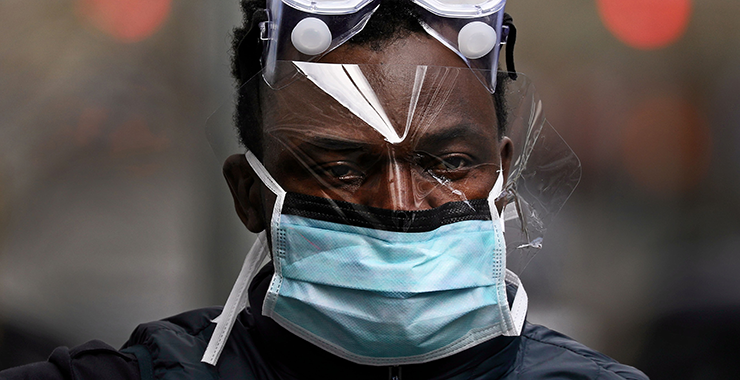
Bridget Boeckman remembers the sinking sensation she felt in early March as she sat in her living room watching the television coverage coming out of Italy. COVID-19 was overwhelming the Italian health-care system and racking up an alarming death toll. As a nurse practitioner and the supervisor of the critical care advanced practice providers at Nebraska Medicine in Omaha, she knew she had to prepare her 32-member team for the virus’s impact on their medical facility.
“My team is used to dealing with emergencies, but I was concerned that they could become completely overwhelmed by the magnitude of the pandemic and prolonged duration of our response,” Boeckman says. “I knew our caseload would increase exponentially and we could potentially face ethical situations, including having to triage scarce resources like ventilators. I decided to seek support for my staff early on.”
Boeckman did not have to look far. Psychologists and other behavioral health professionals at her hospital, part of the University of Nebraska Medical Center, had already developed peersupport and resilience workshop programs to help all 8,000 employees deal with mental health issues during a crisis, such as a pandemic. Peer support is provided by telephone or audiovisual connection.
“We have 120 behavioral health professionals trained in providing one-on-one peer support using a psychological first aid model,” says David Cates, PhD, the director of behavioral health at Nebraska Medicine, who helped implement the peer-support program. “We are not providing therapy sessions. Rather, we are letting our medical professionals know that we are here to listen to them, provide guidance and support, and teach evidence-based ways to cope with stress during a crisis.”
Identifying symptoms
Boeckman, who is now treating patients diagnosed with COVID-19, says the resilience workshop taught her how to identify when she or her colleagues are stressed. These signs can include flashes of anger, sadness and anxiety. Cates provided Boeckman and her team with techniques to help cope with the stress of the crisis.
“The training is also part consciousness raising,” Boeckman says. “It’s good to know other people are struggling with feelings like self-doubt, anticipatory anxiety and depression. At the same time, we must remember that chronic stress can manifest itself in a variety of ways. One person might get angry and another might start crying.”
The resilience workshop includes a “resilience road map” that front-line providers complete during the workshop to spot potential stressors and identify techniques to cope with them. The team’s peer-support and resilience workshop programsopens in new window were developed to be quickly implemented by psychologists at other institutions.
At the epicenter
Nebraska Medicine is not alone in its outreach to medical professionals. Across the country, psychologists are employing similar techniques as they counsel health-care professionals.
At the Icahn School of Medicine at Mount Sinai in New York City, Gregory Hinrichsen, PhD, ABPP, is working with some of the most vulnerable patients and their caregivers in a city that has been hit hard by the virus. As a psychologist working in geriatrics and palliative care, many of his patients are in their 80s. Hinrichsen says the medical professionals working with these patients are under enormous pressure, so he launched a program to provide them with emotional support.
As part of the plan, he has established a standing Zoom meeting with staff each week. He also sent an email to all geriatrics medical staff inviting them to schedule an individual peersupport conversation with him via phone or Zoom. These conversations give people the opportunity to share their concerns about providing care to patients during the COVID-19 pandemic. Hinrichsen says his colleagues are responding favorably to the emotional support.
“I recently asked a doctor how she was doing,” he notes. “She turned to me with this smile on her face and told me that she asks that question of people all day, and it was so nice to finally have someone ask her how she’s doing. Our health-care workers have to keep up a brave front, but underneath it all, they suffer, too.”
Caring for medical residents
While Hinrichsen is working with medical personnel serving older adults in New York City, in Michigan, Molly Gabriel-Champine, PhD, joined forces with six of her colleagues at McLaren Health Care system to provide emotional support to another group of health-care workers: medical residents. “Our residents face unique pressures,” she says. “They are colleagues, but they are also trainees who have to maintain a rigorous schedule, serve on the front line of patient care, and continue to perform at a certain level in order to finish their programs. That could certainly lead to a feeling of helplessness, so we wanted them to have access to the behavioral health resources they need.”
Gabriel-Champine’s group launched an online platformopens in new window with videos providing relaxation techniques, advice on how to improve sleep and information on how to deal with emotions, among other topics. The site is partially open to the public, with a section dedicated exclusively to staff within the McLaren system.
The online platform includes a psychological questionnaire that allows medical professionals to determine whether they should seek additional help. The questionnaire asks people about their experiences with anxiety, depression, post-traumatic stress disorder (PTSD) and substance use.
Support is also offered through webinars that occur three times a day, three days a week. Psychologists take turns hosting Zoom sessions, with the host choosing topics to explore. Those needing additional support can meet with mental health professionals inside or outside the McLaren system.
Serving as a bridge
It is important that the leaders at medical centers have the help they need to support their staff, say Susan McDaniel, PhD, and Lauren DeCaporale-Ryan, PhD, both of whom work as psychologists in the University of Rochester Medical Center (URMC) system helping hospital administrators as they communicate with staff during the crisis.
“Our administrators have a lot of balls in the air right now, so it is important for psychologists to help them provide a supportive and nurturing atmosphere for clinicians serving on the front lines,” says McDaniel. “That means sending kind notes of appreciation to staff or providing treats, such as cookies, to help everyone feel appreciated for their incredible contributions.”
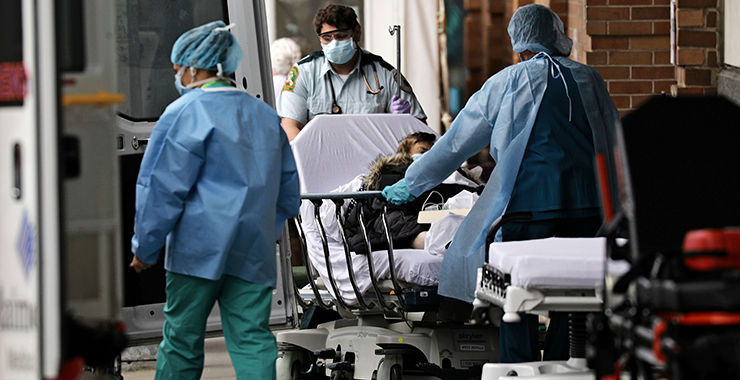
The URMC system has embedded psychologists in eight departments, and psychologists regularly attend departmental and leadership meetings.
“Attending these meetings allows us to take the pulse of our health-care staff,” says DeCaporale-Ryan. “That gives us a sense of how to address any symptoms of stress, anxiety or depression.” McDaniel and DeCaporale-Ryan both emphasize that communications to health-care professionals should be short and to the point to accommodate their busy schedules. McDaniel created a newsletter called “Breath of Fresh Air,” which is distributed regularly and has brief inspirational stories, links to music and comedy, and quick tips for self-care.
The URMC system has also set up regular Zoom check-ins with health-care staff as well as attending physicians, and ones for residents in each clinical department. There is also a URMC call line staffed primarily by psychologists for those who need additional counseling.
Preparing for the aftermath of COVID-19
Psychologists are also emphasizing that the mental health issues they are seeing now will continue and that the health-care field should plan to work with many people dealing with sympathy fatigue, PTSD and other mental health issues.
“Clinicians need to start preparing now for the onslaught of mental health issues that will arise once this crisis is over,” says Jennifer Todd, DrPH, APA’s assistant director of interprofessional continuing education. “We need to make sure that clinicians have the latest information on treating PTSD, depression and trauma.”
Here are some steps clinicians can take to prepare:
- Read APA’s Clinical Practice Guideline for the Treatment of Posttraumatic Stress Disorder.
- Access APA’s arsenal of information related to providing treatment during this time of crisis.
- Seek resources through a state, provincial or territorial psychological association.
- Check out APA’s Office of Continuing Education in Psychology, which is providing information to help psychologists prepare for engaging in telehealth.
“It is also important for psychologists to monitor their own mental health needs,” Cates says. “To truly help others, we must first follow our own advice.”