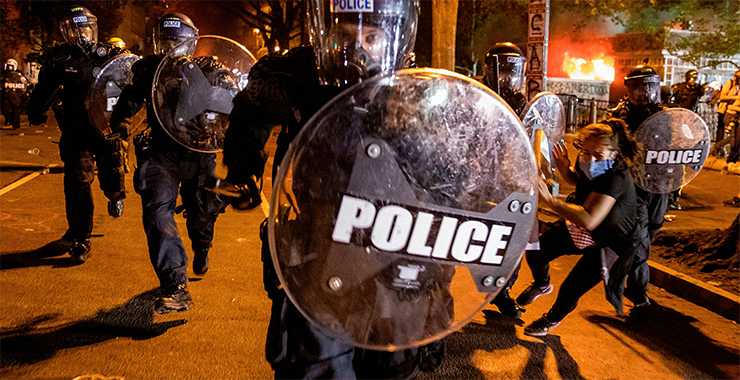
When the Las Vegas Police Department applied a psychology-informed “hands off” policy for officers involved in foot chases, use of force dropped by 23%. In Seattle, officers trained in a “procedural justice” intervention designed in part by psychologists used force up to 40% less. These are just a few examples of the work the field is doing to address police brutality.
“There’s much more openness to the idea of concrete change among police departments,” says Joel Dvoskin, PhD, ABPP, a clinical and forensic psychologist and past president of APA’s Div. 18 (Psychologists in Public Service).
That shift is backed by support from the public. Since 2016, the share of Americans who say that police use the right amount of force, treat racial and ethnic groups equally and hold officers accountable for misconduct has declined substantially, according to the Pew Research Center ( Majority of Public Favors Giving Civilians the Power to Sue Officers for Misconductopens in new window , 2020).
Psychologists have already played a critical role in the reform process—from collecting data on biased police stops, searches and use of force to designing and delivering interventions that reduce the chances that police will rely on stereotypes, for instance by limiting the amount of discretion officers have during searches.
Now, psychologists are promoting those interventions to more police departments, conducting research to determine how well they work and continuing to collect and organize data on police behavior and department culture.
“Criminal justice—police, courts, prisons—has been called an evidence-free zone,” says Tom Tyler, PhD, a professor of psychology at Yale Law School and an expert in the psychology of justice. “People in positions of power tend to make policy decisions based on intuition and common sense—presumptions that we as psychologists recognize are often in error.”
“What’s really needed is an evidence-informed model of criminal justice,” he says. “And a lot of that evidence can come from psychologists.”
Psychological research in action
In 2015, President Obama’s Task Force on 21st Century Policing reviewed scientific data on policing, recommending major policy changes at the federal level to improve oversight, training, officer wellness and more (Final Report of the President’s Task Force on 21st Century Policingopens in new window, 2015).
Federal efforts have slowed in recent years, with most changes happening at the local level. But with around 18,000 police departments nationwide, that response has been fragmented and inconsistent (National Sources of Law Enforcement Employment Dataopens in new window, Bureau of Justice Statistics, 2016).
Still, psychologists have forged ahead with efforts that are making a difference. One key contribution involves spurring policy changes and interventions based on psychological insights.
“One of the most influential approaches coming from psychology is training in procedurally just policing,” says Calvin Lai, PhD, an assistant professor of psychological and brain sciences at Washington University in St. Louis.
That approach aims to increase the public’s trust in police by drawing on psychological research on justice and fairness. It involves teaching officers strategies such as explaining to citizens why they’ve been stopped and how it will benefit public safety ( Principles of Procedurally Just Policingopens in new window , The Justice Collaboratory at Yale Law School, 2018).
“We know that the policing model of using force to compel compliance lowers the crime rate but does not build trust,” says Tyler, who has developed and studied models of procedurally just policing. “The crime rate has declined about 75% in the last 30 years, but public trust in the police hasn’t increased at all.”
His research has shown that what community members really want is for police to treat them with respect and to give them a voice—a chance to explain their situation before action is taken. People also want to know that police are sincere, care about the well-being of their community, and act in an unbiased and consistent way—for example, by explaining the rules they use and how they’re applying them.
A study in Seattle randomly assigned officers to receive training in procedurally just policing, leading to a reduction in use of force of between 15% and 40%, depending on the situation (Owens, E., et al., Criminology & Public Policy , Vol. 17opens in new window , No. 1, 2018).
“It seems to be doing what we’d hope in terms of promoting better relationships between police officers and community members,” says Lai.
The Center for Policing Equityopens in new window (CPE), led by psychologist Phillip Atiba Goff, PhD, of Yale University, has also led a number of psychology-driven policy changes in police departments around the country. In an effort to cut down on high-adrenaline encounters—where police officers are more likely to rely on stereotypes—Goff urged the Las Vegas Police Department to bar officers involved in a foot pursuit from handling suspects when the chase ends. The policy led to a 23% drop in use of force at the department, an 11% reduction in officer injury and a simultaneous drop in racial disparities in use of force data. CPE has also pioneered efforts to recruit racially and ethnically diverse officer candidates and to make immigration enforcement more consistent.
Another key area that psychological interventions target is implicit bias, which has been documented across a range of domains and populations (State of the Science: Implicit Bias Reviewopens in new window, Kirwan Institute, 2017). One study led by Jennifer Eberhardt, PhD, professor of psychology at Stanford University, reviewed body camera footage and found that police officers in Oakland, California, treated Black people with less respect than whites (Voigt, R., et al., PNASopens in new window , Vol. 114, No. 25, 2017).
Eberhardt and others, including Lorie Fridell, PhD, a professor of criminology at the University of South Florida, have designed and begun to deliver training programs on implicit bias to law enforcement agencies around the country (“Producing Bias-Free Policing: A Science-Based Approachopens in new window,” Springer Publishing, 2017).
Those programs, which typically mix instruction, discussion and role-playing, aim to help agencies reduce high-discretion policing and hold officers accountable for biased practices. But there’s no standardized curriculum—and experts say more research is needed to determine whether implicit bias training has a lasting impact and how such training can work alongside other agency reform efforts.
“There seem to be some forms of training that are effective, but the studies on these interventions are still pretty limited,” says Lai. “We just don’t know that much one way or the other.”