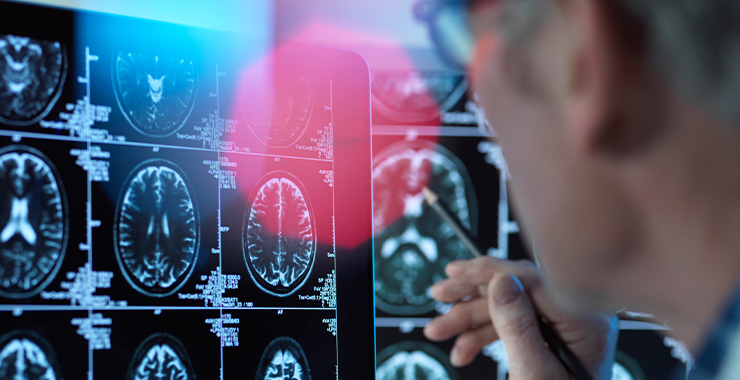
As the COVID-19 pandemic rocketed around the globe, it quickly became clear that this was not your average respiratory illness. The disease appears to affect a number of body systems, including the heart and the brain. Early on in the pandemic, there came reports that many people with the disease had lost their sense of smell, a curious symptom suggesting the virus may affect the nervous system. As more people became infected, accounts of strokes and other neurological complications started coming in. (For more on the possible disease processes involved in these neurological complications, see Multiple disease processes below.)
“There’s documented evidence that patients who are hospitalized with moderate and severe COVID-19 experience a range of neurological, cognitive, psychological and psychiatric symptoms—and I’ve seen them myself,” says Robert Stevens, MD, FCCM, a physician in the intensive care unit (ICU) at Johns Hopkins Medicine who treats patients with critical neurological illnesses. “Virtually all the COVID-19 patients I’ve treated in the ICU have delirium.”
It’s not yet clear how common neurological side effects are in hospitalized patients, let alone in people with less severe respiratory symptoms who don’t spend time in hospitals. “The picture is still evolving,” Stevens says.
In a review of case reports from 901 COVID-19 patients, Mark Ellul, at the University of Liverpool, and colleagues reported a range of neurological manifestations, including loss of smell and taste, confusion, encephalitis (inflammation in the brain), and Guillain-Barré syndrome (a disorder in which the immune system attacks the body’s nerves) (The Lancet Neurologyopens in new window, published online, 2020). A case report of 58 patients from France described neurological findings in 67% of patients (Helms, J., et al., The New England Journal of Medicineopens in new window, Vol. 382, No. 23, 2020).
The prevalence of neurological problems remains an open question, but it’s safe to conclude that “neurological problems are not rare for COVID-19 patients,” says Majid Fotuhi, MD, PhD, medical director of NeuroGrow Brain Fitness Center and lead author of a comprehensive review of COVID-19’s effects on the nervous system (Journal of Alzheimer’s Diseaseopens in new window, Vol. 76, No. 1, 2020). “Our best estimate so far is that 30% to 50% of hospitalized patients have neurological issues,” he says.
In their review, Fotuhi and his colleagues describe the variety of neurological complications in patients with COVID-19. “There’s a wide range of symptoms, including headaches, dizziness, weakness, confusion, eye movement problems, seizures and paralysis,” he says. “The two most common neurological problems seem to be stroke and delirium.”
In general, people who experience more serious symptoms of COVID-19 tend to have more brain-related complications, Fotuhi says. “Broadly speaking, the sicker they are, the more neurological issues they have.” But there are exceptions to that rule. A study by scientists in England of 43 patients with severe neurological complications from COVID-19 found that some patients had relatively mild respiratory symptoms (Paterson, R.W., et al., Brainopens in new window, published online, 2020).
Pandemic neurology: Past, present & future
As researchers continue to gather evidence about COVID-19 and the brain, they’re turning to past epidemics for clues. “The 1918 influenza pandemic was associated with a surge in neurological problems, many of which became apparent months or years later,” Stevens says. The SARS outbreak in 2003 and MERS outbreak in 2012—both caused by coronaviruses similar to the one that causes COVID-19—were also associated with neurological illnesses, including inflammation in the brain. And following each of those outbreaks, Stevens says, “there were reports of people suffering long-lasting neurological injuries.”
Neurology experts are concerned that COVID-19 could leave a similar legacy. But many questions remain, Fotuhi says. “The first step is to document what neurological symptoms occur, at what frequency, and what treatments have or have not affected the neuropsychological symptoms.”
So far, studies of patients with the disease haven’t really drilled down into neuropsychological outcomes, Stevens says. “Trials of antivirals and other therapies being tested to treat COVID-19 are looking at some very coarse outcome measures, like survival or duration of hospitalization. The scientific community needs to include neurological, psychological and psychiatric outcomes as well,” he says.
Experts around the world are working to make that happen. Researchers from 70 sites and 15 countries have registered with the Global Consortium to Study Neurological Dysfunction in COVID-19. The collaborative effort, endorsed by the Neurocritical Care Society, is collecting data and evaluating functional and cognitive outcomes to inform treatment strategies (Frontera, J., et al., Neurocritical Careopens in new window, Vol. 33, No. 1, 2020). But physicians shouldn’t wait until all the data are in to start intervening, Stevens suggests. Existing therapies are available to treat autoimmune encephalitis, for example. “But these haven’t yet been studied specifically in COVID-19 patients,” he says.
The faster such treatments are tested, the better, Stevens adds, since some of the brain damage from COVID-19 may be irreversible. But Fotuhi is hopeful that for some people, interventions may restore brain function. “Targeted brain training may be able to address specific cognitive symptoms, such as difficulty with executive function or memory,” he says. “I think there will be a great need for psychologists to get involved, to help patients recognize their symptoms and seek treatment for them.”