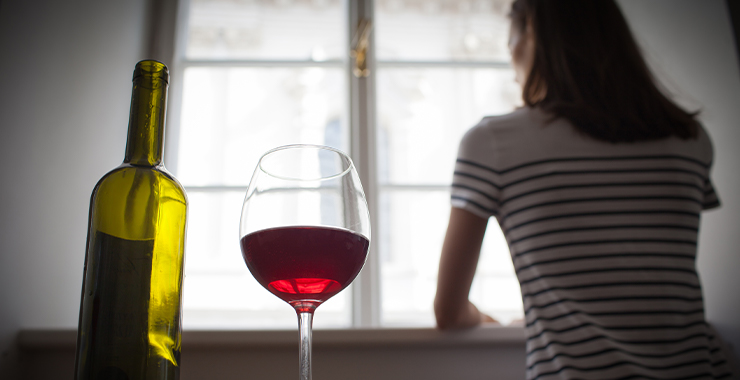
The pandemic’s uncertainty and stress, combined with disrupted routines, may have encouraged some people to progress into heavier drinking habits, along with undercutting efforts to remain sober, though it’s still too soon for much peer-reviewed data, psychologists say.
Potential stressors that can foster more reliance on alcohol are nearly ubiquitous these days—from financial insecurity to juggling work and childcare from home to protests and racial unrest. Alcohol misuse also boosts the chance of contracting the virus, as it can impair the body’s immune system, according to the National Institute on Alcohol Abuse and Alcoholismopens in new window (NIAAA), and people with substance use disorders are both more likely to develop COVID-19 and experience worse COVID-19 outcomes (Wang, Q., et al, Molecular Psychiatryopens in new window, 2020). There’s also the risk that people are more prone to let their guard down about distancing, hand-washing and other safety protocols while under the influence, psychologists say (see Drinking and pandemic safety during the pandemic).
Prior studies conducted in the wake of traumatic events, such as hurricanes and other natural disasters, indicate that some people are likely to escalate their drinking, possibly as a coping mechanism related to stress, says Laura Kwako, PhD, a clinical psychologist and a health scientist administrator at NIAAA. But amidst the pandemic, some of the limitations placed on social gatherings also may have changed up routines in beneficial ways, she says. “If people were mostly going out to bars and restaurants, it’s likely that their consumption would decrease during that time simply because they’re not doing those things anymore.”
Early survey data from several countries, including the United States and Canada, indicate a mixed picture, Kwako says. The percentage of people reporting binge drinking—more than four drinks in two hours for men and three for women—increased from 22% in February to 27% in April, according to North Carolina-based Research Triangle Institute Internationalopens in new window, which surveyed 993 people, including 555 who reported drinking in February. Overall, 31% of respondents reported drinking alcohol more frequently while 21% reported drinking less frequently.
Psychologists can help patients by not only asking about alcohol consumption regularly, but also by teaching motivational, cognitive behavioral, and other techniques for cutting back or trying to stay sober, say Kwako and others. While in-person Alcoholics Anonymous meetings are still rare at the moment, numerous alternatives exist online and through social media, which may be more convenient for people struggling to protect their sobriety during an unsettling time.
Challenges persist amid a pandemic culture rife with references to Zoom happy hours, quarantinis, and in which some states have relaxed restrictions allowing for curbside pickup of liquor and cocktails-to-go from restaurants. Meanwhile, some of the traditional outlets to distract and relieve stress are less available, including spending time with friends and heading to the gym.
While there have been some isolated studies, a clearer picture of how American alcohol habits have been altered likely won’t start appearing in peer-reviewed research until next year, says Denis McCarthy, PhD, who directs the Missouri Center for Addiction Research and Engagement in Columbia. For now, psychologists should try to gain a sense of not only how much a patient is drinking, but the underlying drivers, he says. Broadly speaking, are they drinking to cope with negative emotions and stress or to socialize and celebrate?
“To the extent that people are drinking at home by themselves and to cope with negative emotions, drink for drink they are going to have more problems and it’s going to be less effective in achieving their goals,” McCarthy says. “And at least early in the pandemic, that was pretty much all of the drinking that was happening.”
Risky drinking
Ideally, all patients in therapy should be asked about alcohol consumption, but especially those who are seeking help for anxiety or depression, McCarthy says. “If there is one question that I’d ask people it is, ‘How much has the pandemic changed your drinking pattern?’”
Psychologists can use a number of brief screening tools, such as the Alcohol Use Disorders Identification Testopens in new window, to gain a quick snapshot of a patient’s consumption, says Adam Leventhal, PhD, an addiction psychologist who directs the University of Southern California Institute for Addiction Science in Los Angeles. Another approach is to ask individuals who drink to start logging when they consume and how much, so they are realistic about their own patterns, he says.
If they are progressing toward heavier consumption, the psychologist can work with the patient on a commitment to dial back, for instance deciding to drink no more than twice weekly or no more than one drink each night, he says.
If patients stick with that commitment, that indicates they can control their drinking, and have decreased their consumption in the process, Leventhal says. “But if they break that, that’s a sign that they may have an alcohol use problem,” he says.
As the pandemic continues, Leventhal worries that without intervention, some previously light drinkers may engrain riskier habits. “The longer the period of time that the brain is exposed to higher levels of alcohol more frequently,” he says, “the more the neuroadaptations take place, including brain changes that drive addiction.”
People may assume that they’ll be able to return to their prior patterns once viral fears fade, Leventhal says. “But it isn’t so easy. Over these months the brain has already changed, and it’s not like a simple habit change.”
Cutting back or pursuing sobriety
To some degree, the inherent constraints of pandemic life can assist people who are trying to reduce or eliminate alcohol, says Katie Witkiewitz, PhD, an addiction researcher and professor in the psychology department at the University of New Mexico in Albuquerque. Access to bars is more limited, and going out anywhere is a bigger deal, Witkiewitz says. She’s spoken about the sober-curious movement—in which people opt for a personal break from alcohol consumption sometimes for a month and sometimes longer—on APA’s Speaking of Psychology podcast.
Because people are already not leaving the house a lot and when they do, they have to mask up, there are fewer obvious opportunities to drink, she says. “You’re not stopping at the bar or the liquor store on the way home from work.”
Still, the movement of many AA meetings to online only poses challenges, Witkiewitz says. Not only do they block off this lifeline to support and continued sobriety for those without the necessary technology, but the online format itself can be more limiting.
“Like all of the ways that virtual is not quite as great as real life, there isn’t that informal chatting that can happen before and after meetings,” Witkiewitz says. “That really provides opportunities for connection and social interaction.”
NIAAA provides an online treatment navigator toolopens in new window designed for people seeking help, including medication options, Kwako says. Psychologists can teach numerous techniques via telehealth, from mindfulness-based stress prevention to cognitive behavioral therapy, tailoring the approach to each patient’s circumstances and home environment, she says. They also can incorporate motivational enhancement therapy to help patients create a practical plan to change their drinking behavior, think through potential barriers in advance, and develop drink refusal skills.
For instance, the patient could identify a stressful scenario that typically spurs the desire to drink and then brainstorm a handful of things they could do instead, Kwako says. That list may include ideas such as meditating for five minutes or texting a friend, she says.
Another approach that psychologists can teach is urge surfing, in which people ride out the urge to drink by focusing on their breathing, Witkiewitz says. The breathing practice provides a pause, allowing the patient to consider what they might want in that moment instead of alcohol, whether it’s personal connection with someone else, sleep, or relief from boredom, she says.
Even if the patient still succumbs to pouring a drink, she says, “they get more awareness of themselves and their reasons for drinking, and more awareness of their relationship with alcohol.”
Above all, Witkiewitz suggests that psychologists grant themselves and their patients some grace at a time when the structure and rhythm of everyone’s lives have been upended.
“Slips are more likely to happen right now,” Witkiewitz says. “That doesn’t mean that your recovery is lost. You can get back on track now, just like you can get back on track at any other time.”