Now that many colleges and universities have pivoted to online learning for the first full academic year of the pandemic, psychology instructors are faced with an ongoing challenge: finding new, sustainable ways to connect with their students through screens.
Some professors had taught online before the pandemic, while others had never logged into a learning management system like Blackboard or Canvas. But all psychology teachers have one thing in common: They’re juggling their own stress alongside their students’.
Teaching any subject and academic level comes with unprecedented challengesopens in new window, including exhaustion and burnout. “This is the hardest I’ve ever worked in my academic career, getting my three classes organized and running online,” says Jane Halonenopens in new window, PhD, a psychology professor at the University of West Florida. “All the while dealing with the fact that my students were weirded out by the pandemic while all of us were weirded out, too.” Even amid the challenges, professors say some of their new pandemic teaching methods are working so well—such as using text messaging threads to keep students engaged on a discussion topic—that they will become a permanent part of the post-pandemic curriculum and inform the way they run their classes from now on. Here’s what instructors say they will continue to do long after the pandemic is over.
Make classes interactive
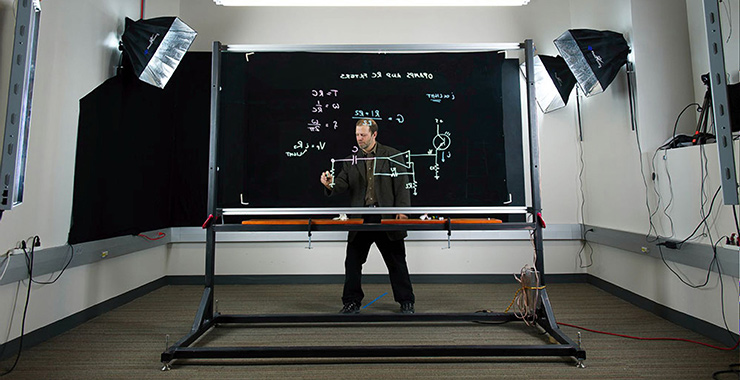
Before COVID-19, Andrew Ainsworthopens in new window, PhD, a professor at California State University, Northridge, wanted to make his statistics classes more interesting. So, with a graduate student, he dreamed up a way to keep students better engaged by using lightboard tutorials, which he had planned to post to YouTube as a resource. Lightboards are like glass chalkboards with lights that cause neon markers to glow, allowing instructors to face their students while writing and teaching.
Then the pandemic arrived, and instead of relying on asynchronous YouTube videos, he used the lightboard to teach in real time on Zoom. “This is the closest I can get to a live, in-person classroom,” he says. “My students can see me writing, and I can interact with them directly with facial expressions and hand gestures that help them learn.”
Similarly, Bridgette Martin Hardopens in new window, PhD, an associate professor and director of undergraduate studies at Duke University in Durham, North Carolina, uses interactive, prerecorded videos to keep students engaged. Every video includes multiple choice questions and polls, which Hard applies to the course grade as participation points.
Set specific expectations
In spring 2020, Regan A. R. Gurungopens in new window, PhD, a professor of psychology at Oregon State University, conducted research on the determinants of student success in remote learning (Scholarship of Teaching and Learning in Psychology, in pressopens in new window). One of the biggest indicators of academic success was the match between what students expected and what they experienced in class. So, he sent his students an email at the start of the fall semester to manage expectations: Online learning would present challenges, but he’d be there to help.
Halonen also shared her expectations with students in her first class sessions: “For me what made a difference was to let the students know right off the bat that we’d adapt, and that while I’d keep them informed along the way, I will also screw up.”
Brittany Avilaopens in new window, PhD, a teaching assistant professor at the University of Nevada, Reno, relies on routine to support both her students’ learning and emotional health. She plans every course module the same: Students read some material, watch a video, do a practice quiz, complete an assignment, and compile a summary.
“My students have told me every teacher is doing things differently and they don’t know what to expect,” she says. “Having the same, predictable structure every week helps them prepare and plan.”
Avila also teaches her students coping skills. When her university stopped giving breaks because of remote learning, she gave her students a week off and offered extra credit when students shared what they did to reduce their stress. “I wanted to make sure my students learned everything they needed to, but I also tried to scale back a bit on academics so I could teach them life skills like self-care,” she says.
Create reusable materials
Recording lectures and creating online tests can be time-consuming for instructors accustomed to doing these tasks in person. Jessica L. Hartnettopens in new window, PhD, an associate professor at Gannon University in Erie, Pennsylvania, says she made all the educational content she developed during the pandemic reusable for future courses, even if it took more time to execute.
“I tried not to teach like this was a temporary situation,” she says. “So, I took all the opportunities I could to do my future self a favor, even if it’s a little more work.”
That could be as simple as keeping video lectures timeless by not dating them, such as by saying “I can’t believe it’s already been a month of remote learning.” As another time-saver for her future self, Hartnett created large banks of test questions that could be graded automatically in her university’s learning management system.
Hard took the same approach when creating her interactive videos, with the goal of using them as a foundation for her course curriculum even after the pandemic. She plans to use the recordings for future online versions of her course and as a tool for enhancing in-person learning. “I may split my class into two groups and rotate them, where some watch the video and some come in for a smaller live lecture with me to be more hands-on with discussions and activities,” she says. “Having these recordings gives me more freedom to experiment in the future.”
Take advantage of support
Advice and encouragement from peers can always enhance one’s teaching and help improve one’s response to a new challenge, including online learning. Anna Roppopens in new window, PhD, a professor at Metropolitan State University of Denver, says many psychology instructors have banded together on Facebook groups throughout the pandemic to share resources and offer support.
Other instructors, such as Julie Alvarezopens in new window, PhD, a senior professor of practice at Tulane University in New Orleans, received significant help from their institutions, many of which have resources for navigating learning management systems and best practices for teaching online. Early in the pandemic, Tulane asked its Center for Engaged Learning and Teachingopens in new window and Innovative Learning Centeropens in new window to create a training courseopens in new window for instructors on how to pivot to online learning. Alvarez says the curriculum, taught by internal instructional designers and consultants hired by Tulane, prepared her to teach and gave her more empathy for her students. “I spent up to 40 hours a week on assignments and Zoom meetings, which made me realize again how difficult it was to be a student.”
Cultivate community
To keep students connected online, Halonen created smaller “hubs” of students within her class to work together on group projects and discussions, which has helped them feel more responsible for their assignments and stay on task during breakout sessions. “When you feel accountable to a few other people, you step up your game.”
Hard says she conducts drop-in office hours on Zoom to stay connected with her students, and she sees up to a dozen students each time, compared with two or three students during in-person learning. “Sometimes they ask questions about material or want to hear what other questions students are asking,” Hard says. “I also try to ask them questions to learn more about who they are outside of class.”
Focus on what matters
The pandemic has also encouraged many faculty to take stock of what matters most in learning. Lindsay Maslandopens in new window, PhD, an associate professor of psychology at Appalachian State University in Boone, North Carolina, primarily taught through lectures before the pandemic. She now encourages her students to use other resources, like a curated list of psychology videos from other professors on YouTube. “I’ve learned to relax the mode, as long as the learning happens,” she says. “What really matters here? Listening to the same lecture as all the other students or mastering the learning objective?”
One potential concern with online tests is cheating, but Halonen says she tries not to fixate on it. Instead, she has focused on trying to catch student struggles earlier and offering help. “It requires more time, but if you’re doing other things that improve student connections on the front end, you should be able to help them be successful.”
Use technology well
Gurung says another perk that offsets the cumbersome nature of new technology is that online teaching allows him to monitor learning in real time. He uses quick polls during class to gauge whether students grasp a concept he’s teaching. If not, he can take a different approach. Gurung also monitors students’ comments in the chat feature during his Zoom lectures to see what students are interested in and what they’re confused about.
“As I’m talking about a research finding, I can see the reaction to the material,” he says. “It’s the kind of reaction you never get to hear in a large face-to-face class.”
He can also tackle sensitive issues that come up in the chat. When he was teaching about the Clark doll experiments, a student unknowingly made an insensitive racial remark and Gurung was able to address it immediately in an appropriate way that everyone could learn from.
Masland feels similarly: While technology has felt limiting in many ways, it has also offered more opportunities for her students to participate. For example, she teaches a hybrid graduate course that meets both synchronously and asynchronously throughout the semester. The students who raise their hands in the live courses are often different from the ones who participate in the discussion forums. “I was missing out on that in the live-only version of the course, so I want to continue hybrid if possible going forward,” she says.
Make learning manageable
Ropp notes that research suggests that lecture videos of less than 10 minutes are easier to stay focused on than longer ones, so that’s the length she’s created. She says these bite-size videos also make it easier for students to study, since they don’t have to weed through long videos to find what they need.
It’s also helpful, Hartnett says, to make learning materials as accessible as possible, ideally on mobile devices. For example, she posts lectures on YouTube rather than the school’s learning management system so students don’t have to sign in before watching. “Plus, behemoths like YouTube don’t crash with an extra million users like some learning platforms,” she says.
Hartnett also uses the mobile texting app GroupMe instead of a traditional online discussion forum. Not only is the class discussion more accessible, it’s also more casual, which Hartnett says encourages students to participate more. “That’s something I’ll definitely stick with, because it’s how students really talk to each other,” she says. “Why not make life a little easier on everyone, especially for students who don’t have internet or a laptop at home?”
But implementing new education technology doesn’t always go smoothly. For example, on Hard’s first online exam, Duke University’s learning management system glitched for many of her students. “They’d try to click ‘save’ and get an error message and lose a bunch of their work on a timed exam,” she says. “It was so stressful, so we had to come up with work-arounds in case that happened again.”
After landing on a test delivery method with an autosave feature, Hard says she’s come to appreciate online exams and may continue using them after the pandemic. Because they’re conducted open book and open note, she can write more interesting, application-focused questions that deepen students’ learning rather than simply asking students to memorize information.
“If you’re going to make changes, think about changes that make sense,” she says. “Use this as an opportunity to innovate in ways you may have felt a little too lazy to do before.”