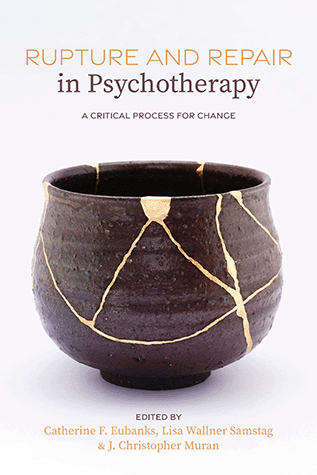
Rupture and Repair in Psychotherapy
Available formats
Also available from
Ruptures in the therapeutic alliance are common. If left unresolved, they can lead patients to drop out, among other poor outcomes.
Repairing therapeutic ruptures is an important process that is relevant for practitioners of all theoretical orientations.
This volume collects the work of 12 teams of scholars and clinicians, each of whom is an expert in a different therapeutic context or theoretical approach, to describe clinical challenges in resolving common therapeutic ruptures.
The authors use case studies to describe realistic, complex clinical examples of rupture and provide strategies and principles therapists can use to help navigate these challenges more successfully with their patients.
As therapists and patients work together their alliance can come under strain, sometimes because of disagreements over therapeutic goals, and sometimes due to a lack of trust and respect. These moments of stress where the relationship has ruptured are challenges, but also opportunities for growth.
Preface
Introduction: Rupture in a Wicked and Wonderful World
J. Christopher Muran, Catherine F. Eubanks, & Lisa Wallner Samstag
- Antioppressive Approaches to Alliance Rupture and Repair: A Critical–Cultural–Relational Model of Rupture Resolution
Doris F. Chang, Maryam Omidi, & Jordan J. Dunn - Alliance Rupture and Repair in Group Psychotherapy
Giorgio A. Tasca & Cheri Marmarosh - A Close Look at the Complex Rupture and Repair Process in Family Therapy
Myrna L. Friedlander & Valentín Escudero - Therapist–Adolescent Therapeutic Ruptures in Attachment-Based Family Therapy
Sophie Cassell & Guy Diamond - Alliance Rupture and Repair in Cognitive Behavior Therapy
Tara Impala, Annika Okamoto, & Nikolaos Kazantzis - Alliance Rupture and Repair in Dialectical Behavior Therapy for Borderline Personality Disorder
Tali Boritz, Sonya Varma, Anne Sonley, & Shelley F. McMain - Alliance Rupture and Repair in Acceptance and Commitment Therapy (ACT)
Robyn D. Walser & Manuela O’Connell - Relational Dialogue in Emotion Focused Therapy: Process Analysis and Comparison With the Alliance-Focused Training Model
James Macdonald, Robert Elliott, & Ana Bela Couto - Alliance Rupture and Repair in Short-Term Psychodynamic Psychotherapy
Allan Abbass & Joel M. Town - Alliance Rupture and Repair in Mentalization-Based Therapy
Peter Fonagy, Chloe Campbell, & Patrick Luyten - Expanding the Rupture Resolution Paradigm: An Integrative Perspective
Sasha Rudenstine, Paul L. Wachtel,Talia Schulder, & Benjamin Bernstein
Conclusion: Don’t Be Afraid to Get Messy: Points of Convergence in Rupture and Repair
Catherine F. Eubanks, Lisa Wallner Samstag, & J. Christopher Muran
Catherine F. Eubanks, PhD, is associate professor of psychology at Yeshiva University. Dr. Eubanks received her PhD in clinical psychology from Stony Brook University and completed a postdoctoral fellowship at the Beth Israel Psychotherapy Research Program, where she serves as associate director and collaborates on research on the therapeutic alliance.
Dr. Eubanks's research interest is the psychotherapy process and outcome, particularly with patients with personality disorder diagnoses. The goals of her research program are to identify therapist skills and characteristics that are linked to effectiveness across various theoretical orientations and to explore how therapists' skills can be enhanced through training.
Lisa Wallner Samstag, PhD, is professor in the Clinical Psychology Doctoral Program at Long Island University and has been a faculty member in the department of psychology since 1999.
Dr. Samstag is author and co-author of numerous psychotherapy research studies and papers, with a particular focus on the development of the therapeutic relationship, including identifying ruptures in the working alliance and other factors that contribute to poor outcome and premature termination. She is the research director and a clinical supervisor in the Psychological Services Center at the Brooklyn Campus of LIU and serves as associate editor/book review editor of the journal Psychotherapy.
Dr. Samstag's specialties include psychotherapy research, clinical research, and developmental research.
J. Christopher Muran, PhD, is associate dean and professor at the Gordon F. Derner School of Psychology at Adelphi University, where he serves as training director for the doctoral program in clinical psychology. Dr. Muran is also principal investigator and director of the Brief Psychotherapy Research Program at Mount Sinai Beth Israel, which has been supported by grants from the National Institute of Mental Health.
Dr. Muran has published extensively on changes in the self and the therapeutic relationship and has presented on the national and international stage. He is a fellow of APA, former editor of the international journal Psychotherapy Research, and past president of the Society for Psychotherapy Research.