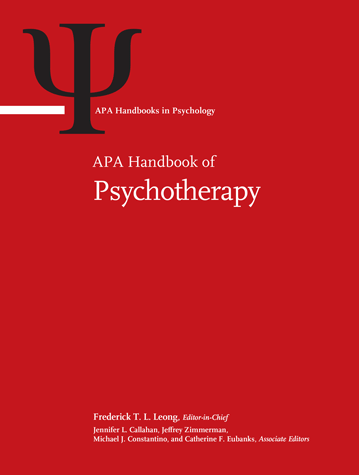
APA Handbook of Psychotherapy
Available formats
Part of the landmark APA Handbooks in Psychology® Series from APA
The 2-volume APA Handbook of Psychotherapy comprehensively presents the field based on the primary ways in which professionals practice psychotherapy and affect such practice through theory, research, and training.
50 authoritative chapters capture the most representative ways in which psychotherapists characterize the driving forces behind their foundational therapeutic approaches. Therapists may:
- Administer psychotherapy according to a specific theoretical orientation, applying this model across most patients and contexts.
- Use a specific, "named" therapy to primarily treat patients suffering from a particular disorder.
- Draw on research evidence to administer psychotherapy in a way that can include, but also transcend, specific theoretical orientations and disorder-specific interventions.
- Generate data and draw on varied forms of research psychotherapy in a participant-driven and contextually responsive manner.
These chapters represent the latest thinking and evidence on the most relevant topics across the "big four" psychotherapy domains of theory, research, practice, and training. All four parts are written for researchers, practitioners, scholars, and trainers, with the major difference among the sections being their emphasis on, and order of, discussing the "big four" elements.
Volume 1. Theory-Driven Practice and Disorder-Driven Practice
Part I. Theory-Driven Practice
Chapter 1. Introduction to Volume 1, Part I: Theory-Driven Practice
Jennifer L. Callahan and Jeffrey Zimmerman
Chapter 2. Psychoanalytic Theory in Psychotherapy
Pratyusha Tummala-Narra and Jonathan Wolff
Chapter 3. Psychodynamic and Relational Psychotherapies
Charles J. Gelso and Kathryn V. Kline
Chapter 4. Existential-Humanistic and Existential-Integrative Theory
Kirk J. Schneider and Louis Hoffman
Chapter 5. Person-Centered Theory in Psychotherapy
Mick Cooper and Gina Di Malta
Chapter 6. Gestalt Therapy: A Contemporary View
Robert W. Resnick
Chapter 7. Experiential Theory in Psychotherapy
Ueli Kramer and Ladislav Timulak
Chapter 8. Emotion-Focused Therapy
Antonio Pascual-Leone and Stephanie Nardone
Chapter 9. Psychotherapy Through the Lens of Contemporary Integrative Interpersonal Theory
Nicole M. Cain, Christopher J. Hopwood, and Aaron L. Pincus
Chapter 10. Exposure-Based and Behavioral Theory in Psychotherapy
Anne N. Banducci, Bryna N. Cooper, Jennifer M. Betts, and Kelsey N. Serier
Chapter 11. Cognitive Theory in Psychotherapy
Keith S. Dobson and Nikolaos Kazantzis
Chapter 12. Couple Theory in Psychotherapy
Jay L. Lebow, Adam R. Fisher, and Sarah E. Swanson
Chapter 13. The Imprint of Systems Theory Upon Psychotherapeutic Process
K. Mark Sossin
Chapter 14. Psychotherapy Integration: History, Current Status, and Future Directions
Jack C. Anchin, Tomáš Řiháček, Jan Roubal, and James F. Boswell
Chapter 15. Constructivist Theories in Psychotherapy
Jonathan D. Raskin and Sara K. Bridges
Chapter 16. Gender and Affectional Orientation: Theoretical Underpinnings of Psychotherapy Practice
Amy E. Ellis
Chapter 17. Cross-Cultural Theories in Psychotherapy
Frederick T.L. Leong
Part II. Disorder-Driven Practice
Chapter 18. Introduction to Volume 1, Part II: Disorder-Driven Practice
Jeffrey Zimmerman and Jennifer L. Callahan
Chapter 19. Anxiety Disorders
Shannon Sauer-Zavala, Matthew W. Southward, and Clair Cassiello-Robbins
Chapter 20. Mood Disorders
Heather A. MacPherson and Eric A. Youngstrom
Chapter 21. Psychotic Disorders
David C. Cicero
Chapter 22. Personality Disorders
Jeffrey J. Magnavita and Barbara L. Ingram
Chapter 23. Eating Disorders
Jessica Van Huysse and Jessica Luzier
Chapter 24. Addressing Substance Use in Clinical Assessment and Treatment
M. Dolores Cimini, Jessica L. Martin, and Laura M. Longo
Chapter 25. Traumatic Disorders
Nnamdi Pole and Lisa Rasco
Chapter 26. Chronic Pain: Psychologically-Based Treatments
Robert S. Meyers
Chapter 27. Sexual Dysfunctions
Marta Meana and Kathryn Hall
Part III. Ethical Considerations and Future Directions in Theory-Driven Practice and Disorder-Driven Practice
Chapter 28. Ethical Considerations of Theory-Driven and Disorder-Driven Practice
Mark M. Leach and Linda Campbell
Chapter 29. Future Directions in Theory-Driven and Disorder-Driven Practice
Jennifer L. Callahan and Jeffrey Zimmerman
Volume 2. Evidence-Based Practice, Practice-Based Evidence, and Contextual Participant-Driven Practice
Part I. Evidence-Based Practice
Chapter 1. Introduction to Volume 2, Part I: Evidence-Based Practice
Catherine F. Eubanks and Michael J. Constantino
Chapter 2. Do Some Theory-Specific Psychotherapies Outperform Others (Relative Efficacy)? A Stepwise Approach to Contextualizing the Results of Randomized Controlled Trials With Direct Psychotherapy Comparisons
Christoph Flückiger and A.C. Del Re
Chapter 3. Are Theory-Specific Treatment Factors Responsible for Psychotherapeutic Change?
Daniel R. Strunk and Samuel T. Murphy
Chapter 4. Are Common Factors Responsible for Therapeutic Change?
Catherine F. Eubanks and Anna Babl
Chapter 5. Do Certain Patients Respond Better to Specific Forms of Psychotherapy?
Wolfgang Lutz, Juan Martin Gómez Penedo, Jessica Prinz, Julian Rubel, and Danilo Moggia
Chapter 6. Can Psychotherapies be Effectively Adapted to Cultural Identity (Fit)?
Alberto Soto
Chapter 7. Responsiveness: Can Psychotherapies and Psychotherapists Adapt Effectively to Participant and Clinical Contexts?
Jeanne C. Watson and Hadas Wiseman
Chapter 8. Evidence-Based Psychotherapy: On What Can We Agree?
Averi N. Gaines and Marvin R. Goldfried
Chapter 9. How Can We Most Effectively Conceptualize and Conduct Psychotherapy According to Evidence-Based Principles? A Consideration of Change Processes, Clinical Choices, and Positions
J. Christopher Muran and Lauren M. Lipner
Chapter 10. What is the Current Configuration of Evidence-Based Psychotherapy? Integrating Common Factors Into Personalized Care
David Kealy and John S. Ogrodniczuk
Part II. Practice-Based Evidence and Contextual Participant-Driven Practice
Chapter 11. Introduction to Volume 2, Part II: Practice-Based Evidence and Contextual Participant-Driven Practice
Michael J. Constantino and Catherine F. Eubanks
Chapter 12. Does Controlled Research on Psychotherapy Translate to Naturalistic Practice Settings (Effectiveness)?
Lily A. Brown, Rachel Schwartz, Nora Brier, Lindiwe Mayinja, and Bridget Feler
Chapter 13. Does Practice-Generated Data Improve Psychotherapy Effectiveness (Routine Outcome Monitoring)?
Robert J. Reese, Barry L. Duncan, and Alyssa L. Clements-Hickman
Chapter 14. Do Therapists Differ in their General Effectiveness? Therapist Effects and Their Determinants
Helene A. Nissen-Lie, Hanne W. Oddli, and Erkki Heinonen
Chapter 15. Therapist Performance Report Cards: Do Clinicians Differ in their Specific Effectiveness?
Alice E. Coyne
Chapter 16. Can We Harness Therapist Effects for Therapeutic Benefit?
Michael J. Constantino and Heather J. Muir
Chapter 17. Do Therapists Get Better With Experience?
Terence J.G. Tracey, James W. Lichtenberg, Rodney K. Goodyear, and Bruce E. Wampold
Chapter 18. What is a Contemporary Patient-Centered Perspective on Psychotherapy Processes and Outcomes?
Joshua K. Swift, Mick Cooper, and Ladislav Timulak
Chapter 19. What are Pathways and Barriers to Implementing Evidence-Based Practice and Practice-Based Evidence in Psychotherapy?
James F. Boswell and Carly M. Schwartzman
Part III. Ethical Considerations and Future Directions in Practice-Based Evidence, Evidence-Based Practice, and Contextual Participant-Driven Practice
Chapter 20. What Are the Primary Ethical Considerations of Evidence-Based Practice and Practice-Based Evidence?
Samuel Knapp, Randy Fingerhut, Michael C. Gottlieb, and Mitchell M. Handelsman
Chapter 21. What are some Primary Future Directions for Psychotherapy Research, Practice, and Training?
Dana Atzil-Slonim
Frederick T. L. Leong, PhD, is a professor of applied psychology at the Chinese University of Hong Kong, Shenzhen, China. Previously, he was a professor of psychology at Michigan State University where he also served as the director of the Consortium for Multicultural Psychology Research. He has authored or coauthored over 300 journal articles and book chapters and edited or coedited 24 books. He is editor-in-chief of the Encyclopedia of Counseling (Sage) and the APA Handbook of Multicultural Psychology (APA). He is the founding editor of the Asian American Journal of Psychology and served as the associate editor of the American Psychologist and the Archives of Scientific Psychology. Dr. Leong is a fellow of the American Psychological Association (Divisions 1, 2, 5, 12, 17, 29, 45, and 52), Association for Psychological Science, Asian American Psychological Association, International Academy for Intercultural Research, and the International Association of Applied Psychology. He is the recipient of the APA Award for Distinguished Contributions to the International Advancement of Psychology, APA Award for Distinguished Service to Psychological Science, Stanley Sue Award for Distinguished Contributions to Diversity in Clinical Psychology from APA’s Division 12, APA Division 45 Distinguished Contributions to Research Award, APA Minority Fellowship Program’s Dalmas Taylor Distinguished Contributions Award, and Leona Tyler Lifetime Achievement Award from APA Division 17.
Jennifer L. Callahan, PhD, is a professor of psychology at the University of North Texas, where she serves as codirector of the Center for Psychosocial Health Disparities Research and director of the Evidence-Based Training and Competencies Research Lab. Dr. Callahan has been awarded more than $7 million in grant funding as PI or co-PI. In addition to multiple awards for quality research (2005; 2020), mentorship (2015), advancement of diversity training in clinical psychology (2022), and community engagement (2022), she has been recognized with the Distinguished Publication of Psychotherapy Research (2012), and the Outstanding Publication in Training and Education in Professional Psychology (2014; 2018). She is the is the current editor-in-chief for the Journal of Psychotherapy Integration and an Associate Editor for the journal Training and Education in Professional Psychology. She is board certified in Clinical Psychology, a fellow of the APA, and President-elect of the international Society for the Exploration of Psychotherapy Integration (SEPI).
Jeffrey Zimmerman, PhD, has been in independent practice for over 40 years. Dr. Zimmerman is a founding partner of The Practice Institute, LLC, which is dedicated to helping mental health professionals build thriving practices. His most recent coedited book (among numerous published books, chapters, and articles) is Bringing Psychotherapy to the Underserved: Challenges and Strategies (2020). Dr. Zimmerman is also the editor of Practice Innovations, the journal of APA Division 42, Independent Practice. In 2004 he received the award for Distinguished Contribution to the Practice of Psychology from the Connecticut Psychological Association. In 2009, Dr. Zimmerman received the ABPP specialty board certification in Clinical Psychology. Dr. Zimmerman is a fellow of APA Divisions 42 and 29. In 2016, Dr. Zimmerman was awarded Distinguished Fellowship in the National Academies of Practice and the Psychology Academy, as a Distinguished Practitioner and Fellow. In 2019, Dr. Zimmerman received the Mentoring Award from Division 42 of the APA.
Michael J. Constantino, PhD, is professor of psychological and brain sciences at the University of Massachusetts Amherst. He has published over 190 journal articles and book chapters, and he has received ample extramural grant and contract support for his research. He is also coauthor of the book, The Essentials of Deliberate Practice: Cognitive-Behavioral Therapy, and coeditor of the book, Principles of Change: How Psychotherapists Implement Research Findings in Practice. Dr. Constantino has received awards from the International Society for Psychotherapy Research, the American Psychological Association’s (APA) Division 29 (Society for the Advancement of Psychotherapy), and the Society for the Exploration of Psychotherapy Integration. Dr. Constantino is also an APA Fellow. He is currently associate editor for Psychotherapy and the Journal of Consulting and Clinical Psychology.
Catherine F. Eubanks, PhD, is professor of psychology at the Gordon F. Derner School of Psychology of Adelphi University. She also serves as associate director of the Mount Sinai-Beth Israel Brief Psychotherapy Research Program. In addition to a number of journal articles and book chapters, she is coauthor of Therapist Performance Under Pressure: Negotiating Emotion, Difference and Rupture and coeditor of Rupture and Repair in Psychotherapy: A Critical Process for Change. Dr. Eubanks is a fellow of the Society for the Advancement of Psychotherapy/APA Division 29 and a previous recipient of early career awards from both Division 29 and SPR. She previously served as an associate editor of the Journal of Clinical and Consulting Psychology and currently serves as coeditor of the journal Psychotherapy Research.