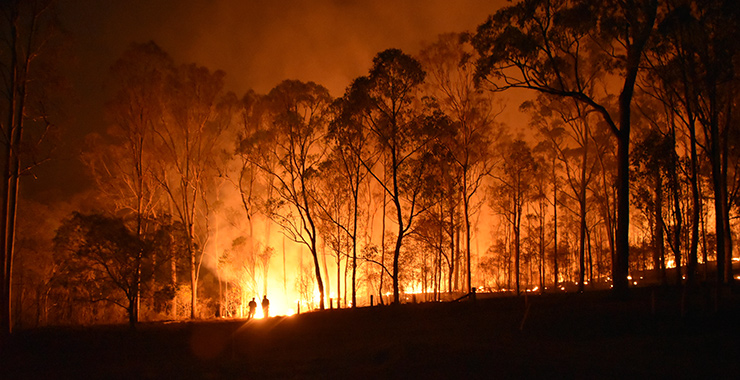

Wildfires, floods, hurricanes, drought, extreme heat, the emergence of new diseases in new places: The planet is undergoing rapid changes that are unprecedented in human history. And as psychologists are increasingly aware, these changes can bring about great stress and mental anguish to all of us living through these challenging times.
“Climate change issues have a significant mental health impact,” says Nancy Piotrowski, PhD, council representative for APA’s Div. 34 (Society for Environmental, Population, and Conservation Psychology). In California, where she lives, weather patterns are being suddenly and drastically disrupted, as the region’s devastating wildfires have shown too clearly. As a consequence of these and other environmental changes, people around the world are learning to live with troubling new stressors such as power outages, water shortages, poor air quality, emergency evacuations, and more.
A key feature of these changes is their ongoing nature, notes Thomas Doherty, PsyD, a practitioner in Portland, Oregon, whose focus is environmental psychology. In the past, he says, calamity would strike—a storm surged and flooded a town, a drought destroyed crops, fires swept through neighborhoods—and then it would end.
But with unfolding, recurring, and new events related to climate change, says Doherty, the damage doesn’t stop. “And that’s really challenging for us.”
Fortunately, clinicians are well positioned to help in these tumultuous times, says Piotrowski. “We know how to deal with anxiety. We know how to deal with depression.” Now, it’s a matter of understanding these common human reactions and finding ways to address and prepare for them, she says.
[Related: How heat affects the mind]
Significant effects
How big a problem is climate change in relation to people’s mental health? An APA survey released in February 2020 found that 56% of U.S. adults said that climate change is the most important issue facing the world today. While people’s focus and concerns have shifted toward the pandemic in the last year, climate issues remain prominent in people’s lives. More than two-thirds (68%) of the adults APA surveyed said they had “at least a little ‘eco-anxiety,’” or anxiety or worry about climate change and its effects. Nearly half (48%) of young adults ages 18 to 34 said they felt stress over climate change in their daily lives. While these changes have been rapid, they have not been surprising: More than a decade ago, The Lancet and the University College London Institute for Global Health Commission called climate change the biggest threat to global health—and mental health in particular—of the 21st century (The Lancetopens in new window,opens in new window Vol. 373, No. 9676, 2009).
Humans have evolved to adjust to some environmental stressors, researchers have found, through allostasis, the system by which the body responds to stress. The fear and uncertainty you feel during your first major storm in childhood, for instance, doesn’t usually stay with you for life. But if those storms keep happening, and growing in intensity, those anxieties are harder to put to rest. The greater the stressors and the longer we are exposed to them, the more likely our response systems are to fail—and those stress responses may remain elevated for the rest of our lives (Crews, D. E., et al., Annals of Human Biologyopens in new window , Vol. 46, No. 1, 2019). Researchers comparing meteorological data with surveys of nearly 2 million Americans over the course of 10 years found that higher temperatures, more rain, and more frequent and intense tropical cyclones all correlated with worsened mental health (Obradovich, N., et al., Proceedings of the National Academy of Sciences opens in new window , Vol. 115, No. 43, 2018). These reactions can take the form of anxiety, stress, depression, violence, aggression, and the loss of community identity, other researchers have found (Trombley, J., et al., American Journal of Nursingopens in new window , Vol. 117, No. 4, 2017).
Researchers and others have coined specific terms to help define the intersection between mental health and climate change, though they are not and should not be official mental health diagnoses. In 2017, for example, APA and ecoAmericaopens in new window defined “eco-anxiety” as “a chronic fear of environmental doom” (APA and ecoAmerica, 2017).
Meanwhile, Ashlee Cunsolo, PhD, researches what she terms the “ecological grief” of Indigenous peoples in northern Canada who are watching their homeland morph and slip away before their eyes ( Nature Climate Changeopens in new window , Vol. 8, 2018). And in 2005, environmental philosopher Glenn Albrecht, PhD, coined the term “solastalgia,” which he defined as “the homesickness you have when you are still at home” because the land has become unrecognizable ( PAN: Philosophy, Activism, Nature opens in new window , Vol. 3, 2005).
It’s not just those directly affected by a disaster who suffer. Often, simply knowing that others are in the path of disaster can trigger anxiety or depression, says Amy Lykins, PhD, an American clinical psychologist and researcher working in Australia and in South Pacific islands such as Fiji. She calls it an “existential fear” facing many of us “who may not necessarily have been directly impacted by flooding or had to run for their lives from bushfires but are aware of what’s going on in the world.”
And there are troubling differential effects of climate-related disasters on different communities, says Derrick Sebree Jr., PsyD, a clinical psychologist and core faculty at the Michigan School of Psychology, who focuses on systemic racism and climate justice. For instance, pollution-generating manufacturing plants or processing centers are more likely to be in and to affect communities of color, and these communities have not had the power to speak out against these practices. Changes in climate are similarly affecting marginalized communities more often and more severely. And around the world, those who have contributed the least to the drivers of climate change are the ones who suffer the most from its effects. Clinicians need to be mindful that this “alarming historical trend” of environmental injustice continues today, Sebree says. “Clinicians must be aware that we have patients who are disproportionately affected and need our support,” he says.
Using what you have
Although addressing the effects of climate change on people’s mental health may seem daunting, psychologists already have important tools to help, Piotrowski says. Clinicians “can leverage off of what we already know from treating anxiety and depression and trauma” to address reactions to climate change, she says.
Most of clinicians’ existing skills are “totally appropriate” for addressing climate change concerns, Doherty adds. Cognitive behavioral therapists can use their knowledge of people’s thinking patterns—the tendency to overworry or catastrophize the significance of a problem, for example—to help people mitigate their responses to climate change. Meanwhile, psychodynamic or depth therapists can help patients make deeper connections between themselves, their behavior, and the environment. Physical or somatic therapists can encourage people to relax, become more mindful, and reduce stress physiologically in the face of environmental stress. Still other therapists may focus on spirituality, feminism, or social justice.
Diagnosing conditions brought on by environmental issues is like making any other mental health diagnosis, such as anxiety or depression, practitioners say. After all, there is no diagnosis of “climate anxiety”—only “anxiety.” Climate change is simply one context for a person’s reactions. The same tools for assessing a person’s distress and how much it impacts their life, such as adjustment disorder criteria, apply when the stressors are environmental.
It is normal for people to be worried about environmental issues—it isn’t a disorder to be stressed by stressors. “We certainly don’t want to pathologize someone’s reasonable distress about climate and environmental threats,” Doherty says. “But we also don’t want to minimize issues that are causing significant impairment to a person’s life.” When worries and fears begin manifesting as anxiety or depression, clinicians can help patients develop long-term strategies to cope in healthy ways. “When working with patients, we’re really looking at the whole picture; it’s not just about climate anxiety or climate grief,” says Zoey Rogers, PsyD, a postdoctoral fellow in Seattle, Washington, and the former student chair of APA’s Div. 34. “This actually allows us to tap into underlying issues and internal structures and attachment issues that we do see with diagnoses.”
Addressing environmental concerns
There are several different ways to address people’s concerns about environmental dangers, Doherty says. An important first step is assessing how (or whether) a person is affected by these concerns. “One of the basic environmental identity assessment measures is just two circles: one that says ‘nature,’ and one that says ‘myself,’” Doherty explains. The patient decides the degree to which those circles overlap. For some, the circles may be separate; for others, they may overlap completely. Understanding how closely patients view the relationship between themselves and the environment will inform therapeutic approaches.
Clinicians can also include environmental concerns on the list of questions they regularly ask patients, Piotrowski suggests. What is their relationship to the environment? Do they have concerns about the state of the world or the planet? How have they been affected by naturally occurring events and disasters? How do they cope with them? How might climate change affect their plans for the future, from choosing a home to deciding whether to have kids? Providers can keep those answers in mind and refer back to them when appropriate. The questions can also signal a willingness from practitioners to talk about these issues, which have sometimes been politicized.
Clinicians can then work on developing a case conceptualization to understand the etiology of the issue and determine how these concerns fit into the person’s larger life story and how cultural, socioeconomic, and other factors may play a role.
Practitioners also need to understand their own histories and perspectives on climate change, Doherty says. Building a better understanding of the issues at stake, and the responses they spur in people, helps you take patients’ concerns seriously and address them appropriately. Not everyone needs to become an expert on these issues, he adds—simply having a basic competency goes a long way.
The bigger picture
Of course, addressing climate change concerns is not confined simply to gaining insight. Clinicians can also play an important role in encouraging patients to take action, experts say. According to the February 2020 APA poll, 4 in 10 people have not changed their behavior in light of climate change, but 7 in 10 say they wish they could do more, while 5 in 10 say they don’t know where to begin. Other research bears this out: Even when people are concerned about climate change and the environment, they may feel paralyzed or useless when it comes to taking action (Landry, N., et al., Journal of Environmental Psychology opens in new window , Vol. 55, 2018).
Recognizing a threat but not knowing what to do about it can make people feel even more helpless, which can lead to increased stress and anxiety, experts add. Likewise, avoiding discussions about it facilitates inaction, and psychologists can help with that, too, says Rogers. “For a lot of people, it’s too scary to actually sit with those feelings,” she says. “Facing our grief and despair doesn’t make the feelings go away, but it may help us place them within a larger context that gives it different meaning.”
People may feel particularly helpless in the face of ecological catastrophes, Sebree says. “After a big disaster, sometimes just the idea of being out in nature for people is hard, if it feels like this is dangerous,” Sebree says. Encouraging people to work through their trauma and regain control can help—including connecting with nature in positive ways, he says.
Educating patients about specific actions they can take is another valuable tool to help increase their efficacy and engagement in public discussions, research finds (Geiger, N., et al., Journal of Environmental Psychology opens in new window , Vol. 51, 2017). Clinicians offering a safe space for patients to share concerns and feelings can segue into discussions about taking action. That may include anything from private actions to make yourself feel better, like going on a hike or going camping; to public actions, like supporting causes and working in your community; to higher-level advocacy and activism to change policies.
“We want to make sure people don’t overmagnify things to the point where they feel like they can’t do anything,” Piotrowski says. Practitioners can help people “break the problem up so that there are smaller pieces that they can be working on.”
Given the emotional weight of the topic, helping your patient take any action is a positive step, adds Lykins. That can be as simple as taking a break from the news, or just putting their head on their pillow at night and saying, ‘Well, I tried my best today,’” she says. Other individual actions might include eating less meat, using clean energy at home and on their commute, joining public protests, and writing letters to elected officials.
That said, there are limits to personal responsibility. If the streets in your city need repair, for example, “I don’t expect you to get a shovel and fix the potholes yourself,” Doherty says. “Climate change is similar. We need to get our leaders and our systems to work on these things.” It’s important for psychologists to remind patients that they can’t fix everything on their own, which can help release some of the burdens they carry, he says.
For some, the solution might be taking less action, Doherty points out—especially for those who are burned out. Activists and climate scientists are at increased risk of this. Susan Clayton, PhD, a professor at The College of Wooster in Ohio and member-at-large of APA’s Board of Directors, found that climate scientists are particularly vulnerable to environmental anxiety and depression “because they are immersed in depressing information and may face apathy, denial, and even hostility from others. But they also have sources of resilience,” including many of the actions discussed here ( Nature Climate Change , opens in new window Vol. 8, Issue 4, 2018).
Unfortunately, the climate crisis shows no sign of abating. Because these disruptions will continue and likely worsen, it’s important for clinicians to develop these types of long-term strategies, Piotrowski says.
“When you have something like this that’s more likely to be chronic, that’s more likely to be a fixture across the lifetime—that’s where there needs to be some sort of a more systematic way of helping people engage around checking in with themselves and getting help for these kinds of issues around anxiety and depression,” Piotrowski says. “This is probably going to be something we’re all going to be working on in one way or another as long as we’re alive.”