Industrial and organizational (I/O) psychologist Charlene Zhang, PhD, is among the millions of employees who now work from home because of the COVID-19 pandemic, which displaced most office workers to their kitchens and living rooms back in March 2020. But even though Zhang spent her time in graduate school researching the science of remote work, she often has to remind herself not to let the lines between work and home life blur. On the plus side, she can start working whenever she wants. “But then I find myself checking emails all the time,” said Zhang. “I need to put in a conscious effort to separate work and life.”
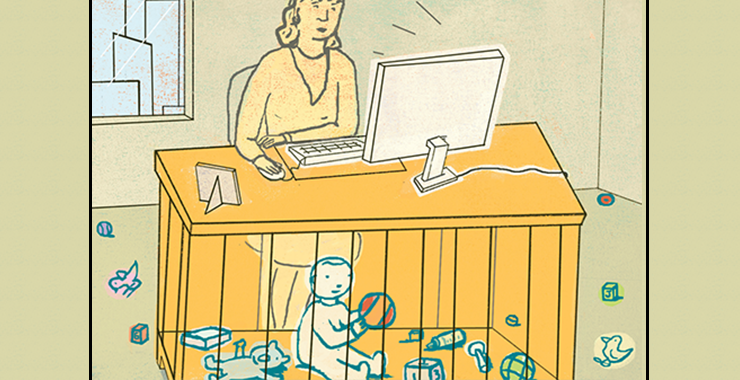
Zhang is just one participant in a global, unplanned experiment in transforming work virtually overnight, whether workers stayed on the job in circumstances that were now life-threatening or had to transform their homes into offices, often with children as unwitting officemates.
Attitudes about work are already changing dramatically. For one, employees are reassessing work-life balance. APA’s 2021 Work and Well-being Survey, for example, found that prioritizing mental health has become more important to 59% of employees since the pandemic began. Research by Microsoftopens in new window suggests that 41% of workers worldwide are considering leaving their current employers. Texas A&M University management professor and psychologist Anthony Klotz, PhD, coined the term the “Great Resignation” to describe the phenomenon. (For a look at how COVID is forcing women out of the workforce, see “Women’s Workforce Losses”)
“The 1918 flu pandemic shaped how workers approach work,” said Cort Rudolph, PhD, an associate professor of psychology at Saint Louis University, noting that the resulting uprisings over unsafe working conditions helped usher in employer-sponsored insurance and workplace safety improvements (Industrial and Organizational Psychologyopens in new window, Vol. 14, No. 1–2, 2021). Now, he said, instead of succumbing to the temptation to return to business as usual, society needs to consider what we’ve learned during this pandemic and reshape work again.
Remote work
Finding ways to improve remote work is a key priority. When workplaces sent many workers home in 2020, Zhang and colleagues took advantage of Twitter to gather real-time data about how employees across the English-speaking world were responding (Journal of Applied Psychologyopens in new window, Vol. 106, No. 6, 2021).
Their analysis revealed many upsides, such as increased productivity, no commute, and the ability to structure workdays as desired. But while workers enjoyed “not sitting in a cubicle all day,” said Zhang, many—especially parents—reported that working from home was stressful because of blurred boundaries and competing demands from family also at home. Managers can help mitigate these challenges by equipping workers with proper home office setups, helping employees maintain structure by setting aside times for meetings, and encouraging colleagues to engage with each other via frequent check-ins.
Other I/O psychologists are focusing on specific elements of the work-from-home experience. Kristen Shockley, PhD, an associate professor of psychology at the University of Georgia, has examined the phenomenon of Zoom fatigue (Journal of Applied Psychologyopens in new window, Vol. 106, No. 8, 2021). In an experiment in which employees were randomly assigned to have cameras either on or off for 2 weeks and then switch conditions for 2 additional weeks, Shockley and colleagues found that having cameras on resulted in employees—especially women and recent hires—feeling more fatigued, less engaged in meetings, and less like they had a voice in meetings.
“The self-presentation that goes with having the camera on is cognitively taxing,” explained Shockley. “You’re looking at yourself and being hypervigilant about how people are reacting to you.” In future research, Shockley hopes to investigate whether using avatars or side-view cameras that simulate a typical meeting space would help.
For members of marginalized groups, such as non-White workers and sexual and gender minorities, working from home can feel more comfortable, said Darrin Grelle, PhD, principal research scientist at SHL, a company with offices around the world that helps employers select the best employees.
“Speaking as a gay man, the way you act in the office may not be the way you act at home, and that uses up emotional and psychological resources,” he said. “If you’re working remotely, you don’t have to do that as much, and, therefore, you have more cognitive resources to get your work done.”
It’s not just employees who are benefiting from remote work, said psychologist Dianne Nilsen, PhD, a managing partner and executive consultant at Curphy Leadership Solutions, a business strategy consulting firm. The pandemic has also demonstrated to once-reluctant organizational leaders that productivity doesn’t falter when employees aren’t in the office.
“A lot of employers are seeing increased profitability; business is even better with people working from home,” said Nilsen, coauthor of an APA Div. 14 (Society for Industrial and Organizational Psychology) tip sheet on optimizing remote work. In fact, she said, the enhanced work-life balance remote work allows has become such a perk that she expects remote or hybrid arrangements to become the norm post-pandemic. “Those organizations that are insisting on butts in seats are having a very hard time recruiting and retaining people,” she said.
The statistics bear that out. According to market research firm Medallia’s 2021 Return to Workopens in new window consumer insights study, fewer than 1 in 5 employees currently working remotely want to return to an exclusively in-person workplace. Instead, most prefer a hybrid arrangement, with 2 or 3 days of in-person work per week as the “sweet spot.” About half of workers said they would be very or somewhat likely to seek employment elsewhere if their preferred setup was not available.
Hybrid work, which offers the best of both worlds, will be the wave of the future, predicts I/O psychologist Tammy Allen, PhD, a psychology professor at the University of South Florida. “Ease of collaboration remains an issue,” she said. “There are still benefits of having face-to-face interactions, but people don’t need to be in the office 9 to 5 every day.” Employers shouldn’t just have half their workforce come in Mondays and Wednesdays and the other half come in Tuesdays and Thursdays, Allen said.
Instead, managers should focus on activities and ensure that team members are all in the office on the same days. “I have a colleague who has to go into work but then is just on Zoom meetings all day because the people he needs to work with are working from home,” Allen said. “You don’t need to go into an office just to do more Zoom.” Managers should also evaluate employees not on the amount of time they spend at work but on the impact they’re making with their work, she added.
In-person work
Of course, the majority of workers haven’t enjoyed the luxury of working from home; many jobs simply can’t be performed remotely. Even at the height of pandemic-induced teleworking in May 2020, only 35% of the total workforce was working remotely, according to a poll from the market research and analytics company Leger, commissioned by The Atlanticopens in new window magazine. And those who have been at physical workplaces since the pandemic’s beginning—especially health care professionals—are burned out. A 2021 KFF/Washington Post pollopens in new window, for example, found that 3 in 10 health care professionals have considered leaving the field.
To help such workers, the University of Colorado’s Rebecca Richey, PsyD, has developed a brief cognitive behavioral therapy (CBT) intervention for women working in health care (Psychotherapyopens in new window, advance online publication, 2021). In contrast to traditional CBT, this intervention goes beyond challenging distorted thinking patterns to challenging sexism, racism, and other factors contributing to stress for this population.
“It empowers workers to use their voice to say this isn’t a problem with me; it’s a situation that’s not okay,” said Richey, an assistant professor of internal medicine and lead psychologist at the university’s Women’s Integrated Services in Health clinic. In one case, a health care worker tasked with working extra night shifts despite being a single mother used skills developed from Richey’s intervention to successfully challenge a boss who claimed her reluctance stemmed from not being a team player.
In addition, vaccine mandates are helping to make workplaces feel safer. In the summer of 2021, President Joe Biden announcedopens in new window federal vaccine requirements for as many as 100 million Americans—including vaccination or weekly testing for employees of organizations with more than 100 workers, vaccination for employees of health care facilities that receive federal Medicare or Medicaid funding, and vaccination for executive branch employees and federal contractors.
Mandates are also an effective way to persuade many resistant employees to get vaccinated, according to psychology professor Arthur Markman, PhD, of the University of Texas at Austin, who studies decision-making (The Conversationopens in new window, Sept. 23, 2021). For those who have made their opposition to vaccination public via social media, for example, mandates provide face-saving “social cover” to get the shot. Mandates also help tip the balance of evidence toward vaccination for employees who are wavering.
Employers also shouldn’t simply assume that their employees want to return to the norms of their pre-pandemic workplaces, said Allison Gabriel, PhD, a professor of management and organizations at the University of Arizona’s Eller College of Management. Employers shouldn’t assume that employees want to keep working at all, said Gabriel, pointing to the Great Resignation. “There’s an assumption that everybody wants to return to work, that everyone is grateful and thrilled,” she said. “That’s not what we’re seeing.”
What’s needed, said Gabriel, is a deeper dive into the emotional complexities of work during COVID (Industrial and Organizational Psychologyopens in new window, Vol. 14, No. 1–2, 2021). The pandemic has led many workers to realize their jobs no longer align with their broader goals, she said. Others may feel fearful or resentful about being forced back into situations that are still dangerous. Said Gabriel, “This is a crucial moment to step back and figure out new ways of doing things rather than making a big rush to the old way of working.”