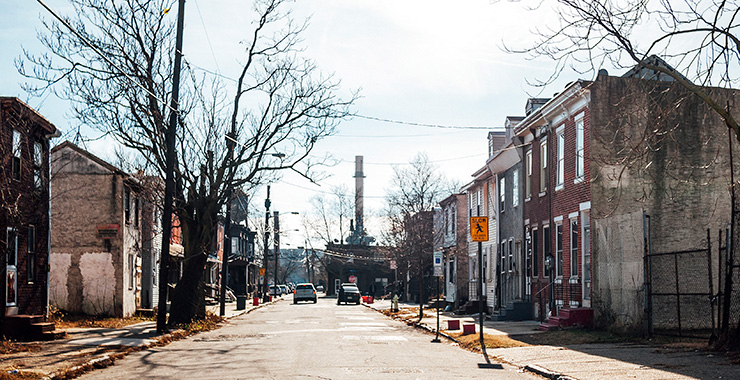
For years, researchers have been studying how a family’s socioeconomic status can affect children’s brain development, but new findings are revealing that the neighborhood surrounding a family may also influence the maturing brain. Even if a family is financially stable, the children in that home are more likely to have smaller hippocampus and prefrontal cortex volumes if they live in the midst of neighborhood deprivation—areas with higher rates of unemployment, more single parent households, fewer people with high school diplomas, fewer homeowners, and a lower median income (Taylor, R. L., et al., JAMA Network Openopens in new window, Vol. 3, No. 11, 2020).
These parts of the brain help regulate memory, learning, self-control, executive functioning, and response to stress, said Deanna Barch, PhD, a psychological and brain sciences professor at Washington University in St. Louis who led the study. Her lab, one of 21 sites involved in the national ABCD (Adolescent Brain Cognitive Development) Study, collected data from more than 11,000 children ages 9 and 10. They found that neighborhood deprivation was associated with lower scores on memory, vocabulary, executive functioning, and reading tasks. These decreased cognitive abilities can lead to difficulties in school, which can in turn increase the risk of problems such as substance use as children become adolescents, said Barch.
For psychologists at the forefront of substance use prevention work, the science linking brain development to environment is showing what they have suspected for years: that prevention efforts must start earlier and focus on the community in addition to the individual child. “Substance use prevention usually begins in middle school or high school, but that is too late,” said psychologist Linda Richter, PhD, vice president of prevention research and analysis at the New York City–based Partnership to End Addiction, a national nonprofit focused on addiction prevention, treatment, and recovery. “We typically teach kids what not to do related to drugs and alcohol, but we need to involve parents, teachers, and community leaders because they can elevate protective environmental factors.”
Barch’s findings in another study suggest that interventions should begin as early as pregnancy. She was part of a research team that recruited 399 pregnant women from St. Louis, who were then assessed for depression, stress, discrimination, and socioeconomic status. The mothers who experienced greater social disadvantage (lower income and greater neighborhood adversity) delivered babies with smaller brain volumes, and mothers in high-crime areas delivered babies with reduced functional connectivity between brain regions related to emotion and stress responses.
“This shows how Mom’s experience is translated into brain development,” said Barch. “We need to give these women access to stable, clean housing, safe neighborhoods, and quality medical care to support healthy fetal brain development.”
These and other findings were presented during a Friends of NIDA (National Institute on Drug Abuse) briefing for policymakers in October 2021opens in new window that addressed environmental contributions to risk for substance use, including a presentation by NIDA Director Nora Volkow, MD, on the agency’s prevention research initiatives. (APA is a member of the Friends of NIDA coalition and helped host the briefing.)
The research on disadvantaged neighborhoods’ neurological effects on children is consistent across cities—regardless of the city’s overall wealth. As part of the ABCD Study, Megan Herting, PhD, a behavioral neuroscientist at the University of Southern California, analyzed data from thousands of youth living in 21 cities across the United States, including Pittsburgh; Baltimore; San Diego; Portland, Oregon; and Los Angeles. Despite socioeconomic and demographic differences between cities, children living in neighborhoods with greater disadvantage showed smaller cortical surface area and subcortical volume and poorer neurocognitive performance (JAMA Pediatricsopens in new window, Vol. 175, No. 8, 2021).
“This suggests that the role of neighborhood disadvantage on child outcomes is similar in cities across the country,” Herting said.
Overriding genetics
Psychologists are also discovering that neighborhood context can sometimes have a greater influence on child development than genetics. Behavioral geneticist S. Alexandra Burt, PhD, of Michigan State University, launched her academic career at a time when researchers were touting the role of genes in everything from personality and behavior problems to parenting and divorce. But as she reviewed the literature, Burt noticed that nearly all the studies had been done in samples made up of mostly White, middle-class families. “Scientists were making broad claims about the power of genetics, but I wanted to test whether the results changed when the samples included people experiencing significant forms of adversity,” she said.
Burt investigated twins ages 6 to 10 who were living in both advantaged and disadvantaged areas in Michigan. She assessed the children for nonaggressive antisocial behavior—such as theft, vandalism, and substance use—a frequent precursor to substance use disorders. In impoverished neighborhoods, she found that fraternal twins were nearly as similar to each other in their antisocial behavior as identical twins. This was not the case in wealthy and middle-class neighborhoods, where identical twins were far more similar than fraternal twins (Journal of Abnormal Child Psychologyopens in new window, Vol. 48, 2020).
“Some environmental contexts can be so challenging that they can increase acting-out behaviors regardless of whether the child is at genetic risk,” said Burt. But in wealthier enclaves, there are fewer environmental influences that lead to antisocial behaviors, so genetic risk matters more. The findings suggest that neighborhood adversity is a potent risk factor for behavior that is associated with risk for substance use disorders.
But unlike genes, a child’s environment can be changed—and psychologists like Richter are working to raise public awareness about the importance of supporting programs that increase access to resources in disadvantaged areas. “The funding for child tax credits, housing assistance, and free food services during the pandemic may not be considered substance use prevention, but [those programs] indirectly reduce the risk of unhealthy coping strategies by alleviating stress,” said Richter, who hopes these programs will be extended beyond the pandemic. “Parents who are not in a constant state of stress will likely have more emotional resources to devote to their kids.”
Empowering parents to have healthy relationships with their children is also important because this bond can be a protective factor for children growing up in disadvantaged neighborhoods, said Amanda Sheffield Morris, PhD, a developmental psychologist at Oklahoma State University. “Brain circuitry is developing rapidly in the first 5 years of life, and children who have a safe, secure parent in their lives can be shielded from the broader environment around them.” To help low-income mothers learn positive parenting strategies, Morris’s team led groups for several years in the community and trained staff who work with mothers through the Tulsa Educare family support centers.
Changing social environments
Resilience—the ability to cope adaptively with trauma and adversity—is another protective factor against substance use, and psychologists are tapping into social resources within disadvantaged neighborhoods to foster this skill. Benjamin Houltberg, PhD, LMFT, started his career as a therapist working with at-risk youth in Union Public Schools in Oklahoma, but after several of his patients lost their lives to violence, suicide, and drug overdose, he realized that youth needed a broader network of support than he could offer as an individual practitioner.
Houltberg returned to school to earn a doctoral degree in human development and started investigating how relationships could buffer risk of adversity in childhood. Now as president and CEO of the Search Institute in Minneapolis, he trains teachers, coaches, and leaders in underprivileged communities how to form developmental relationships. These relationships help young people to discover who they are, gain abilities to shape their own lives, and learn how to interact with the world around them, according to the institute’s studies. “Resilience is not an individual trait or endeavor,” said Houltberg. “It is built through relationships and access to resources.”
Research at the Search Institute informs the way he trains members of the community to work with youth. For example, he has found that people who believe they are good at forming developmental relationships with children and adolescents are frequently unaware of how these youth perceive them. “Our surveys show that there is often a discrepancy between what youth are experiencing and what the teachers, mentors, and coaches are reporting,” he said.
One common mistake is forgetting to share power, which means allowing young people to have a voice, he said. In classrooms, for example, teachers can encourage students to create some of the classroom rules or invite them to participate in decision-making meetings. In mentoring relationships, adults can ask children to decide which activities they will do together or take the time to listen to their perspectives on important societal issues. “Sharing power with young people not only gives them confidence to shape their own lives but also has the potential to transform communities into places where young people can thrive,” Houltberg said.
In cross-sectional and longitudinal studies conducted by researchers at the Search Institute, developmental relationships were linked to increased academic motivation, self-awareness, responsible decision-making, self-efficacy, and other positive development outcomes (Scales, P. C., et al., Applied Developmental Scienceopens in new window, in press). Also, kids with stronger developmental relationships had the lowest levels of alcohol, tobacco, and drug use, according to the institute’s recent survey of 1,000 youth nationwide.
Social-emotional skills are another valuable psychological commodity that can protect youth from unhealthy coping behaviors. Psychologist Tamar Mendelson, PhD, a professor at the Johns Hopkins University Bloomberg School of Public Health, partnered with 29 schools in Baltimore to launch a program to help eighth graders learn social-emotional skills during classroom time. “We did not want to screen kids for problems and pull them out of class for sessions, because this can be stigmatizing,” she said. “This method can also miss students who would benefit from the skills.”
Since 2017, her team has delivered a 12-session group prevention program called RAP (Relax, be Aware, and do a Personal rating) Club in at least six middle school classrooms per year. Kids learn mindfulness practices, the effect of stress and trauma on the body, and cognitive behavioral and problem-solving skills. The team also hired young adults from the Baltimore community to cofacilitate the program, which built trust and increased buy-in with students, said Mendelson.
Students who participated in the program reported significantly fewer trauma symptoms after completing the program than a control group. In a recent survey, Mendelson found that youth who were involved in the intervention maintained the same level of anxiety before and during the pandemic, while those in the control group experienced increased anxiety during the pandemic. She is also tracking substance use outcomes, and she hopes the coping skills will reduce the risk of alcohol, tobacco, and drug use.
Through her work in Baltimore schools, Mendelson has witnessed how neighborhood environments shape children, and she believes that schools are a strategic place to empower youth to overcome the societal systems that are failing them.
“The symptoms kids develop in disadvantaged neighborhoods are adaptive responses to threatening situations, but these responses can set them up to have difficulty thriving,” she said. “Young people are incredibly strong, and we need to find more ways to enhance their natural resilience while we simultaneously address the systemic oppression that is harming them.”