The return of college students to campuses has also meant a return to the potential for campus sexual assault, as new students adjust to college, its social life, and pressures to drink and conform. Previous research shows that the period of time from start of the academic year until Thanksgiving break is a particularly vulnerable stretch for first-year students (Kimbel, M., et al., Journal of American College Healthopens in new window, Vol. 57, No. 3, 2008).
This year, many college leaders have welcomed back essentially two first-year classes, as the sophomores were largely isolated learning online the previous year, said Erin Bonar, PhD, an associate professor in the Department of Psychiatry at the University of Michigan in Ann Arbor. “Whether it’s technically their first or second year in college, they’re in a new environment and that is going to potentially affect their risk for sexual violence or sexual assault,” she said.
Moreover, college students of all ages might be tempted to go overboard socializing as they embrace a return of prepandemic campus life, Bonar said. “Some people are excited to be back, they want to party, they want to see their friends, they’re drinking, and that context might increase their risk of sexual violence occurring.”
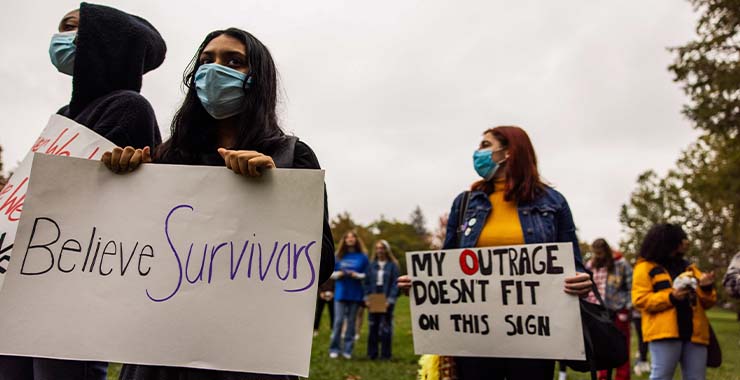
Students returning to campus have also been vocal about episodes of sexual assault. In September 2021, more than 100 students gathered at Virginia Techopens in new window to highlight what they described as a worrisome pattern, including assaults at sports events and other university gatherings. The previous month, hundreds of students at the University of Nebraska–Lincolnopens in new window protested over several nights after the alleged sexual assault of a young woman at a fraternity there.
Despite disturbing reports in media coverage, it’s too soon to gather national data about sexual assault trends for the current academic year, said Bonar. Plus, it’s not guaranteed that violence will increase, she pointed out. Some students might limit dating or avoid large gatherings owing to ongoing COVID concerns. Others might be required to periodically quarantine as a result of potential exposures, she said.
There also is an increasing awareness among students of what is considered sexual assault. A 2021 study, involving 2,566 college students who took an online survey, indicated heightened awareness in the wake of the #MeToo movement. The findings, which covered a 3-year period that overlapped with the start of the movement, found a trend toward greater recognition over time that past unwanted sexual experiences should be described as “sexual assault” (Jaffe, A. E., et al., Psychology of Violenceopens in new window, Vol. 11, No. 2, 2021).
Psychologists, researchers, and campus activists have long strived to reduce students’ vulnerability to unwanted sexual contact, including assaults, at U.S. colleges and universities. Overall, 13% of college and graduate students report nonconsensual sexual contactopens in new window by physical force or an inability to consent, according to a 2019 Association of American Universities survey of nearly 182,000 students. The highest rates occurred among female undergraduates (25.9%) and college students who identified as gay, transgender, or nonbinary (22.8%).
Psychologists are contributing to increased insights into the trauma of campus sexual assault, measuring the extent of the problem, identifying the risk factors for perpetration, and developing related interventions. Counseling centers play a key role in screening and watching out for signs of relationship and sexual trauma among students, according to an American College Health Association toolkit about violence preventionopens in new window. Victim advocates, often affiliated with the campus, provide support and assistance to those students who decide to report a violent encounter.
But there are also gaps in knowledge, including a limited understanding of how sexual assault impacts gay and transgender individuals. A report published in the wake of a 2018 University of Michigan Injury Prevention Center’s summit on campus sexual assault prevention also cited the need for more evidence-based interventions. Although promising approaches exist, such as active bystander training, such approaches typically address individual- and relationship-level risk factors, “with little known about what works at the community level,” according to Bonar and colleagues who wrote the report (Journal of American College Healthopens in new window, online first publication, 2020).
Developing interventions
Today’s students are pushing for their colleges to offer more than “check-the-box methods” of prevention, something more substantial and comprehensive than a 30-minute online program before fall registration, said Tracey Vitchers, executive director of It’s On Us, a nonprofit focused on campus sexual assault prevention.
“What we’re seeing that looks very different this time around with this new wave of campus protests against sexual assault is the demand from students for schools to take more accountability,” she said. “For [them] to take a more comprehensive and community-centered approach to sexual violence prevention that actually stops it from happening in the first place.”
At Rutgers University in New Jersey, clinical psychologist Courtenay Cavanaugh, PhD, has observed that the undergraduate students in her Violence Against Women & Women’s Health class don’t want to just learn about the scope of sexual assault; they also want information about prevention. “They really [are] hungry to take more action to address the problem,” she said
Beginning in 2017, Cavanaugh started teaching bystander intervention to her students, using a video-based training program called the TakeCARE approach, which has been developed and evaluated by other researchers (Jouriles, E. N., et al., Journal of Consulting and Clinical Psychologyopens in new window, Vol. 87, No. 1, 2019 ). The first group of 16 students took what they learned and then disseminated it more broadly, she said, reaching 156 other students through peer-facilitated group sessions on campus (Teaching of Psychologyopens in new window, Vol. 46, No. 4, 2019).
Typically, bystander intervention and other prevention training are part of a university’s orientation as well as elective programs offered later in the year, which students may not make time to attend or think they would benefit from, Cavanaugh said. “What’s novel about the work I’m doing,” she said, “is that there are a few examples of incorporating these bystander programs into academic courses.”
TakeCARE, Bringing in the Bystander, and The Men’s Program are the most commonly evaluated bystander interventions for the prevention of sexual violence, according to a systematic review of 44 studies looking at programs in the United States and Canada (Mujal, G. N., et al., Trauma, Violence, & Abuseopens in new window, Vol. 22, No. 2, 2021).
Another recent study, a meta-analysis of 24 studies involving bystander interventions on college campuses, found short-term benefits from the programs, which were delivered in a variety of formats, from video and online training to in-person sessions by trained facilitators. Those students who participated expressed stronger beliefs about the problem of sexual violence and displayed efforts to intervene compared with those who didn’t (Jouriles, E. N., et al., Journal of American College Healthopens in new window, Vol. 66, No. 6, 2018). The bulk of these meaningful changes persisted at least six months, but they did diminish over time, the researchers found.
Bystander programs are one of the most common prevention tools used by colleges, said Kim Webb, LPC, the immediate past president of the American College Health Association, who also directs the Relationship and Sexual Violence Prevention Center at Washington University in St. Louis. But bystander approaches can’t aid students who are assaulted behind closed doors and can’t prepare bystander students for every scenario they might face, Webb said. There are also other potential downsides.
Students may hang back, assuming that someone else will intervene or out of fear that their impression is incorrect, Webb said. “They don’t help because they’re afraid that they’re misinterpreting what’s going on,” she said. “They don’t want to be wrong, and they don’t want to be ostracized as a friend or lose a friend because they’re trying to address something that they are misinterpreting.”
Still, although the training is directed at individual students, it can be a powerful weapon to engage the entire college community, Webb said. Any student can learn the strategies and practice them, she said. “You don’t have to have a personal connection to sexual violence to feel that you can make a difference.”
In other emerging research, psychologists are looking at whether insights into protective behavioral strategies may help pave the way for future prevention efforts. They already show promise in the context of alcohol. College students who adopt protective behavioral strategies, such as alternating alcohol and nonalcoholic beverages, have been shown to be less prone to driving while drunk or engaging in other high-risk drinking behaviors, according to one review article (Pearson M. R., Clinical Psychology Reviewopens in new window, Vol. 33, No. 8, 2013). Psychologists hope that, to a similar degree, identifying protective behavioral strategies may help guard against sexual assaults.
In a 2021 study, researchers surveyed 567 men at two universities who endorsed sexual attraction toward women. They assessed their use of a dozen protective behavioral strategies, among them an awareness that alcohol can impair their judgment and efforts to respond to a woman’s sexual cues, such as by backing off or checking in if her enthusiasm decreases. Nearly half of participants reported “always” using these strategies, whereas 71.3% reported “always” or “often” (Aggressive Behavioropens in new window, Vol. 47, No. 3, 2021).
“What’s particularly encouraging about the findings is that such a large percentage of college men are regularly using these protective strategies that we think are likely to reduce risk associated with sexual behavior,” said Teresa Treat, PhD, the study’s lead author and a professor in the Department of Psychological and Brain Sciences at the University of Iowa in Iowa City. “That suggests that they might be useful prevention targets.”
Meanwhile, nearly 15% of participants reported “never” or “seldom” using the strategies. In addition, researchers found that men who had engaged in at least one risky behavior in the previous year, such as having sex without protection, used fewer of these strategies.
Treat stressed that her findings to date point to an association but not a causal relationship. “We don’t know yet whether using the protective strategies reduces the likelihood of future sexual aggression,” she said. As part of her ongoing research, she has created a revised version of the strategies, and related instructions, that’s designed to be more inclusive to all college students regardless of sexual orientation or gender identity.
Broadening prevention
Targeting individual behavior runs up against the inherent limits, said Bill Flack, PhD, professor of psychology at Bucknell University in Lewisburg, Pennsylvania, who studies gender-based violence in higher education. “My preference, and the preference of a lot of people working in this area, is increasingly to view this problem using an ecological model—to take more of a community psychology approach,” he said.
For instance, Flack said, it can be daunting for a student to intervene in a worrisome scenario if they feel like they are swimming upstream against a larger community, such as if the potential aggressor is a teammate or another brother in their fraternity “There are pressures that are inherent in group membership that can be very difficult to stand up against.”
When sexual violence does occur, campuses often can provide not just the support of a counseling center but also an advocacy service to assist victims who may be interested in reporting the encounter. At Lehigh University in Bethlehem, Pennsylvania, roughly a dozen staff advocates are available in person or through a 24-7 hotline for students coping not just with sexual assault but also with a range of other violent behaviors, including intimate partner abuse and stalking, said Brooke DeSipio, PhD, director of Lehigh’s Office of Gender Violence Education and Support. Their training includes working with students who are lesbian, gay, bisexual, or transgender, as additional issues may be involved, she said.
For instance, a lesbian woman who has been assaulted by a cisgender man may be grappling both with the trauma of the violence itself as well as what that assault means in relationship to her sexual orientation. She may feel like her choice only to have sex with other women has been taken away from her by the assault, DeSipio said. “It can bring up lots of those identity pieces for students to work through.”
In recent months, there have been signs on some campuses that administrators are trying to respond to a broader point being made by campus activists—that the institutional culture itself must change to better protect students. In October 2021, the University of Nebraska–Lincoln reported that the fraternity where the alleged assault that led to protests on campus took place had been suspended through 2026opens in new window. The following month, Virginia Tech’s president announced the creation of a 21-member Sexual Violence Culture and Climate Work Groupopens in new window in an effort “to enhance” the university’s prevention efforts. The recent episodes of sexual violence and misconduct “strike at the heart of the learning community we aspire to be and defy the core values that guide our strategic vision,” Virginia Tech President Tim Sands was quoted as saying in a November 2021 press release about the work group’s formation.
In the last few years, research and prevention efforts have been somewhat stymied by a lack of commitment to the issue by the Trump administration as well as the pandemic’s lockdown constraints, said Kevin Swartout, PhD, a professor of psychology and public health at Georgia State University, who also served on the advisory committee that developed a 2019 APA resolutionopens in new window on campus sexual assault.
But prevention efforts have shifted back into gear, and the best results will be achieved by intervening on multiple tracks, Swartout said. “More and more you are seeing the development of programs that are targeting multiple levels of the social ecology,” he said.
Even as of early 2022, it’s likely too soon to know the extent of the sexual violence that students have experienced since they returned to an in-person environment, DeSipio said.
“It is very rare that students will report immediately following the incident,” she said. “It’s normally a couple of months after when they realize that it is having an impact on them and they’re not able to manage it themselves and need some additional help and support.”