College and university campuses have always offered a wealth of intellectual, cultural, and practical resources and opportunities for the surrounding communities. Now, a group of visionaries that includes numerous psychologists is working to help U.S. campuses expand their opportunities for older adults in a wide variety of capacities—as students, community and research partners, university-based residents, and more.
Those championing these initiatives are part of a growing movement called the Age-Friendly University (AFU), an outgrowth of the World Health Organization’s 2002 “promoting healthy life” initiative. Employing the ideas and practices of similar successful initiatives—especially those in Southeast Asia and Oceania known for promoting lifelong learning, work opportunities, and healthy aging—AFUs have seen tremendous growth. To date, 89 colleges and universities worldwide are designated AFUs, nearly two thirds of them in the United States.
“It’s really about making a culture change in higher education,” said Nina Silverstein, PhD, a gerontology professor at the University of Massachusetts (UMass) Boston and a champion for AFUs in the United States. “It’s about recognizing that universities could thrive much more if they recognized that there are many people on their campuses who are beyond [traditional young student] age groups and that they have a lot to contribute.”
Alongside these aspirations are two relevant demographic trends, added APA’s Division 20 (Adult Development and Aging) President Joann M. Montepare, PhD, a social-developmental psychologist and director of the RoseMary B. Fuss Center for Research on Aging and Intergenerational Studies at Lasell University in Newton, Massachusetts, who has also been instrumental in promoting AFUs in the United States. One is a decline in the number of younger students attending colleges, especially private ones: Data from the National Student Clearinghouse Research Centeropens in new window show a 7.8% drop in undergraduate enrollment since the fall of 2019, the probable result of both the COVID-19 pandemic and a greater number of young adults with limited economic resources opting for work rather than college.
The other is a rapidly expanding older population, said Nancy Morrow-Howell, MSW, PhD, who directs the Harvey A. Friedman Center for Aging at Washington University in St. Louis, which became an AFU in 2018. Thanks to their rich array of resources, campuses are ideal gathering places to promote healthy aging in various capacities, she said. Another important reason to make campuses more age inclusive: They are already environments where many faculty and staff spend much of their professional and working lives.
“As far as we can see, these demographic shifts are here to stay,” Morrow-Howell said. “So now is the time to respond in transformative ways to ensure long and healthy lives.”
AFUs in action
In 2015, Dublin City University in Ireland hosted the inaugural meeting of the Age-Friendly University initiative. There, a leadership group unveiled the 10 age-friendly university principles, a framework that has since guided institutions seeking to become AFU partners or to launch initiatives to make their campuses more age-friendly and inclusive. Professional organizations have also endorsed the principles, including the Academy for Gerontology in Higher Education (the educational unit of the Gerontological Society of America [GSA]) and APA’s Division 20.
AFU-designated campuses are participating in a variety of ways, with some expanding on existing age-friendly initiatives and others just getting started.
One arena for these activities is the classroom itself. Lasell University—the second U.S. institution to become an AFU, in 2015—created a natural vehicle for intergenerational classroom learning in 2000 when it built a residential facility for older citizens on the edge of campus called Lasell Village. A central feature of life for these residents, who range in age from 73 to 104, is taking part in 450 hours of learning and fitness activities, including many on campus.
At first, the university offered courses across the curriculum designed to engage older and younger students, with names like Generations in America and A Global History of Childhood. But while younger students loved the classes, some older participants felt that the courses negatively highlighted their age, in keeping with research showing that stereotype threat—or feeling at risk of conforming to stereotypes about one’s group—also applies to aging.
To tackle this problem, Montepare introduced a new framework called Talk of Ages, which highlights topics of common educational interest rather than those that explicitly target age or generational differences. It includes a speaker series that covers such themes as “Exploring Life Through Science and Art” as well as a curricular component that features short intergenerational modules that are a part of regular classes.
“The framework makes use of practices shown to help to enhance intergenerational exchange, such as providing younger and older learners with meaningful roles, time to interact, and opportunities to develop personal connections in a novel learning experience,” Montepare said.
At Central Connecticut State University (CCSU), in New Britain, Connecticut, which became an AFU in 2017, social and developmental psychologist Carrie Andreoletti, PhD, coordinator of gerontology at the university, has been running different iterations of a program she developed called Wise (Working Together: Intergenerational Student/Senior Exchange). The goal is to break down stereotypes and facilitate sharing and learning between students and older adults, in this case members of a nearby senior center. Prior to COVID, the older adults sometimes came to campus via bus and took part in classroom discussions; other times, students visited the older adults at the senior center.
During the pandemic, Andreoletti and her geropsychology colleague, Andrea June, PhD, moved the program to Zoom. As part of their virtual gerontology and adult development and aging classes, they had students and older adults meet in virtual breakout rooms to discuss salient topics like relationships and ageism. In collaboration with the university’s LGBT Center and several community partners, they held a virtual intergenerational conversation in late 2021 between younger and older LGBTQ+ adults and allies in the community.
In a similar vein, Lauren M. Bowen, PhD, an associate professor of English on the AFU team at UMass Boston, has included both undergraduates and lifelong learners in her English 101 class. Students in both age groups read articles and op-ed essays that rely on age-based stereotypes to make their arguments about reading and writing, such as that older adults are technologically illiterate, or that millennials are shallow. The two groups then write and share essays discussing how such ideas about literacy and language shape our sense of who we are and the potential effects of such ideas on intergenerational relationships. “The conversations [are] so rich and so much fun,” Bowen said.
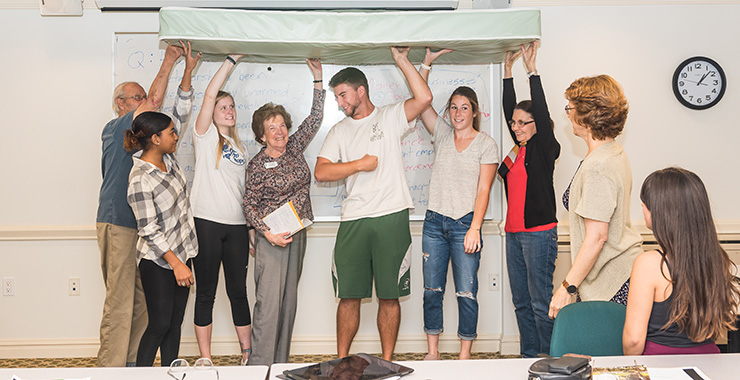
AFUs are getting creative in other educational domains as well. Florida State University, already a pioneer in age-inclusive programming and activities, expanded its offerings when it became an AFU in 2017. An example is InnoVenture Weekend, an event first held in 2018 that originated in the university’s College of Engineering as a design contest for undergraduate and graduate students. Human factors psychologist Neil Charness, PhD, who directs the university’s Institute for Successful Longevity, and his students joined the effort when the engineering college asked them for design ideas involving older adults.
Charness first tapped a research registry of local older adults, asking them to share everyday problems they encountered with products or processes—difficulties in opening medication bottles, for instance, or carrying heavy items from the car to the house. Students chose some of the ideas, and Charness asked the older adults to mentor the students.
Students developed several innovative ideas, including a mug that dispenses medications. The winning design, called Findr, is something most of us could use: a device that tracks often-misplaced items like car keys, eyeglasses, and TV remotes.
“To me, it was a perfect AFU-type activity because students and seniors worked together on a joint project, which they both enjoyed,” Charness said.
Beyond the classroom
AFU advocates are also enthusiastic about making the entire campus climate more age inclusive. Some AFUs are collaborating with their equity, diversity, and inclusion (EDI) offices to include age as an identity factor along with identities related to race, ethnicity, and sexual and gender orientation. Advocates at Washington University, for example, have been working with their EDI office to create sessions on ageism and age that will be available on campus and in the community. Similarly, CCSU’s gerontology program has partnered with the university’s EDI office to offer an online course called Ageism First Aid to faculty and staff for free. The course, developed by the GSA, discusses what ageism is, how it develops, how it affects people of all ages, and how to communicate and interact more effectively with older adults to avoid this kind of bias.
It is also important to recognize that age inclusivity applies to anyone who doesn’t fit the traditional 18-to-22-year-old college undergraduate mold, Morrow-Howell added.
To this end, Washington University is widening its campus culture through a program called Next Move that is geared to students who have returned to college in midlife or later. The university is working to support these students professionally and socially, Morrow-Howell said.
On the social end, AFU leaders on Washington University’s campus are learning from Next Move students about the kinds of social activities they would like to see that differ from the undergraduate norm, such as family-friendly gatherings or events that better fit work and family schedules.
The university is also providing these students with advisory and career services that highlight their experience and teach them strategies to reduce any age discrimination they may face, such as lessons on new technology and ways to highlight their strengths to potential employers.
Preparing older students for the job market helps the students and society, Morrow-Howell added. “If workplaces have three to four generations working there and communities have people living in them until they’re 100,” she said, “we need to work together to envision new ways of doing things.”
Challenges and opportunities
Many of those involved in the AFU movement have also been working on large-scale projects that seek to understand what challenges campuses face in becoming more age inclusive in general and how they can overcome barriers.
As one example, a research team that includes Silverstein, Montepare, Bowen, and UMass Amherst professor emerita Susan K. Whitbourne, PhD, among others, has conducted several related projects funded by the Chicago nonprofit RRF Foundation for Aging. These include developing an Age-Friendly Inventory and Campus Climate Survey (ICCS) piloted across all five UMass campuses and conducting a study using the ICCS at 22 campuses in the United States, reported in The Gerontologist (Vol. 62, No. 1, 2022).
A key driver of the team’s work is to understand the gap between what campuses say they are doing and people’s perceptions of what they’re doing, Whitbourne said. That’s because if people don’t feel that a university is age inclusive, the programs won’t make a difference.
In fact, the team’s surveys found that “no more than 55% of the age-friendly practices that the campuses were undertaking were recognized by campus members at any level—faculty, staff, or students,” Whitbourne said. “So, it became clear that it’s one thing to have a purported age-friendly environment and another to actually accomplish that.”
Next, the team will return to representatives from the 22 campuses to discuss how higher education can become more age inclusive in three areas: teaching and learning, career services, and human resources. Then, a national panel of higher-education experts will take those recommendations and develop applied strategies for use on any campus.
Realizing the AFU vision can be challenging, advocates admitted. The AFU principles don’t address the physical environment of the university, with the tacit understanding that such changes can be costly. Language in the area is also evolving, with some preferring the more comprehensive “age inclusive” to “age friendly.” Other concerns include the importance of being mindful when asking to be included in EDI activities, best integrating age-inclusivity efforts with important ongoing work on racial and other disparities, and keeping the momentum going over time, even when resources and funding are scarce.
But Silverstein believes the possibility of broadening campuses to take advantage of the many pluses that intergenerational learning and participation can offer makes these challenges worth it.
“The momentum for this movement is here, and I think it would invigorate many campuses,” she said. “The most important thing is to get the conversation going.”