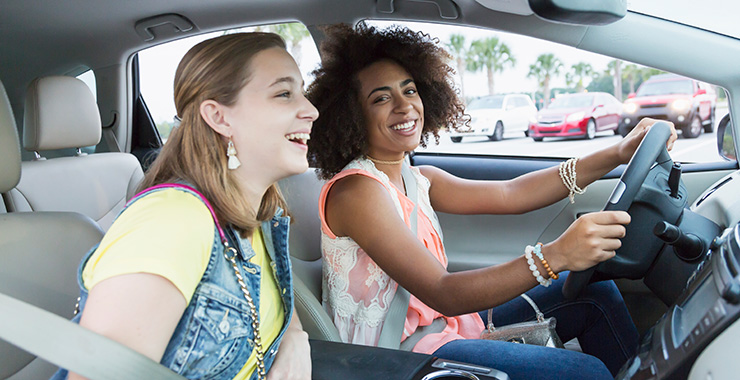
When the covid-19 pandemic triggered shutdowns in 2020, many states waived on-road testing for new drivers. Generally, pre-pandemic standards have now returned, but in some places, covid wrought a permanent change. In Wisconsin and Mississippi, for example, teen drivers with a learner’s permit can now have their parents submit an affidavit of practice in lieu of an on-road test. North Carolina also allows road test waivers for some new drivers over the age of 18. Meanwhile, some states’ licensing offices have now outsourced road tests to third-party driving schools.
It is unclear what effect, if any, these changes will have on teen driving safety. Most teens do pass their road tests, which cover only very basic driving skills. But the pandemic’s echoes highlight the push and pull of licensing these young, vulnerable drivers. Novice drivers have crash rates 2 to 3 times higher than experienced drivers, and they’re overrepresented in fatal crash statistics. Deciding how to license teen drivers is often a balancing act between mobility, equity, and safety.
“They are learning to do something that is really quite complex that they’ve never done before,” said Robert Foss, PhD, a social psychologist at the University of North Carolina Highway Safety Research Center. “And the way that we have traditionally licensed in the United States is basically to say, ‘If you can pass a written test, go for it, good luck.’”
Researchers in psychology have already changed the way teens get their licenses by championing the graduated driver licensing (GDL) system, which built in protections for young drivers and made them safer over the past 2 decades. Now, they are seeking new ways to hasten the learning process and save lives in the first critical months of independence on the road.
Learning the road
Deaths from vehicle crashes climbed in 2020, the last year for which full data is available, and teen drivers were no exception. According to the National Highway Traffic Safety Administration, fatal crashes involving drivers 15 to 20 years old rose from 3,863 in 2019 to 4,405 in 2020, an increase of 14%.
This uptick is a reversal in a long-term trend toward fewer fatal crashes for teens since the late 1970s, in part because of improved safety standards in cars and in part because of the graduated driver licensing systems instituted by most states in the late 1990s. Under a GDL system, teens must first get months of practice while supervised by experienced adults. Newly licensed teen drivers have limits on the number of passengers in their vehicles, and sometimes on the times of day when they can drive. These limitations reduce distractions and challenges during a sensitive period of learning for teens.
“It’s just meant to use the driver’s licensing system to ensure that young beginning drivers get a lot of practice driving, while at the same time protecting them from the consequences of the mistakes that they’re likely to make,” Foss said. He and his colleagues found that in North Carolina, fatal crashes among 16-year-olds declined 57% after the GDL system started, and minor- or no-injury crashes decreased 23% (JAMA, Vol. 286, No. 13, 2001opens in new window). Drivers licensed under the GDL system had a 10% lower crash rate in the first 5 years of driving compared with those licensed before the GDL system was put into place (Accident Analysis & Prevention, Vol. 42, No. 6, 2010opens in new window).
Teen drivers are often considered foolish, reckless, and irresponsible, Foss said, an extension of the notion that teens are developmentally unformed and unready for adult responsibilities. But while it is true that the United States licenses drivers during a time of great neurodevelopmental change, brain development (or lack thereof) isn’t the main culprit behind teen car crashes. “What we now know very well and should have known long ago, had there been more expert academic inquiry into the issue, is that the main problem is that they are inexperienced,” Foss said.
Bearing out this fact is the crash rate for new drivers. Across countries (including nations that license at 18 instead of 16), the highest rate of crashes occurs when drivers first start piloting the car alone (McCartt, A. T., et al., Traffic Injury Prevention, Vol. 10, No. 3, 2009opens in new window). The learner’s period, during which an experienced supervisor is always in the car, is remarkably safe. But the first 6 to 12 months after getting fully licensed are the most dangerous, on average, said Neale Kinnear, PhD, a lead behavioral psychologist at Humn in the United Kingdom (Accident Analysis & Prevention, Vol. 50, 2013opens in new window). “This is the crucial time that a new driver learns by themselves to become safer,” Kinnear said. “What’s happening in that time frame, we don’t really know.”
Hazard perception
There are hints as to what the first months of independent driving teach. One likely skill is hazard perception, or the ability to detect and respond to developing situations—a car that might pull out on a blind curve, a pedestrian hovering near a busy corner. This skill is likely both cognitive and visual; research going back decades finds both that novice drivers struggle to anticipate other drivers’ actions and that they have a more restricted visual focus as they scan the roadway (McKnight, A. J., & McKnight, A. S., Accident Analysis & Prevention, Vol. 35, No. 6, 2003opens in new window).
In the United Kingdom, a hazard perception test has been part of the process of getting licensed since 2002. Applicants must watch short videos and press a button when they see a hazard, such as a pedestrian stepping into the road.
“Estimates put [the impact of the test] at reducing more than 1,000 injury-based collisions in the U.K. annually,” said David Crundall, PhD, a professor of psychology at Nottingham Trent University who studies hazard perception testing and training. U.K. Department for Transport research pegs the impact at an 11% reduction in collisions each year (Cohort II: A Study of Learner and New Drivers, 2008opens in new window). The testing has spurred a training industry around hazard perception, he said. There are free practice tests online, and driving instructors incorporate practice into their courses. “We’re still keeping the worst drivers off the road, but we’ve also upped the game of the majority of the drivers,” Crundall said.
But how new drivers best learn hazard perception isn’t yet clear. Part of the learning process may involve linking experience to emotions. “We don’t make continuous conscious decisions when driving, because we don’t have time,” said Kinnear. Anticipating hazards, then, may develop as drivers practice in real-world situations and acquire a “gut feeling” about what is and is not safe. A brand-new driver attempting a double left turn next to a semitruck might start that turn without any emotion about the experience, but after a firsthand brush with being cramped and close to colliding, they might get an anticipatory tingle the next time and decide to hang back or speed up to avoid the truck’s swinging back end. “Ultimately, by translating complex scenarios into feelings, we learn to anticipate risk and speed up decision-making,” Kinnear said.
This is called the somatic marker hypothesis, and Kinnear and his colleagues have some evidence that it might play a role in hazard perception for new drivers. In a laboratory study, the researchers asked learner drivers, inexperienced drivers, and drivers with more than 3 years of experience to watch video clips containing road hazards while having their skin conductance measured (Accident Analysis & Preventionopens in new window, Vol. 50, 2013opens in new window). They found that experienced drivers had a greater skin conductance reaction at the moment of the hazard than inexperienced drivers, and that inexperienced drivers, in turn, reacted more strongly than learners. Interestingly, the same was true of the skin conductance reaction in the moments leading up to the hazard, when a situation was developing but was not yet dangerous—for example, a biker riding on a road parallel to the driver’s road, well prior to the two roads merging. These findings suggest that newer drivers don’t experience as strong a gut feeling about developing dangers as more seasoned drivers.
“This can start to tell us what it is that new drivers don’t have that they need to learn to have,” Kinnear said.
It can also help explain why teen drivers don’t pick up on these skills as quickly as would be ideal during the supervised learning process. Often, parents teaching their children to drive take on much of the cognitive load of the task themselves, said Jessica Hafetz Mirman, PhD, a lecturer in applied psychology at the University of Edinburgh. They will instruct teens on when to start a turn and when to brake, for example, and will scan the road for hazards themselves. “It’s hard to pass that baton over to your kid, I think for fair reasons,” Mirman said. “It’s scary.”
The result, though, is that teens are often the “CEO of the car” for the first time when driving solo, Mirman said. Qualitative interviews with parents also suggest that they sometimes don’t understand why their children are ignoring hazards that seem obvious to the adults as experienced drivers (Journal of Adolescent Research, Vol. 27, No. 3, 2012opens in new window). “They tend to interpret that as a maturity issue, that [the teens are] not taking driving seriously, for example, but it’s really a skill issue,” Mirman said.
Those same interviews indicated that while parents were highly motivated to help their learning drivers and understood the importance of practice, they didn’t often highlight specific skills for teens to learn. They more often brought up big-picture concepts like preparedness or awareness. This could indicate a need to give parents and guardians—typically the main supervisors for teens’ driving practice—more research-based information on how to support their children.
One possibility is that teens could practice hazard-spotting from the passenger seat. This strategy has not been subjected to many studies, though one experiment by Crundall and colleagues using a driving simulator did suggest that it could improve reaction time and reduce virtual crashes compared with no training, at least in the short term (Accident Analysis & Prevention, Vol. 42, No. 6, 2010opens in new window). (Teens shouldn’t be asked to comment on hazards while they drive, Crundall warned—that task can too easily overwhelm them.)
Parents and guardians may also need to keep a keen eye out for distractions, especially smartphones, said Charlie Klauer, PhD, an industrial and systems engineer with a master’s degree in psychology at the Virginia Tech Transportation Institute. Using on-the-road monitoring systems for new teen drivers, Klauer and her colleagues have found that distractions are particularly dangerous for young drivers (The New England Journal of Medicine, Vol. 370, 2014; International Journal of Epidemiology, Vol. 46, No. 1, 2017opens in new window). “Not only do they engage in those activities more frequently than adults do, but they’re at more risk than adults are when they do it,” Klauer said.
Part of the problem seems to be that teen drivers don’t adjust their approach to adjusting the music or answering a phone call based on road conditions. They tend to give in to the distraction regardless of how challenging the driving environment. Apps that prevent the phone from being used while in motion are one way to combat this tendency, Klauer said. Parents can also sign driving contracts with their teens, laying out expectations and consequences for falling short. Phone use should be part of that conversation, she said.
There may also be opportunities to encourage more effective practice during the learner’s permit period. Teens don’t often get enough experience with driving in difficult conditions such as bad weather or with night driving during the learning phase, Mirman said, “They’re just not getting the quality, quantity, and diversity of practice that they should.”
How to develop and effectively implement a program to support better parent instruction and practice is a bigger question. It’s a hard place to make headway, Foss said, because it requires targeting parents in hopes of changing teen behavior.
“You’re taking an indirect route,” he said, “which greatly complicates and greatly reduces the chances that you’re going to be successful.”
Mirman and her colleagues at the University of Pennsylvania are currently recruiting 1,200 parent-teen dyads for an NIH-funded randomized controlled trial to evaluate the Drivingly Programopens in new window, which aims to test whether a comprehensive program of hazard awareness training, on-road driver assessment and feedback, 1:1 parent sessions with a trained health coach, and online logbook and psychoeducational modules for families might reduce the crash rate for new drivers. “How can we accelerate the learning that happens during the first few months of licensure and bring it back earlier during the learner’s permit phase?” Mirman asked. This study is the first to target multiple risk and protective factors at once and use police-reported crashes as the main outcome, she said.
Despina Stavrinos, PhD, a psychologist at the University of Alabama at Birmingham, is currently running an NIH-funded study to examine how teens respond to hazards—especially under distracted conditions—as an outcome of age and experience. The study should help untangle how much of teens’ struggles on the road are due to developmental effects versus experience, Stavrinos said. Research on new teen drivers skews toward 16-year-olds, since that is when many get their licenses, but some teens delay licensure to older ages. Stavrinos’s study is testing both 16- and 18-year-old new drivers. “We don’t know much about how older novices navigate,” she said.
At Johns Hopkins, Johnathon Ehsani, PhD, MPH, a public health researcher who works closely with psychologists on transportation safety, is currently studying the impact of a simple practice-tracking app for learner drivers. Most states have requirements for how many hours teens should drive with supervision before full licensure, but very few require any sort of verification. Ehsani and his team wanted to create something that would give novice drivers feedback on the type of practice they had done. The researchers created The Driving Appopens in new window, which allows drivers to track their practice drives and then manually enter information about the driving conditions and roadways taken.
Ideally, Ehsani said, the app could be expanded to automatically detect some of this information and to provide suggested routes for more challenging practice. Right now, though, the research is in its early stages and the app has been tested with only 150 families in Maryland.
Ehsani and Kinnear are also collaborating on an ongoing study to use fMRI to explore how new and experienced drivers in their late teens and early 20s assess risk when watching videos of gradually unfolding driving hazards. The goal is to understand how brain activation might change as people gain expertise, perhaps providing targets for training and practice. “We’re just at the very beginning of interpreting that information and seeing if there are differences in the groups and how those differences might be reflected in brain activation,” Ehsani said.
Targeting high-risk learners
Graduated driver licensing was a psychology and public health coup: a relatively easily implemented, population-based program that had a widespread impact on crash rates. It will be hard for psychology to clinch another win like it, Foss said.
But researchers might be able to make big gains in smaller populations. Teens with attention-deficit/hyperactivity disorder (ADHD) have twice the crash rates as other teen drivers, said Annie Garner, PhD, a clinical psychologist at Saint Louis University. Driving safety in this population is understudied, Garner said, but she and her colleagues have found basic differences in safety behaviors. For example, teens with ADHD are more likely than teens without to make extended glances (of more than 2 seconds) away from the roadway when distracted by hands-free phone calls or voice-to-text tasks, leading to problems maintaining lane position in a driving simulator (Journal of Abnormal Child Psychology, Vol. 43, No. 6, 2015opens in new window). Self-report studies also indicate that teen drivers with ADHD make more traffic infractions than teens without ADHD, resulting in more fines and remedial driving courses (Journal of Attention Disorders, Vol. 22, No. 12, 2018opens in new window).
The question is whether these teens need specialized driving instruction or whether the focus should be on managing their ADHD more globally, Mirman said. Garner and her colleagues are now running a randomized control trial funded by the National Institute of Child Health and Human Development to see if an intervention designed to reduce extended eye glances away from the road can help teens with ADHD drive more safely. The intervention is based on a program called FOrward Concentration and Attention Learning (FOCAL), developed at the University of Massachusetts Amherst, which has been shown to reduce extended eye glances in neurotypical teens (Pradhan, A. K., et al., Ergonomics, Vol. 54, No. 10, 2011opens in new window). Garner and her multidisciplinary team made up of pediatric psychologists, engineers, and experts in eye tracking and biofeedback have modified the original FOCAL intervention to include more parent-oriented material in the hopes that targeting both parents and their new drivers will help this vulnerable group of teens. The researchers are currently in the data analysis phase of the study.
Stavrinos is also conducting research on driving in teens with mild traumatic brain injury. There are protocols for teens to return to sports and school after a concussion, Stavrinos said, but nothing about when they should get back behind the wheel. She and her colleagues are recruiting teens within 72 hours of head injury to take driving tests in a simulator under periods of distraction and no distraction. “Clinicians are very interested in this study in particular, because they’re not sure what recommendations to make,” Stavrinos said.
The field also needs to grapple with the same rigor and reproducibility issues that the rest of psychology has had to face over the past decade, Mirman said. These range from lack of data sharing and preregistration to underpowered studies and misuse of statistical analysis. Chasing small effect sizes from lab studies could waste funds that might go to more effective interventions, she said.
“These are young people’s lives,” Mirman said. “We owe it to them to do it the right way, even if it takes longer.”