skip to main content
News

Psychologists are working to increase the number of opioid overdose prevention centers

Prevention sites are proven to reduce opioid overdose deaths. Psychologists’ research is identifying ways to increase public support for these lifesaving centers

APA Style leaf logo Cite This Article in APA Style
Pappas, S. (2023, April 1). Psychologists are working to increase the number of opioid overdose prevention centers. Monitor on Psychology, 54(3). https://www.apa.org/monitor/2023/04/opioid-overdose-prevention-centers

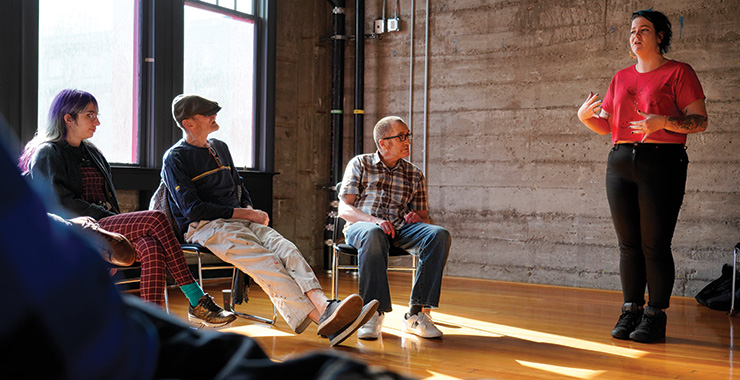
woman talking while standing in front of a group of people

Last year, the city government of San Francisco did something new as part of an emergency response to the city’s overdose crisis: They opened a center in the Tenderloin neighborhood where people could go to use substances in a supervised environment, well stocked with the opioid-blocker naloxone and staffed with medical professionals to watch for potential signs of overdose.

The site became a local flash point in the debate about how to handle the drug-poisoning crisis, which killed more than 100,000 Americans in 2021 alone (CDC National Center for Health Statistics, 2022)opens in new window. Some experts are now using the term “drug-poisoning crisis” instead of “overdose crisis” because the root of the increase is in contamination of the drug supply with the powerful narcotic fentanyl. Situated across from a Whole Foods and a few blocks from Twitter’s headquarters, the facility was a visible reminder of poverty and drug use, said Alex Kral, PhD, an epidemiologist at the research nonprofit RTI International who has been analyzing the health impacts of the site. Though it offered an array of noncontroversial services such as access to meals, showers, and referrals to social services, “it became a political football,” Kral said.

On December 4, 2022, the city shut down the site, though not as a failed experiment. Kral’s city-funded study found that staff reversed 333 overdoses, 305 of which were at the site and 28 of which occurred on nearby streets. No one died. San Francisco is now looking to open similar overdose prevention sites, dubbed “wellness hubs,” elsewhere in the city, Kral said.

But the Tenderloin’s year-long experiment exemplifies the national tension around overdose prevention sites, which allow people who use substances to inject or smoke drugs in a medically supervised, safe environment. Research by psychologists, public health experts, and criminal justice researchers shows that these sites are unambivalently successful, but the United States currently has only two legally sanctioned sites, both in New York City, which function without government funding for the supervised use areas. Rhode Island may soon set up a site in Providence.

ADVERTISEMENT

Part of why so few exist is that overdose prevention sites are still illegal under a statute in the U.S. Controlled Substances Act that prohibits anyone from maintaining a location for the purpose of selling, storing, or using drugs. Another issue psychologists are tackling is U.S. public opinion. People may view these sites as enabling drug use and often fear that they will attract crime to the neighborhood. Studies show that these fears are unfounded, but given the strong stigma around substance use, researchers say more needs to be done to educate the public about the harm-reduction benefits of these sites.

Research by psychologists is now showing that there are ways to frame overdose prevention centers that do not trigger knee-jerk stigma against people who use substances. Even the name alone can alter support, with people exhibiting more openness to “overdose prevention programs” than to alternatives like “safe consumption site,” “supervised injection site,” or “harm reduction center,” according to research (currently under review) by Western New Mexico University media psychologist Jennifer Johnston, PhD. Focus groups were very concerned with saving lives, Johnston said, and with the right framing, they were open to the idea that safe consumption sites are successful at doing so.

“There is true compassion,” Johnston said.

The case for prevention

The first overdose prevention center opened in Bern, Switzerland, in 1986. Today, there are nearly 200 overdose prevention centers operating under various names in 14 countries around the world. The sites do not provide drugs, but staff are available to give advice on safe injection procedures, provide injection supplies, and—important for the sites’ key goal of preventing deaths—monitor for and help reverse overdose. Center staff can typically connect people to help if they want to stop using drugs, but are careful not to push visitors because the primary priority is establishing trust and ensuring people use drugs in a safer environment than the streets. In the first two months of operation at the United States’ first two overdose prevention centers, operated by the nonprofit OnPoint NYC, staff intervened 125 times to mitigate overdose risk, including 19 administrations of the opioid blocker naloxone (Harocopos, A., et al., JAMA Network Open, Vol. 5, No. 7, 2022opens in new window).

New York’s experience is not unique. “Now there are literally dozens and dozens of peer-reviewed studies demonstrating very clearly that these facilities are meeting their primary objectives of reducing public disorder, reducing infectious disease transmission, reducing overdose deaths, and promoting engagement with the systems of care, including addiction treatment,” said Thomas Kerr, PhD, a counseling and health psychologist who is the director of research at the British Columbia Centre on Substance Use (BCCSU) and the head of social medicine at the University of British Columbia. “There is really no serious academic debate about this.”

A systematic review of studies on the sites in the United States and abroad, many focused on a long-running facility in Vancouver, have found that they reduce overdose morbidity and mortality, improve injection safety behaviors, expand access to addiction treatment, and do not increase crime or public nuisance (Levengood, T. W., et al., American Journal of Preventative Medicine, Vol. 61, No. 5, 2021opens in new window). An older systematic review found similar results and noted reduced levels of public drug injection and discarded syringes around overdose prevention sites (Potier, C., et al., Drug and Alcohol Dependence, Vol. 145, 2014opens in new window). Another review coauthored by Kerr found that these sites did not increase community patterns of drug use, with several studies finding that they instead facilitated people’s entry into treatment programs (Current HIV/AIDS Reports, Vol. 14, 2017opens in new window). These sites are targeted to the most vulnerable substance users, such as people who are experiencing homelessness, and do indeed benefit these populations, according to a fourth systematic review that found reduced overdoses and improved access to health care for unhoused individuals who used overdose prevention sites (Magwood, O., et al., PLOS ONE, Vol. 15, No. 1, 2020opens in new window).

“Safe consumption sites not only provide numerous health benefits but also don’t have the negative impacts that people often fear,” said Mary Clare Kennedy, PhD, a public health research scientist at BCCSU and the University of British Columbia, who coauthored the 2017 review with Kerr.

Communicating the science

There are signs that resistance to overdose prevention sites in the United States might be crumbling. The California Senate passed a bill authorizing three pilot sites in August, though Governor Gavin Newsom vetoed it. New York City’s two centers opened in late 2021. Those sites depend, in part, on private funding, but Rhode Island has devoted $2.25 million from a national settlement with three major opioid distributors to open its upcoming site in Providence. In February 2022, the Department of Justice signaled that it may relax its position on overdose prevention sites, telling the Associated Pressopens in new window that it was in conversations with regulators about “appropriate guardrails.”

If more sites do open, they will likely be accompanied by public debate. Until recently, overdose prevention sites have been largely unknown in the United States, which makes surveying public opinion on them tricky. People are unfamiliar with the concept, for one thing, said Colleen Barry, PhD, a public health researcher at Cornell University. For another, Kral said, they are being asked to respond to what they imagine the policy would be, not a policy that is already in place.

But research suggests that framing matters. Barry and her colleagues published the first findings to this effect only four years ago. The researchers asked a web-based, nationally representative survey of U.S. adults about their support for either “safe consumption sites” or “overdose prevention sites,” providing an identical definition for both. They found that support for “overdose prevention sites,” at 45%, was 16 percentage points higher than support for “safe consumption sites” (American Journal of Public Health, Vol. 108, No. 9, 2018opens in new window).

In another national survey, U.S. adults again proved more supportive of “overdose prevention sites” than “safe injection sites,” evincing the equivalent of a 10% to 15% increase in support for the option that emphasizes reducing overdoses versus the option that triggers thoughts of needles (Criminology & Public Policy, Vol. 20, No. 4, 2021opens in new window). “If you can use a label that focuses attention on reducing overdoses—in other words, saving lives—that is going to get a lot more support than if the label is focused on safely using drugs,” said Kelly Socia, PhD, a criminal justice researcher at the University of Massachusetts Lowell, who led that research.

Socia also found that abstract support for these sites was generally higher than support for such a site in one’s community. Overall, 64% of the sample was at least somewhat supportive of overdose prevention sites, but that support dropped to 53% when participants were asked how they felt about a site in their neighborhoods.

The overdose prevention framing again won out in research by Western New Mexico University’s Johnston and her student Kaya Thompson. Johnston conducted both a nationally representative survey and focus-group research and found that the term “overdose prevention program” beat out “safe consumption site,” “harm reduction center,” and “supervised injection site.” Johnston also tested different informational materials about these sites and found that people were most supportive when the materials used compassionate language and human-centered imagery and presented facts and statistics about the sites’ efficacy.

“Sometimes marketing rules suggest that less is more and going only for the emotional appeal is the way to go,” Johnston said. “But we found that appeal combined with some key facts about opioid deaths, about lives saved, about the fact that one massive study found that people who participated in these programs live on average 34 years longer, increased favorability. You can say the facts fairly quickly and simply to shift public opinion.”

Garnering support for lifesaving overdose prevention sites ties into the larger need to reduce stigma around substance use. Research has consistently found that stigmatizing attitudes toward people who use substances are associated with less support for harm-reduction policies. For example, Barry and her public health colleague Emma McGinty, PhD, now at Weill Cornell Medicine, conducted a nationally representative web-based survey and found that 84% of U.S. adults would not want someone who used opioids to marry into their family, and 72% would not want to work closely with someone who used opioids (Preventative Medicine, Vol. 111, 2018opens in new window). Ninety percent stated that they perceived people who use opioids as weak. Holding more stigmatizing views was associated with lower support for both syringe services programs and overdose prevention sites.

In that sense, overdose prevention sites are not a special case, Kral said; they tend to trigger similar stigma as places like homeless shelters or methadone clinics, which people also often do not want in their neighborhoods.

On the other hand, people’s attitudes are complex. Many would prefer an overdose prevention site to a needle exchange program in their neighborhood, Kral said, because overdose prevention sites move drug use out of the public eye. And personal experience may change minds. Though few researchers have looked at shifts over time, one study of neighborhood attitudes toward an overdose prevention site in Sydney, New South Wales, that surveyed people before the site opened and a year after it began operation found that people became more supportive once the site was up and running (Thein, H., et al., International Journal of Drug Policy, Vol. 16, No. 4, 2005opens in new window).


Expanding harm reduction

While the United States is taking tentative steps in setting up overdose prevention sites, other countries where these sites have run longer are now testing further forms of harm reduction. These include more medication-assisted treatment methods as well as safe supply efforts.

“The drug supply is becoming more contaminated and more potent, and although we have evidence showing that the various harm-reduction strategies have prevented a lot of deaths, the overall rate has gone up,” Kerr said.

He and his team are now focused on efforts to provide pharmaceutical alternatives to black market drugs. Kerr said that Vancouver is seeing promise in providing fentanyl patches, but other options used around the world include hydromorphone tablets and, in some chronic, relapsing cases, injectable diacetylmorphine, the active ingredient in heroin. This latter treatment has been shown effective for the subgroup of people with severe opioid use disorder who are not helped by oral maintenance treatments such as methadone and buprenorphine (Oviedo-Joekes, E., et al., JAMA Psychiatry, Vol. 73, No. 5, 2016opens in new window). However, diacetylmorphine is a Schedule I drug in the United States, meaning it cannot be prescribed for medical reasons.

“It’s really to separate people from the drug supply,” Kerr said. “Everybody who is using the drug supply right now is overdosing, and in our little province we have six people dying every day. It’s a horrible situation.”

While the public opinion studies by Johnston, Kral, Barry, and others show that liberals are generally more willing than conservatives to support overdose prevention sites, the drug crisis has not yet been politicized to the same extent as other issues in the United States, Barry said. Johnston’s work, for example, found that stereotypes of people who use substances as “weak” were more strongly associated with resistance to harm-reduction policies than political leaning. Additionally, harm-reduction strategies are gold-standard, evidence-based solutions. Having interventions that work is a huge boon, Barry said, because the challenge is not insurmountable; it’s just a matter of communicating the facts to the public and policymakers. “Being able to talk about tools for combating the drug crisis in ways that resonate for people and don’t immediately trigger their natural reactions is important,” Barry said.

If overdose prevention sites do become a left-right flash point, though, it could stymie efforts to institute this sort of harm reduction. More work must be done in real-world settings to understand people’s perceptions of these efforts, Barry said. There is also a need to implement and evaluate stigma-reduction efforts among law enforcement, emergency responders, and medical staff, whose negative attitudes toward people who use substances can be a barrier to treatment, she said.

With awareness of the suffering caused by the drug crisis at high levels and the potential thaw in harsh restrictions on overdose prevention sites at the federal level, the time is ripe for these types of efforts, Barry said.

“This,” she said, “is the moment.”

Attitudes toward people who use substances

  • 84% of U.S. adults would not want someone who used opioids to marry into their family.
  • 72% would not want to work closely with someone who used opioids.
  • 90% stated that they perceived people who use opioids as weak.

Recommended Reading

Speaking of Psychology

Subscribe to APA’s audio podcast series highlighting some of the most important and relevant psychological research being conducted today.

Subscribe to Speaking of Psychology and download via:

Appleopens in new window
Apple podcast logo

Spotifyopens in new window
Spotify logo

You may also like