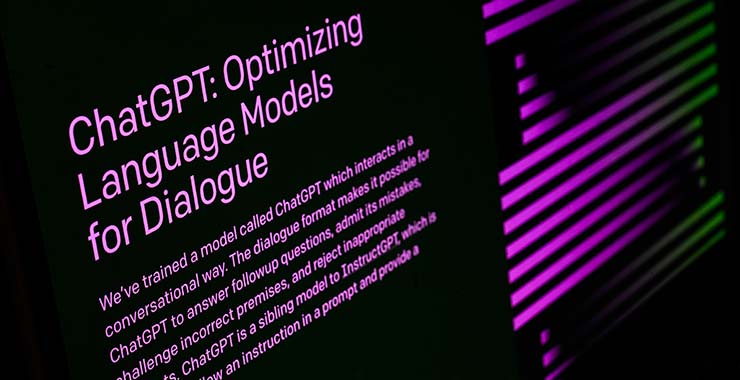
ChatGPT offers fast and easy access to information, which you may deem inappropriate in certain learning scenarios. But finding ways to incorporate AI tools in your course could actually help prepare students for the real world, where they’ll need to apply concepts rather than simply recall facts. “We want to train students how to think like a psychologist rather than how to know what a psychologist knows,” Oppenheimer said.
The bot may be best used to help students think critically about topics they’re already familiar with, said Gary Lupyanopens in new window, PhD, a professor of psychology at the University of Wisconsin–Madison. “Like talking with a colleague, it can be an interactive partner that’s useful in areas you know a lot about already, so you can critically evaluate the suggestion without blindly copying it,” he said.
For example, Oppenheimer teaches a course on human intelligence and stupidity, in which he encourages students to compare GPT-generated text with human-generated text. Hirsh-Pasek actually requires her honors psychology students to use ChatGPT, asking them to use ChatGPT for a first draft and edit a second draft with critiques, corrections, and additions. “A really good essay is not just a synthesis of information, but also the ability to support a thesis,” she said. “ChatGPT teaches students to ask better questions and then defend those questions, which could help them become real scientists.”
ChatGPT can also be used to incite classroom or lab discussion, said James W. Pennebakeropens in new window, PhD, a professor of psychology at the University of Texas at Austin. For example, you could ask the bot why one theory is better than another. Then, ask again why the second theory is better. “Students can learn to appreciate other arguments and see both sides objectively before establishing an opinion,” he said.
Using ChatGPT in your course not only encourages critical thinking about class concepts, but it also encourages your students to be technologically literate in an increasingly tech-centric world. “We should be thinking about the world we’re preparing our students to enter and what habits of thinking we want to instill in them so they can successfully represent the discipline of psychology,” said Oppenheimer. “That means figuring out how to incorporate novel technology they will be using in the real world into classroom exercises.”