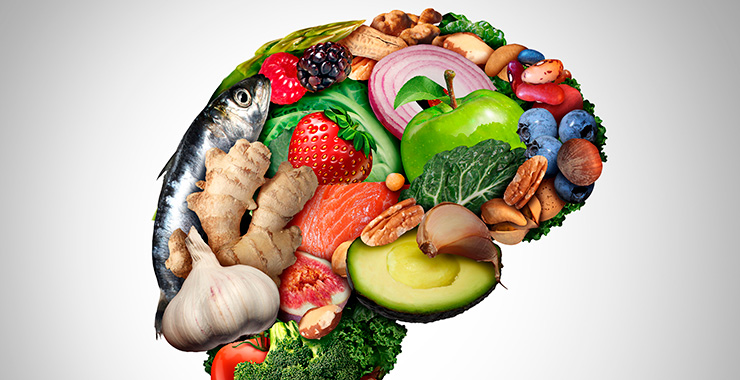
Researchers are taking this basic information and studying how different diets impact various mental health conditions. They are finding that diets that feature whole foods and contain diverse nutrients—like those promoted in the Mediterranean, Japanese, and Norwegian diets—can have a positive impact on many conditions. They are also finding that high-quality vitamin and mineral supplements—as well as amino acids, herbal formulations, and probiotics—can help as well. (For recent clinical guidelines on this topic, see Sarris, J., et al., The World Journal of Biological Psychiatry, Vol. 23, No. 6, 2022opens in new window).
Depression is the most widely examined condition in this research, with studies showing that improved nutrition can help people with both nonclinical and clinical levels of the disorder. For example, a meta-analysis of 16 randomized controlled trials—mostly with samples of people who had nonclinical depression—found that dietary interventions significantly reduced depressive symptoms though they had less effect on anxiety, found Joseph Firth, PhD, of the University of Manchester in the United Kingdom, and colleagues (
Psychosomatic Medicine
, Vol. 81, No. 3, 2019
opens in new window).
Similarly, a randomized controlled trial conducted by South Australia-based psychologist Natalie Parletta, PhD, and colleagues found positive effects of a healthy diet intervention for adults with self-reported depression. Ninety-five participants received either 3 months of biweekly cooking classes featuring a Mediterranean diet and 6 months of fish-oil supplements or 3 months of biweekly fun and stimulating social groups along with 3 additional months of fish-oil supplements.
The moods of all participants improved by the end of 6 months, but the diet group did better: Their depression scores fell by 45% compared with 26.8% in the social group. In addition, the diet group’s reduced depression was related to specific types of food intake, including eating a diversity of vegetables, consuming nuts, and adhering to a Mediterranean diet overall (
Nutritional Neuroscience
, Vol. 22, No. 7, 2019
opens in new window).
High-quality diets also appear to have a positive effect on people with major depressive disorder, other studies are finding. In a randomized controlled trial known as SMILES (Supporting the Modification of Lifestyle in Lowered Emotional States), psychiatric epidemiologist Felice N. Jacka, PhD, director of the Institute for Mental and Physical Health and Clinical Translation (IMPACT)’s Food & Mood Centre at Deakin University in Victoria, Australia, and colleagues tested two interventions on adults with major depressive disorder. Thirty-three participants received seven individual nutritional consulting sessions delivered by a clinical dietitian, and 34 other participants received seven visits from trained personnel who “befriended” them—who chatted with them about subjects of interest and engaged with them in fun and positive activities. After 12 weeks, 32.3% of those in the dietary group had no reported symptoms of depression, compared with 8% of those in the social support group (
BMC Medicineopens in new window
, Vol. 15, No. 1, 2017). Similar results were found in a randomized controlled trial by Jessica Bayes, PhD, of the University of Technology Sydney in Australia, and colleagues, who showed that a 12-week Mediterranean diet intervention improved moderate to severe depression symptoms in young men more than a befriending intervention (
The American Journal of Clinical Nutrition
, Vol. 116, No. 2, 2022
opens in new window).
Another condition that is showing promise with nutritional interventions is ADHD, a major focus of Rucklidge’s work. In 2014, she and colleagues conducted the first blinded randomized controlled trial to examine the effects of a micronutrient supplement on adults with ADHD.
Compared with 38 participants who took a placebo, 42 participants who took the formula reported having fewer ADHD symptoms, including inattention, hyperactivity, and impulsivity, at the end of 8 weeks. Moreover, among participants who had moderate to severe depression at the beginning of the study, those who took the supplement were much more likely to report improved mood at the end of the study than those taking the placebo. But there were no differences between groups on clinician ratings of ADHD (
The British Journal of Psychiatry
, Vol. 204, No. 4, 2014
opens in new window).
In a second blinded randomized controlled trial, Rucklidge and colleagues compared how nonmedicated children diagnosed with ADHD fared over 10 weeks when they received a placebo or a broad-spectrum micronutrient formula.
At the end of the study, 32% of the children taking the supplement showed clinically meaningful improvement on symptoms of inattention, compared with 9% of kids taking the placebo. They also had greater improvements in emotional regulation, aggression, and general functioning (
The Journal of Child Psychology and Psychiatry
, Vol. 59, No. 3, 2018
opens in new window).
Those findings were replicated in another randomized controlled trial headed by psychologist Jeanette M. Johnstone, PhD, of the Oregon Health and Science University in Portland. Over the course of 8 weeks, 135 nonmedicated children with ADHD at three sites—Portland, Oregon; Columbus, Ohio; and Alberta, Canada—received either a placebo or a broad-spectrum multinutrient containing all known vitamins and essential minerals.
More than half of those who received the formula—54%—showed improved symptoms overall, compared with 18% of controls, based on blinded clinician ratings. The findings suggested another potential benefit as well: Children on the formula grew six millimeters taller over 8 weeks than kids on placebo when other basic factors were controlled for. That is a potentially important finding because suppressed height may be a concern with standard ADHD medications, Johnstone noted (
Journal of the American Academy of Child & Adolescent Psychiatry
, Vol. 61, No. 5, 2022
opens in new window).
Others are investigating the effects of nutritional interventions on more serious conditions as well, including bipolar disorder, eating disorders, and psychotic disorders, as well as autism. They are also looking into the effects of particular kinds of diets and foods on some of these disorders. These include potential impacts of the ketogenic (low-carb, high-fat) diet on bipolar disorder (Campbell, I. H., & Campbell, H., BJPsych Open, Vol. 5, No. 4, 2019opens in new window) and Alzheimer’s disease (Phillips, M. C. L., et al., Alzheimer’s Research & Therapy, Vol. 13, No. 51, 2021opens in new window), and of a gluten-free diet as an adjunctive treatment for people with schizophrenia (Levinta, A., et al., Advances in Nutrition, Vol. 9, No. 6, 2018opens in new window). While there is some promise in all these areas, more research is needed to demonstrate their effectiveness, according to these studies.
Researchers conducting this work also comment that it raises questions about what constitutes good treatment in general, including about the kinds of outcomes providers should be looking for.
For example, while Rucklidge’s study on children with ADHD found improvements on symptoms like inattention, there were no group differences on parent and teacher reports of hyperactivity and impulsivity, some of the main hallmarks of the disorder. But parents and teachers did see a rise in other positive outcomes that are not specifically related to ADHD symptoms, such as reduced anger and a greater ability to regulate emotions and cope with stressors.
In addition, children in the study did not have to cope with side effects that can sometimes occur with traditional ADHD medications, such as dizziness, moodiness, loss of appetite, and trouble sleeping. Instead, by applying nutritional interventions that do not have these side effects, some kids can improve functioning and learn better. “So, when we think about treatments for these kids, I really do encourage a more holistic approach,” Rucklidge said. In fact, she has applied for and received approval from Pharmac, New Zealand’s equivalent of the Food and Drug Administration, for practitioners to prescribe the micronutrient formula used in her studies as a second-tier treatment. So if conventional medications have not worked or have intolerable side effects, practitioners can try these supplements instead. (There are still many steps that need to occur before Pharmac will actually pay for the use of the formula, however, Rucklidge noted.)