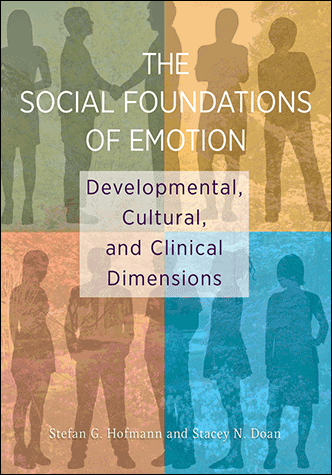
The Social Foundations of Emotion
Available formats
Also available from
Many researchers today view emotions as biologically based, evolutionary adaptations to environmental stimuli. In this book, Stefan G. Hofmann and Stacey N. Doan argue that emotions cannot be understood without taking into account the dynamic social and cultural worlds we inhabit.
They propose instead a "core self,"which contains the biological basis for our emotions, and a "social self," which develops over time and embraces the shifting social and cultural influences around us as we grow and learn.
Through a wealth of clinical case examples and an expert synthesis of contemporary research, Hofmann and Doan examine how emotions are determined and regulated internally and externally, via social bonds and feedback.
By emphasizing the client's social world, they show clinicians how to offer treatment solutions to common mental health problems, such as depression and anxiety.
They also show that sociocultural context is not just a contributing factor to emotional development but an essential element for understanding the complex foundations of human emotion.
Acknowledgments
Introduction
- Defining Emotions
- Social Self and Emotions
- Social Neuroscience of Emotions
- Sociocultural Aspects of Emotions
- Socialization of Emotions
- Moral and Collective Emotions
- Social Regulation of Emotions
- Social-Emotional Aspects of Mental Disorders
- Conclusion
References
Index
About the Authors
Stefan G. Hofmann, PhD, is a professor of psychology in the Department of Psychological and Brain Sciences, Boston University, where he directs the Psychotherapy and Emotion Research Laboratory.
He has an actively funded research program studying various aspects of emotional disorders with a particular emphasis on anxiety disorders and cognitive behavioral therapy.
He has won many prestigious professional awards, including the Aaron T. Beck Award for Significant and Enduring Contributions to the Field of Cognitive Therapy by the Academy of Cognitive Therapy and the Alexander von Humboldt Research Award.
He is a fellow of the Association for Psychological Science and was president of various national and international professional societies, including the Association for Behavioral and Cognitive Therapies and the International Association for Cognitive Psychotherapy.
He was also an advisor to the Diagnostic and Statistical Manual of Mental Disorders, Fifth Edition (DSM–5) development process and a member of the DSM–5 Anxiety Disorder Sub-Work Group.
Dr. Hofmann has been identified as a highly cited researcher by Thomson Reuters. He is currently editor of Cognitive Therapy and Research and associate editor of Clinical Psychological Science.
He has published more than 300 peer-reviewed journal articles and 15 books, including An Introduction to Modern CBT: Psychological Solutions to Mental Health Problems and Emotion in Therapy, and a popular textbook (with David Barlow and Mark Durand), Abnormal Psychology: An Integrative Approach.
For more information, visit the Psychotherapy and Emotion Research Laboratoryopens in new window website.
Stacey N. Doan, PhD, received her BA from Carleton College and her PhD from Cornell University.
She is an associate professor of psychology at Claremont McKenna College and director of the Applied Mind and Health Laboratory and the Berger Institute.
She is the recipient of Early Career Awards from the Western Psychological Association and from the Society for Research on Child Development.
Her research is funded by the National Institutes of Health.
She is a frequent speaker on topics such as parenting, emotions, and mind–body interactions, and she has published more than 30 papers in some of the best child development and health psychology journals.
Longtime emotion researchers will find a thorough review of theories and research, but also a fresh perspective on emotions emphasizing social and cultural influences. This book is timely, as it provides a much-needed update to the psychology behind emotions. Highly recommended.
—Choice
Stefan Hofmann and Stacey Doan have done a fantastic job of synthesizing contemporary understanding of emotions, elegantly weaving together research findings from cognitive, affective, social and developmental psychology with clinical science. The Social Foundations of Emotion is broad and fresh, and will be a valuable resource for academics and clinicians, and also for lay people who explore this important topic.
—Joseph LeDoux, author of Anxious, Synaptic Self and The Emotional Brain
Our social worlds act on and are mediated through our emotions, so our social and emotional lives are nearly one and the same. With this volume, Hofmann and Doan draw our attention to the fundamentally social nature of emotion and its regulation. Scholars looking for safe passage through the theoretical minefield of emotion research are not likely to find a more reliable guide than this.
—James Coan, PhD
Professor of Psychology and Director of the Virginia Affective Neuroscience Laboratory, University of Virginia, Charlottesville
Social constructivism, which has influenced the rest of the humanities, has left developmental, cognitive, and clinical psychology largely untouched as most researchers in these disciplines continue to focus on emotions as intrapersonal processes. This book bridges the intrapersonal– interpersonal gap by using contemporary emotion science to highlight often surprising social influences on a variety of psychological and underlying mechanistic processes.
—Greg Siegle, PhD
Associate Professor of Psychiatry, University of Pittsburgh School of Medicine, Pittsburgh, PA
With data and careful argument, Hofmann and Doan steadfastly challenge pat answers about why emotions are key to understanding human beings. They show how emotion develops as an emergent property of a multidimensional and multilayered network of social, cognitive, self, motivational, neurobiological, and cultural systems. This book will change your fundamental view of emotion. Highly recommended.
—Steven C. Hayes, PhD
Foundation Professor of Psychology, University of Nevada, Reno