skip to main content
Cover story

AI is changing every aspect of psychology. Here’s what to watch for

Psychologists and their skills are irreplaceable, but thoughtful and strategic implementation of AI is crucial

APA Style leaf logo Cite This Article in APA Style
Abrams, Z. (2023, July 1). AI is changing every aspect of psychology. Here’s what to watch for. Monitor on Psychology, 54(5). https://www.apa.org/monitor/2023/07/psychology-embracing-ai

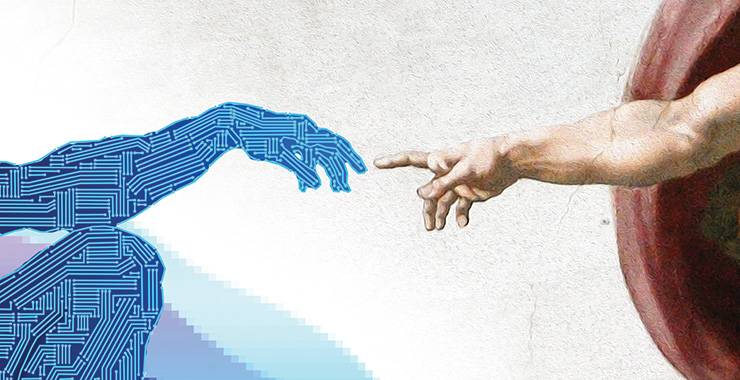
graphic of Michelangelo's Adam with technology pattern on skin reaching out and touching human finger

In psychology practice, artificial intelligence (AI) chatbots can make therapy more accessible and less expensive. AI tools can also improve interventions, automate administrative tasks, and aid in training new clinicians. On the research side, synthetic intelligence is offering new ways to understand human intelligence, while machine learning allows researchers to glean insights from massive quantities of data. Meanwhile, educators are exploring ways to leverage ChatGPT in the classroom.

“A lot of people get resistant, but this is something we can’t control. It’s happening whether we want it to or not,” said Jessica Jackson, PhD, a licensed psychologist and equitable technology advocate based in Texas. “If we’re thoughtful and strategic about how we integrate AI, we can have a real impact on lives around the world.”

[Related: How to use ChatGPT as a learning tool]

Despite AI’s potential, there is still cause for concern. AI tools used in health care have discriminated against people based on their race and disability status (Grant, C., ACLU News and Commentary, October 3, 2022opens in new window). Rogue chatbots have spread misinformationopens in new window, professed their love to usersopens in new window, and sexually harassed minorsopens in new window, which prompted leaders in tech and science to call for a pause to AI researchopens in new window in March 2023.

“A lot of what’s driving progress is the capacities these systems have—and that’s outstripping how well we understand how they work,” said Tom Griffiths, PhD, a professor of psychology and computer science who directs the Computational Cognitive Science Labopens in new window at Princeton University. “What makes sense now is to make a big parallel investment in understanding these systems,” something psychologists are well positioned to help do.

Uncovering bias

As algorithms and chatbots flood the system, a few crucial questions have emerged. Is AI safe to use? Is it ethical? What protections could help ensure privacy, transparency, and equity as these tools are increasingly used across society?

Psychologists may be among the most qualified to answer those questions, with training on various research methodologies, ethical treatment of participants, psychological impact, and more.

“One of the unique things psychologists have done throughout our history is to uncover the harm that can come about by things that appear equal or fair,” said Adam Miner, PsyD, a clinical assistant professor of psychiatry and behavioral sciences at Stanford University, citing the amicus brief filed by Kenneth Clark, PhD, and Mamie Phipps Clark, PhD, in Brown v. Board of Education.

[Related: AI in hiring: More research required]

When it comes to AI, psychologists have the expertise to question assumptions about new technology and examine its impact on users. Psychologist Arathi Sethumadhavan, PhD, the former director of AI research for Microsoft’s ethics and society team, has conducted research on DALL-E 2, GPT-3, Bing AI, and others.

Sethumadhavan said psychologists can help companies understand the values, motivations, expectations, and fears of diverse groups that might be impacted by new technologies. They can also help recruit participants with rigor based on factors such as gender, ancestry, age, personality, years of work experience, privacy views, neurodiversity, and more.

With these principles in mind, Sethumadhavan has incorporated the perspectives of different impacted stakeholders to responsibly shape products. For example, for a new text-to-speech feature, she interviewed voice actors and people with speech impediments to understand and address both benefits and harms of the new technology. Her team learned that people with speech impediments were optimistic about using the product to boost their confidence during interviews and even for dating and that synthetic voices with the capability to change over time would better serve children using the service. She has also applied sampling methods used frequently by psychologists to increase the representation of African Americans in speech recognition data sets.

“In addition, it’s important that we bring in the perspectives of people who are peripherally involved in the AI development life cycle,” Sethumadhavan said, including people who contribute data (such as images of their face to train facial recognition systems), moderators who collect data, and enrichment professionals who label data (such as filtering out inappropriate content).

Psychologists are also taking a close look at human-machine interaction to understand how people perceive AI and what ripple effects such perceptions could have across society. One study by psychologist Yochanan Bigman, PhD, an assistant professor at the Hebrew University of Jerusalem, found that people are less morally outraged by gender discrimination caused by an algorithm as opposed to discrimination created by humans (Journal of Experimental Psychology: General, Vol. 152, No. 1, 2023opens in new window). Study participants also felt that companies held less legal liability for algorithmic discrimination.

In another study, Bigman and his colleagues analyzed interactions at a hotel in Malaysia employing both robot and human workers. After hotel guests interacted with robot workers, they treated human workers with less respect (working paper).

“There was a spillover effect, where suddenly we have these agents that are tools, and that can cause us to view humans as tools, too,” he said.

Many questions remain about what causes people to trust or rely on AI, said Sethumadhavan, and answering them will be crucial in limiting harms, including the spread of misinformation. Regulators are also scrambling to decide how to contain the power of AI and who bears responsibility when something goes wrong, Bigman said.

“If a human discriminates against me, I can sue them,” he said. “If an AI discriminates against me, how easy will it be for me to prove it?”


AI in the clinic

Psychology practice is ripe for AI innovations—including therapeutic chatbots, tools that automate notetaking and other administrative tasks, and more intelligent training and interventions—but clinicians need tools they can understand and trust.

While chatbots lack the context, life experience, and verbal nuances of human therapists, they have the potential to fill gaps in mental health service provision.

“The bottom line is we don’t have enough providers,” Jackson said. “While therapy should be for everyone, not everyone needs it. The chatbots can fill a need.” For some mental health concerns, such as sleep problems or distress linked to chronic pain, training from a chatbot could suffice.

In addition to making mental health support more affordable and accessible, chatbots can help people who may shy away from a human therapist, such as those new to therapy or people with social anxiety. They also offer the opportunity for the field to reimagine itself, Jackson said—to intentionally build culturally competent AIs that can make psychology more inclusive.

“My concern is that AI won’t be inclusive,” Jackson said. “AI, at the end of the day, has to be trained. Who is programming it?”

Other serious concerns include informed consent and patient privacy. Do users understand how the algorithm works, and what happens to their data? In January, the mental health nonprofit Koko raised eyebrows after it offered counseling to 4,000 people without telling them the support came from ChatGPT-3. Reports have also emerged that getting therapy from generative language models (which produce different text in each interaction, making it difficult to test for clinical validity or safety) has led to suicideopens in new window and other harmsopens in new window.

But psychology has AI success storiesopens in new window, too. The Wysa chatbotopens in new window does not use generative AI, but limits interactions to statements drafted or approved by human therapists. Wysa does not collect email addresses, phone numbers, or real names, and it redacts information users share that could help identify them.

The app, which delivers cognitive behavioral therapy for anxiety and chronic pain, has received Breakthrough Device Designation from the United States Food and Drug Administration. It can be used as a stand-alone tool or integrated into traditional therapy, where clinicians can monitor their patients’ progress between sessions, such as performance on cognitive reframing exercises.

“Wysa is not meant to replace psychologists or human support. It’s a new way to receive support,” said Smriti Joshi, MPhil, the company’s chief psychologist.

AI also has the potential to increase efficiency in the clinic by lowering the burden of administrative tasks. Natural language processing tools such as Eleosopens in new window can listen to sessions, take notes, and highlight themes and risks for practitioners to review. Other tasks suited to automation include analysis of assessments, tracking of patient symptoms, and practice management.

Before integrating AI tools into their workflow, many clinicians want more information on how patient data are being handled and what apps are safe and ethical to use. The field also needs a better understanding of the error rates and types of errors these tools tend to make, Miner said. That can help ensure these tools do not disenfranchise groups already left out of medical systems, such as people who speak English as a second language or use cultural idioms of distress.

Miner and his colleagues are also using AI to measure what’s working well in therapy sessions and to identify areas for improvement for trainees (npj Mental Health Research, Vol. 1, No. 19, 2022opens in new window). For example, natural language models could search thousands of hours of therapy sessions and surface missed opportunities to validate a patient or failures to ask key questions, such as whether a suicidal patient has a firearm at home. Training software along these lines, such as Lyssnopens in new window—which evaluates providers on their adherence to evidence-based protocols—is starting to hit the market.

“To me, that’s where AI really does good work,” Miner said. “Because it doesn’t have to be perfect, and it keeps the human in the driver’s seat.”

Transforming research

For researchers, AI is unlocking troves of new data on human behavior—and providing the power to analyze it. Psychologists have long measured behavior through self-reports and lab experiments, but they can now use AI to monitor things like social media activity, credit card spending, GPS data, and smartphone metrics.

“That actually changes a lot, because suddenly we can look at individual differences as they play out in everyday behavior,” said personality psychologist and researcher Sandra Matz, PhD, an associate professor at Columbia Business School.

Matz combines big data on everyday experiences with more traditional methods, such as ecological momentary assessments (EMAs). Combining those data sources can paint a picture of how different people respond to the same situation, and ultimately shape personalized interventions across sectors, for instance in education and health care.

AI also opens up opportunities for passive monitoring that may save lives. Ross Jacobucci, PhD, and Brooke Ammerman, PhD, both assistant professors of psychology at the University of Notre Dame, are testing an algorithm that collects screenshots of patients’ online activity to flag the use or viewing of terms related to suicide and self-harm. By pairing that data with EMAs and physiological metrics from a smart watch, they hope to build a tool that can alert clinicians in real time about patients’ suicide risk.

“The golden goose is passive sensing,” Jacobucci said. “How can that inform, not only who is at risk, but more importantly, when they’re at risk?”

Natural language processing models are also proving useful for researchers. A team at Drexel University in Philadelphia has shown that GPT-3 can predict dementia by analyzing speech patterns (Agbavor, F., & Liang, H., PLOS Digital Health, Vol. 1, No. 12, 2022opens in new window). Cognitive psychologists are testing GPT’s performance on canonical experiments to learn more about how its reasoning abilities compare to humans (Binz, M., & Schulz, E., PNAS, Vol. 120, No. 6, 2023opens in new window). Griffiths is using GPT as a tool to understand the limits of human languageopens in new window.

“These models can do a lot of things that are very impressive,” Griffiths said. “But if we want to feel safe in delegating tasks to them, we need to understand more about how they’re representing the world—and how it might differ from the way we think about it—before that turns into a problem.”

With their toolbox for understanding intelligent systems, psychologists are in the perfect position to help. One big question moving forward is how to prepare graduate students to collaborate more effectively with the computer scientists who build AI models.

“People in psychology don’t know the jargon in computer science and vice versa—and there are very few people at the intersection of the two fields,” Jacobucci said.

Ultimately, AI will present challenges for psychologists, but meeting those challenges carries the potential to transform the field.

“AI will never fully replace humans, but it may require us to increase our awareness and educate ourselves about how to leverage it safely,” Joshi said. “If we do that, AI can up the game for psychology in so many ways.”

Recommended Reading

Speaking of Psychology

Subscribe to APA’s audio podcast series highlighting some of the most important and relevant psychological research being conducted today.

Subscribe to Speaking of Psychology and download via:

Appleopens in new window
Apple podcast logo

Spotifyopens in new window
Spotify logo

You may also like