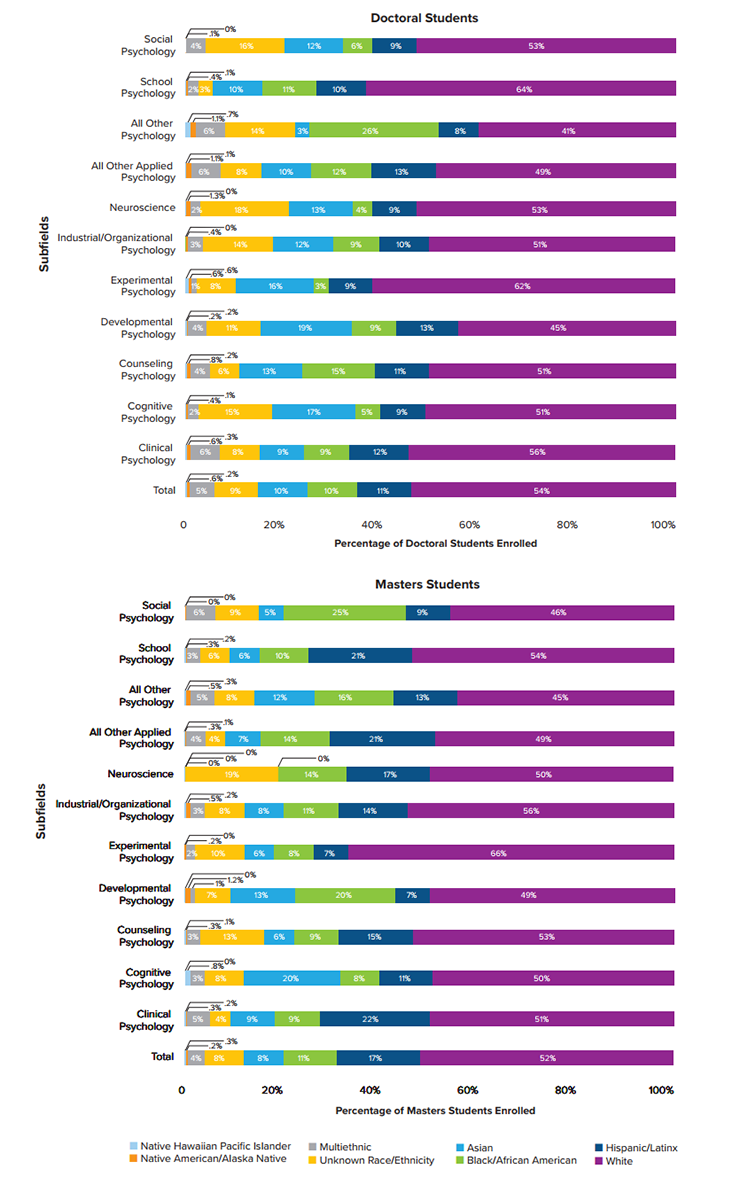
In psychology master’s programs in the 2021–22 academic year, the racial/ethnic background of enrolled students was: 0.2% Native Hawaiian/Pacific Islander, 0.3% Native American/Alaska Native, 4% multiethnic, 8% unknown, 8% Asian, 11% Black, 17% Hispanic, and 52% White.1 Students enrolled in psychology doctoral programs were 0.2% Native Hawaiian/Pacific Islander, 0.6% Native American/Alaska Native, 5% multiethnic, 9% unknown, 10% Asian, 10% Black, 11% Hispanic, and 54% White.
Racial diversity varied across both subfields and degree levels.2 At the master’s level, programs in clinical psychology reported the greatest racial diversity. At the doctoral level, programs in developmental psychology reported the greatest racial diversity. Both master’s and doctoral programs in experimental psychology reported the lowest racial diversity.
Graduate psychology programs can use these findings as benchmarks or to compare the racial diversity within their graduate programs to racial/ethnic patterns for specific degree levels or subfields. These findings can also be used to guide decisions about how to attract the next generation of diverse psychology professionals.