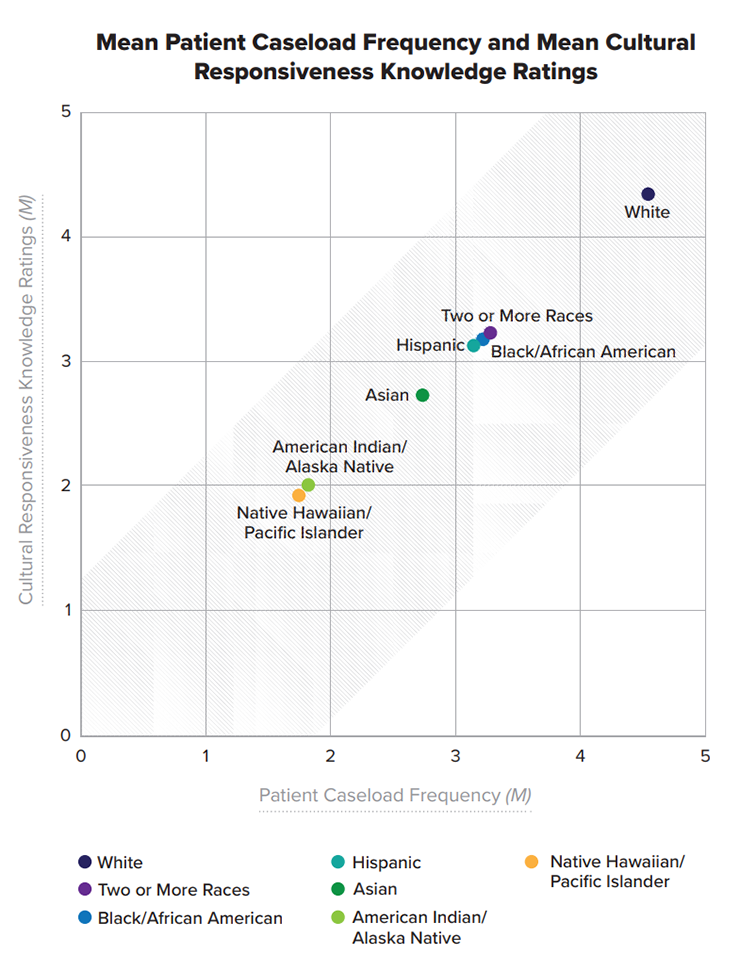
The more often psychologists see patients of a certain race or ethnicity, the more knowledgeable they are about treating patients from that racial or ethnic group, according to data from APA’s Center for Workforce Studies (CWS). Specific findings from the data:
- How frequently psychologists treated patients from a population group is highly associated with psychologists’ self-reported cultural responsiveness knowledge rating for that group.1
- Patient caseloads and cultural responsiveness knowledge ratings were lowest for Native Hawaiian/Pacific Islander were highest for White populations. Caseloads and ratings for Asian, Black/African American, and Hispanic populations and those with two or more races or ethnicities fell in the middle of the distribution.
- Findings highlight the need to attract and maintain a diverse psychologist workforce and ensure the workforce is appropriately sized and prepared to work with diverse populations. In 2021, the psychologist workforce was 0.03% Native Hawaiian/Pacific Islander, 0.13% American Indian/Alaska Native, 3% Asian, 5% Black/African American, 8% Hispanic, 81% White, and 3% all additional racial or ethnic populations.2