Despite attempts to eliminate bias from school discipline policies, Black students continue to receive harsher punishments than White students for the same infractions. But Jason Okonofua, PhD, an assistant professor of psychology at the University of California, Berkeley, is working to change that. He developed an intervention, known as empathic discipline, that helps teachers cultivate a growth mindset and respond with empathy when students act out.
“In the heat of the moment when a student misbehaves, it allows teachers to be more mindful about just what that misbehavior is, how to interpret it, and most important, what a productive response would be,” he said.
Research shows his intervention can lead to dramatic improvements in biased discipline, reducing racial disparities in suspension by up to 50%.
Okonofua has also developed a similar intervention to help students transition from the juvenile justice system back into schools, with promising early reductions in recidivism, and is exploring ways “sidelining bias” can help reduce discrimination.
How can the interplay between students and teachers lead to racial disparities in disciplinary action?
The teacher-student relationship involves a power dynamic. There’s a person in a position of authority and a subordinate and an ongoing relationship, as opposed to a one-off encounter, like one between a police officer and a civilian. Those distinctions really matter when it comes to understanding how problems arise, but also what we can do to turn them around.
[Related: Boys are facing key challenges in school. Inside the effort to support their success]
What we’ve found is that it’s important to think about the teacher-student relationship in a holistic manner, as opposed to just focusing on one party. Research by Claude Steele and others shows that if someone feels they will be a victim of discrimination, that can change how they relate to a situation. For students who are racially stigmatized, that may mean they engage in behaviors that are considered infractions, like insubordination or not following instructions. On the teacher side, research I did with colleagues at Stanford found that teachers are more likely to label a Black student as a troublemaker and to seek more severe discipline for them, compared with White students.
These processes interact with each other and can ultimately become a vicious cycle, in which neither the teacher nor the student is getting what they want. Students go to school to learn and become their best possible selves; teachers joined the profession to help students learn and grow. Instead, we end up with students dropping out or being kicked out of school and teachers who are disheartened.
How does your intervention help teachers respond to students more productively?
Teachers are some of the most empathic people in society, so the intervention helps them bring those values to mind and put them into practice. The key thing to know is that it’s still discipline. We don’t tell teachers to just let students run amok, but rather discipline them in a productive way that will lead to the outcomes we want.
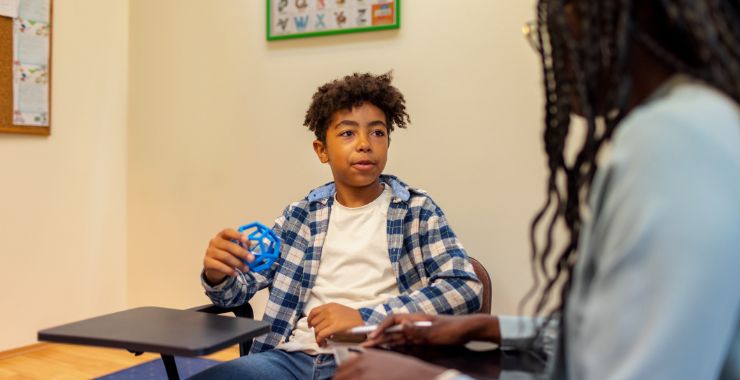
The empathic discipline intervention is delivered in two 45-minute online, interactive exercises that teachers complete during their regular teacher-development time. It consists of three major themes. One is shifting from a fixed to a growth mindset about the student. When a student misbehaves, that’s not an indictment of their character, but rather an opportunity for the teacher to help that child learn and grow. A lot of times misbehaviors are actually a cry for help.
Another component is having a growth mindset about one’s capacity to build a better relationship with a student. If there has been conflict, teachers have the knowledge and expertise to turn a relationship around. The third component is perspective-getting. Rather than imagining what the student might be going through, we encourage teachers to ask students what they’re going through and what they’re feeling. That gives teachers real information that can inform the type of discipline they give, and it also shows the student they care.
In a preliminary test across three Northern California school districts, with a sample of about 1,700 students, the intervention cut racial disparities in suspension rates by 50%. In a recent replication of this work in Florida schools with about 6,000 students with a different racial makeup, it cut the racial disparities in suspension rates by 45%. The intervention was also particularly effective in lowering suspension rates among students who had previously been suspended, which is the biggest predictor of future suspension. The intervention also completely eradicated disparities in discipline rates due to special education status.
[Related: Keeping youth engaged in school]
What’s also really promising is that when we followed up with students a year later—when most no longer had a teacher trained in empathic discipline—they remained less likely to be suspended. It seems like this is not only shifting things for teachers but providing a fundamental shift in the development of students. Having just one person treat them with more empathy led them to get in less trouble throughout the school day, but then also for multiple years. We are now providing school districts with professional development based on this research.
How do you use these same principles to help kids involved with the justice system transition back into schools?
We led students who had recently been released from juvenile detention through exercises to help them develop a growth mindset and to emphasize that they belong in society and in school. We asked them questions about their values and challenges they might face, then used language from empathic discipline to craft a letter to a teacher of their choice. The letter encouraged teachers to find out more about that student and provided them with the values and information that student shared, again targeting the relationship rather than individuals. This “relationship-orientation” intervention cut recidivism by 60%, and students who received it were also less likely to be disciplined at school.
At the teacher level, what that letter did was profound, because it encouraged them to be more involved in helping children learn and grow, and to show care to children who might not receive that type of care outside of school.
[Related: Cultivating empathy]
What does it mean to “sideline bias” and how can it reduce racial disparities in schools and beyond?
People are complex beings, with multiple identities. Like in sports, we tend to put some of those selves on the sidelines in various contexts. We’re exploring how to reorganize various contexts to sideline biased selves in pivotal situations, rather than trying to debias individual people. We’re finding it effective in getting the outcomes we want—things like reduced recidivism, lower disparities in suspension rates, and better access to education.
Now, my team and I are looking at ways to integrate this into health care and the workplace and how to support this mindset shift so that these interventions have even larger and longer-lasting effects.