American Psychological Association. (2024, January 1). Psychologists persevere in EDI work despite growing backlash against racial equity efforts. Monitor on Psychology, 55(1). https://www.apa.org/monitor/2024/01/trends-anti-equity-diversity-inclusion-laws
During the past year, many private industry and public institutions have cut equity, diversity, and inclusion (EDI, also referred to as DEI) funds and positions, leaving psychologists who filled many of these roles—and especially the racial equity work they have done—in limbo. In addition to these challenges, there have also been legislative battles, both at state and national levels, to undermine racial equity efforts. Recent developments such as the Students for Fair Admissions v. Harvard decision by the Supreme Court of the United States (SCOTUS), which eliminated the use of race-based affirmative action in college admissions decisions, and efforts by state legislatures to pass anti-EDI laws have created a number of legal, financial, and social roadblocks for those who are doing the work to create a more just and equitable society.
“This has never been easy work, but this is a particularly hard climate right now to be fighting this fight,” said Brooke Vick, PhD, a social psychologist and the chief diversity officer and associate provost for equity and inclusion at Muhlenberg College in Allentown, Pennsylvania. “It’s particularly hard to do this work against forces that feel big and out of your control.”
Anti-EDI legislation
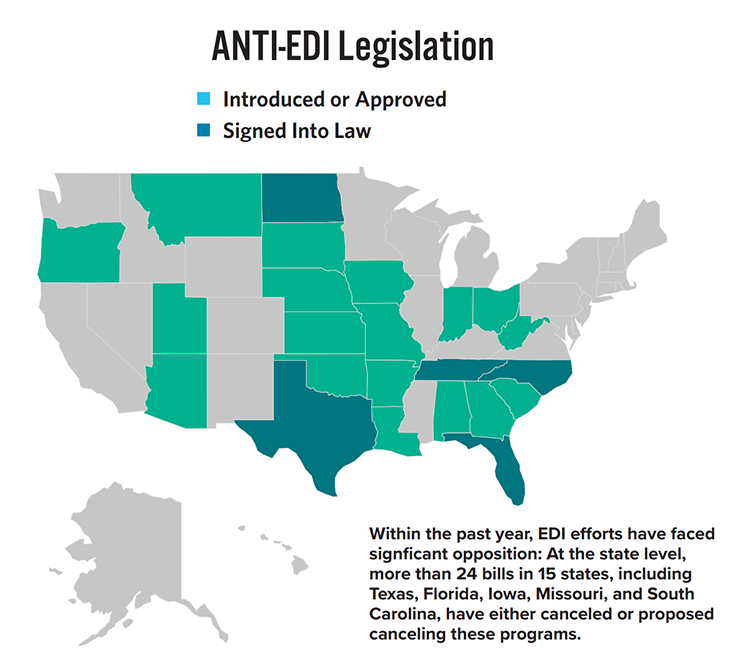
Within the last year, EDI programs have faced a significant number of legislative efforts aimed at either undermining or eliminating their endeavors. At the state level, more than 24 bills in 15 statesopens in new window, including Texas, Florida, Iowa, Missouri, and South Carolina, have either canceled or proposed canceling EDI programs. This includes Florida Governor Ron DeSantis announcing he would block EDI programs at state colleges and Texas Governor Greg Abbott signing a bill banning EDI offices and initiatives at higher education institutions.
Some of these bills have passed into law, while others are still being debated. However, even if these bills never become law, the damage may already have been done. “There are still open questions about whether the law even needs to be passed,” said Skyler Jackson, PhD, an assistant professor of social and behavioral sciences at Yale School of Public Health, where his work focuses on the ways social identities such as race, gender, and sexual orientation influence mental health and well-being. “Your identity or social group becoming a high-profile controversial topic that is discussed on the news, in your classroom, or in your home, that can be enough to lead to a feeling of isolation, alienation, and stress.”
More than 3 years after summer 2020, when many companies and public institutions made pledges to increase racial diversity in the wake of the murder of George Floyd, the story on the ground is far less optimistic than what many had hoped for. “There’s two different sides,” said Courtney Bryant Shelby, PhD, an organizational psychologist and founder of Simply You Solutions, LLC. “DEI has fallen off in some places, and in other places, companies are buckling down and saying, ‘It’s a part of our values, so we’re here for the long haul.’” As Shelby notes, a lot of chief diversity officers and EDI employees are losing their jobs after funding cuts or are quitting because of burnout. For example, Hollywood recently saw an exodus of six EDI leadersopens in new window, from companies such as Netflix, Disney, and Warner Bros. Discovery, owing to a mixture of company restructuring and voluntary resignations.
For those who are still in EDI roles, the current backdrop of anti-EDI legislation is making these jobs much harder, as many find themselves having to navigate a very fine line—one that ensures compliance with the law while also finding ways of achieving their goals—with far fewer resources than needed. “It is having a chilling effect on the implementation of new ideas,” Vick said. “A lot more time and resources are being spent in a way that is not advancing our goals.”
Even within this context, there is still cause for hope, as these laws do not affect equity initiatives by private companies, nor do they explicitly outlaw certain types of efforts, such as strategies to increase the racial diversity of an applicant pool. However, “it’s making people nervous that there’s a group that will come for [their EDI efforts] next,” Shelby said.
SCOTUS decision
Although the full impact of the SCOTUS decision banning race-based affirmative action in college admissions will only be realized years down the road, similar state measures foreshadow the results. One example is Proposition 209, passed in California in 1996, which made it illegal to use race, ethnicity, or sex as a criterion for admissions to state schools. As a result, the percentage of underrepresented minorities dropped at many University of California campuses, including UC Berkeley and UCLA (Bleemer, Z., Affirmative Action, Mismatch, and Economic Mobility after California’s Proposition 209, 2020 [PDF, 2.7MB]opens in new window).
“Based on what happened in California after Prop. 209, we can expect to see, across the board, less diversity at our higher education institutions,” said Cynthia Pickett, PhD, a social psychologist and the chief diversity officer at Cal Poly Pomona. “I’m expecting that there will be a backslide.”
In the absence of affirmative action since the passing of Proposition 209, schools in California have devised other strategies for increasing diversity; however, these efforts tend to be less targeted and less effective. For example, although universities cannot make admissions decisions based on race, they can try to diversify the applicant pool, and they can factor major life experiences, such as experiencing adversities because of race, into application decisions. Such efforts can help increase the diversity of a campus, but are not quite as effective as the use of affirmative action.
If the proposed anti-EDI legislation does pass, research suggests that it can affect the physical and mental health of the people it targets. “When laws are introduced that attack or undermine the dignity of a population, it sends a message to them that they don’t matter, that their rights might be taken away,” Jackson said. “That can elevate stress, and that, over time, if chronic and not adequately coped with, can undermine their mental health.”
The ongoing role of psychologists
In this particular area, psychologists are uniquely situated to continue making progress, especially through clinical expertise and research.
Whether it is finding ways to support individuals who are facing the mental and physical toll of being stigmatized, coming up with effective strategies for increasing access to historically underrepresented groups, carrying out research to understand the factors leading to polarization, or working with legislators to create more equitable laws, psychologists possess essential skills that can further EDI efforts.
One major skill includes applying clinical expertise to the practice of racial equity work, which is often emotionally fraught. “Psychologists are experts at thinking about what it takes to create a safe place for people to explore and talk about things that are difficult, that are emotional, and that they aren’t encouraged by society to talk about, and these are the precise skills that are sorely needed to do effective DEI work,” Jackson said. “This is an area where psychology thrives.”
[Related: APA’s Inclusive Language Guide]
Another major skill is the broader practice of researching effective strategies for creating a more racially equitable societal framework. “One critical role that psychologists can play, in the long term, to secure the role of diversity and inclusion work in the fabric of our society, is to improve the science and the scientific rigor that shows DEI work is safe, [is] effective, and leads to a better society for all of us,” Jackson said. “Science is not going to save us alone. However, I do believe that the lack of good science is an additional vulnerability, and it is a place where psychologists are uniquely positioned to contribute.”
Some examples of researchers who are doing this crucial work are Kimberly Rios, PhD, at the University of Illinois Urbana-Champaign, who studies how people respond to threats to their social and personal identities, with a particular focus on majority versus minority identity, and Mark Hatzenbuehler, PhD, at Harvard University, who studies the effects of structural stigma, such as racist policies.
Rios, who runs the Conformity, Attitudes, Threat, and Stereotypes (CATS) Lab, is studying the backlash against EDI initiatives. “A lot of my own research looks at why members of dominant groups feel threatened by diversity,” said Rios. “These different sources of threat that dominant group members might feel are good predictors of eventual backlash” (Personality and Social Psychology Review, Vol. 26, No. 4, 2022opens in new window).
These threats can include practical concerns about losing resources, such as jobs, promotions, or educational opportunities. They can also be intangible, such as feeling left out of the conversation or failing to become invested in EDI efforts because of a lack of connection. “Dominant group members often perceive that discussions of diversity are not about them at all,” Rios said. “That, in and of itself, can feel threatening.” Researching the ways in which members of the dominant groups feel threatened by EDI initiatives can help lend insight into why the backlash is happening, while also suggesting strategies for lessening the perceived threats.
Despite the backlash against racial equity funding and initiatives, psychology as a field and psychologists as individuals continue to persevere in creating a more diverse and inclusive society. “When I moved into DEI leadership, I knew I was not leaving psychology behind,” Vick said. “Psychology is at the heart of how I do my job.”
Further reading
State-level immigration and immigrant-focused policies as drivers of Latino health disparities in the United States
opens in new window Philbin, M. M., et al., Social Science & Medicine, 2018
Structural racism and myocardial infarction in the United States
opens in new window Lukachko, A., et al., Social Science & Medicine, 2014
Stigma as an unrecognized determinant of population health: Research and policy implicationsopens in new window
Link, B., & Hatzenbuehler, M. L., Journal of Health Politics, Policy and Law, 2016
Taking a “multiple forms” approach to diversity: An introduction, policy implications, and legal recommendationsopens in new window
Rios, K., & Cohen, A. B., Social Issues and Policy Review, 2023
Multiculturalism and colorblindness as threats to the self: A framework for understanding dominant and non-dominant group members’ responses to interethnic ideologiesopens in new window
Rios, K., Personality and Social Psychology Review, 2022