American Psychological Association. (2024, January 1). What’s ahead for clinical practice? Monitor on Psychology, 55(1). https://www.apa.org/monitor/2024/01/trends-telehealth-new-normal-technology
Telehealth enters a new normal
The Covid-19 pandemic threw telepsychology into overdrive overnight. Now, nearly 4 years later, the practice of psychology at a distance is settling into a new normal, but new policies around reimbursement and data privacy are still being hammered out.
The federal Public Health Emergency (PHE) enacted at the onset of the coronavirus pandemic expired in May 2023. Prior to the PHE, Medicare and Medicaid reimbursed for telehealth at a lower rate than in-person therapy, said Stephen Gillaspy, PhD, senior director of the Office of Health and Health Care Financing. Under the PHE, these rates were made equitable. Now that the PHE has expired, the Centers for Medicare and Medicaid Services (CMS) has announced that the agency will continue to pay for telehealth and audio-only mental health services at the same rate as in-person.
“That’s very positive,” Gillaspy said.
But questions remain about psychological and neuropsychological testing via telehealth. These were included in reimbursement under the PHE, and CMS has extended waivers to continue to reimburse for them via telehealth for the time being. Whether that policy will persist long term, however, is not clear, Gillaspy said.
On the state and private insurance levels, the policies are mixed, but there seems to be an acceptance of the fact that many practitioners are moving to a hybrid model: seeing patients in-person at times and virtually at others, Gillaspy said. A survey this year by the New York State Psychological Association found that 96% of respondents reported delivering at least some services via telehealth. The respondents were not a representative sample of all psychologists—or even all New York psychologists—said Barbara Meehan Reyes, PhD, a clinical psychologist and the chair of the Psychology Interjurisdictional Compact (PSYPACT®) Subcommittee for the association, but the overwhelming number hints at how common telepractice has become.
[Related: Here’s how psychologists are serving patients with lower incomes]
There has been some concern that if payers saw practitioners moving en masse to virtual-only practice, they might slash reimbursement rates, because those practitioners would no longer be maintaining a physical office and have reduced practice expense, Gillaspy said. So far, however, that does not seem to be the most common arrangement. “When I talk to insurance companies and regulators, I talk about how the vast majority of people are going to continue to provide the full array of services,” he said. “Most people think about services in which the default is in-person, but with telehealth as an option.”
Closing a physical office can also be a challenge, because using one’s home address as a business address enters it into the public record, which can be undesirable for many mental health practitioners. Several insurance companies and Medicare require the use of physical addresses for providers and will not accept a P.O. box or a UPS-center address, said Marnie Shanbhag, PhD, senior director of the Office of Independent Practice at APA. “You’re going to have to think about how comfortable you are with your home address being on your billing,” she said.
Another perennial concern for telehealth is privacy. Earlier this year, Zoom rolled out a plan to leverage user data for artificial intelligence (AI) training, which they had to walk back after user outcry, said Deborah Baker, JD, director of legal and regulatory policy at APA. Instances such as that raise questions about how to govern the use of big data. “Our members are becoming more sensitive to the use of data, and what the limits are in terms of technology in practice,” she said.
The U.S. Department of Health and Human Services has issued several invites for public comment on these data and security issues in telehealth in the last year, Baker said, while several states have enacted consumer data privacy laws that are stronger than what HIPAA alone would mandate. As a result, many telehealth platforms now issue additional protections for residents of those states. Patients, too, are becoming savvier about the policies of the tech tools they engage with, Baker said.
“Now users are starting to be more thoughtful and read the fine print about how data is being used a little more closely,” she said.
PSYPACT widens practice across state lines
PSYPACT now encompasses 39 states, enabling participating psychologists to see patients across state lines without having to get separate licensure in each state. A 40th state, Vermont, has enacted PSYPACT legislation and will become active this year.
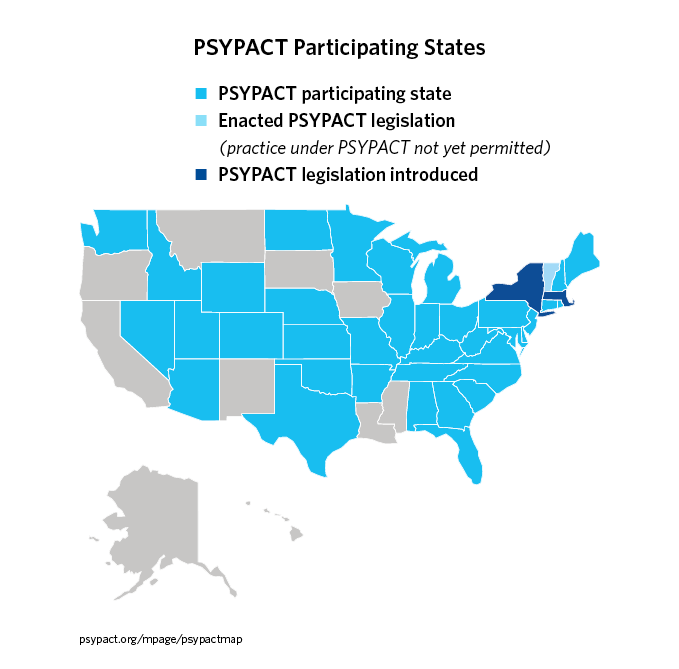
The compact has been adding roughly six members a year in recent years, said Janet Orwig, executive director of the PSYPACT Commission, the compact’s governing body. This rate will likely slow, given the relatively few states and territories left outside of PSYPACT, Orwig said, but there is still interest in these areas.
“Folks are providing an increasing amount of mobile services to an increasingly mobile population,” said Reyes.
New York has not yet enacted PSYPACT but was one of two states, along with Massachusetts, with active PSYPACT legislation in 2023. In New York, Reyes said, the association is currently seeking a majority lead sponsor in both legislative houses for the bill, which is necessary for moving legislation through the New York state system. Other states, including Mississippi and Hawai’i, had bills in committee in 2023, but time ran out in the legislative session before they could come up for a vote. Hopefully, Orwig said, those bills will be reintroduced in 2024. In all, 12 states saw PSYPACT bills in 2023, and six enacted them.
The New York State Psychological Association began pursuing membership after a “groundswell of interest” from members, Reyes said. “It really is far less cost-prohibitive and far less logistically challenging to practice with PSYPACT than it is to pursue licensure in multiple states,” she said.
New York psychologists have a patient base prone to cross state lines, Reyes said. Patients may live in Connecticut, work in New York, and have a second house in a third state, Reyes said, or they may commute as far away as Washington, D.C.
PSYPACT is also helpful when a patient moves out of state permanently, Reyes said; they can continue receiving care from the provider they’ve already built rapport with, or at least have a cushion before transferring to a psychologist in their new state.
“What we have heard most from our members is that their client base was increasingly more mobile, and they are finding it difficult to provide ongoing service and continuity of care,” Reyes said.
[Related: Making digital interventions accessible and affordable]
Many of the challenges to adding additional states to the compact are a matter of education and outreach for local legislators, Orwig said. Especially in states that don’t have compacts for other professional licensures, PSYPACT can be new territory. New York is one of those states, Reyes said, which means that policymakers have to consider the possible impacts on other professions and on the regulatory framework surrounding licensing before they set final rules.
PSYPACT is currently working on developing its first strategic plan, Orwig said, beginning with surveys of the individual practitioners who hold PSYPACT authorization. One theme, she said, is that PSYPACT allows psychologists in specialty areas to expand their reach, bringing their services to patients who would not otherwise have options in their regions. As a result, PSYPACT is helping address the psychologist shortage, said Shanbhag.
“Maybe the pediatric psychologists in our state are booked out several months, but you can get one in the neighboring state in 3 weeks,” she said. “It helps you get care much more quickly, and you can get much wider access for specialty care.”
There are still implementation questions around PSYPACT and billing, said Baker. It can be tricky to navigate payment when a provider is in-network for a national insurance company but not in-network in any of that company’s plans in the state that they are practicing in remotely. APA has begun educational outreach to payers in order to understand their level of awareness of any provider policies around PSYPACT.
“My hope is that interjurisdictional practice is becoming more streamlined under PSYPACT, and more resources are made available to psychologists practicing under PSYPACT, so providing care across jurisdictional lines is easier,” Baker said.
Ultimately, Orwig said, it’s unlikely that every single state and territory will join PSYPACT; it’s rare for any cross-state compact to achieve universal reach. And she expects to continue adding new PSYPACT members at a slower rate going forward.
“If we can add one or two per year going forward,” she said, “that will be really excellent.”
AI’s gradual integration into practice
As machine learning grows more powerful, researchers and health systems are starting to explore bringing AI into practice. However, while some tools are already being used by larger organizations to help streamline administrative tasks, it’s still uncommon to see AI digital therapeutics used in direct patient care. (See What psychologists need to know about the evolution of generative AI.)
“We don’t have a lot of saturation of these products in the hands of clinicians because there’s just not a reimbursement pathway yet,” said C. Vaile Wright, PhD, senior director of the APA Office of Health Care Innovation. “The products exist, but how much they’re being used is unclear.”
Unlike health and wellness apps that are prohibited from making medical claims about their outcomes, digital therapeutics are under the purview of the U.S. Food and Drug Administration, Wright said. But the health care regulatory and reimbursement systems are not designed for innovative products or for the idea of software as a medical treatment, she said. That has led to slow implementation even as companies and academic researchers develop algorithms for everything from matching patients with potential providers to monitoring of passive suicide ideation. Expanding the use of AI as a tool in practice will likely require careful testing, a rethinking of regulatory categories around innovative technologies, and the cultivation of trust in technology from both clinicians and patients.
“I don’t think we’re quite ready for AI or similar approaches to be used in direct care without human oversight, but there are a lot of exciting opportunities for AI in supporting the care that is being provided by trained professionals,” said Victoria Bangieva, PhD, a clinical psychologist who advises technology companies developing mental health tools, as well as a member of APA’s Mental Health Technology Advisory Committee. “That’s what we’re seeing happen.”
For instance, HIPAA-compliant services such as Mentalyc or Eleos will transcribe session transcripts into insurance-ready progress notes, reducing the time therapists must spend on non-patient-facing activities. Some larger systems are also using algorithms to match patients to the provider most likely to suit their needs, Bangieva said. Some services are also used to coach clinicians, giving them suggestions of which treatment paths to pursue. In the United Kingdom, the National Health Service is using Ieso, a service founded by two psychologists to provide online typed therapy. The company is working to use AI to analyze what human therapists write in these sessions and tie it to outcomes, in the hopes that AI can help therapists understand which concepts and phrasings are most effective.
“There is a lot of excitement around AI, but we’re still quite early on, and there needs to be a bit more validation of the models and the different tools that are being built,” Bangieva said, particularly in a real-world environment. AI always carries a risk of perpetuating preexisting biases, Wright said—if bad data go in, bad data come out.
“Algorithms are written by people,” she said, “and if you’ve got people with biases using data that’s biased, what are the unintended consequences in perpetuating what is already an inequitable system?”
Nevertheless, these tools are important to pursue, she said, because there are simply not enough providers to handle the mental health need without additional help. There are efforts underway to create a framework around both data management and reimbursement for the use of these tools. Earlier in 2023, CMS solicited a request for information about digital therapeutics from stakeholders. A response to those comments outlining next steps from the federal payer is expected at the end of 2023, Wright said.
A final hurdle for the development of AI in mental health right now involves training, said Ross Jacobucci, PhD, an assistant professor of psychology at the University of Notre Dame, who is working on a project using machine learning to monitor suicide risk using screenshots of people’s cell phone activity. There are relatively few people who are trained in both big data and psychology, Jacobucci said, and most psychology graduate programs lack the in-house statistics classes needed to work in machine learning. Students who want to work on the tool-development side should look to outside workshops on AI and machine learning, he said. Fortunately, more and more graduate programs are providing funding for students to get that expertise from third parties, he added.
“It’s really difficult for a clinical person to speak to somebody in computer science if neither of them has worked with the others’ type of data,” Jacobucci said. “I do think there are a lot of people with the skill set that want to work with both.”