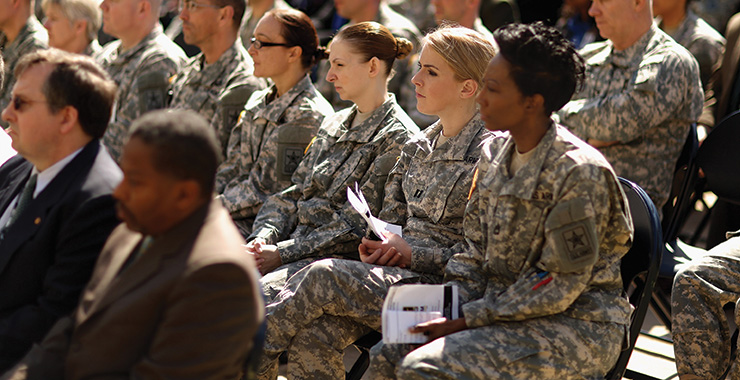
The U.S. military has launched an ambitious effort to hire and train more than 2,000 experts focused on preventing sexual assault and other harmful behaviors within its ranks. The move comes after an estimated 25% increase in military sexual assaults, which affected about 35,900 active duty service members in 2021, up from about 28,600 in 2018 (2021 Workplace and Gender Relations Survey of Military Members, Office of People Analytics, 2023opens in new window).
“We had already seen an uptick in prevalence in 2018, and then once again, that number increased,” said Nathan Galbreath, PhD, acting director for the Department of Defense (DoD) Sexual Assault Prevention and Response Office (SAPRO). “This was certainly concerning to us and also to the secretary of defense,” who launched an Independent Review Commission (IRC) on Sexual Assault in the Military (PDF, 3.2MB)opens in new window within days of taking office.
After 90 days of interviews, observations, and data collection, the IRC released a report pinpointing problems in the military’s approach to sexual assault, including “a near total lack of prevention specialists.” The urgency of responding to reported assaults had left little bandwidth for prevention efforts, which generally took the form of lecture-style meetings or well-meaning but unhelpful awareness campaigns such as pancake breakfastsopens in new window and golf tournamentsopens in new window (Hard Truths and the Duty to Change: Recommendations from the Independent Review Commission on Sexual Assault in the Military, 2021 [PDF, 7.4MB]opens in new window).
“We also found that a key driver of sexual assault, as well as other harmful behaviors, was the culture within a unit,” known as the command climate, said Andra Tharp, PhD, the senior prevention adviser for the DoD Office of Force Resiliency. “When command climate is unhealthy, these behaviors are more likely to take place.”
The new Integrated Primary Prevention Workforce (IPPW)opens in new window is the military’s intended antidote—but culture shifts take time, especially for an organization with more than 2 million personnel. Through 2028, the IPPW will recruit, hire, and train more than 2,000 psychologists and other prevention experts to serve at hundreds of military locations and ships around the world. Prevention specialists will take a holistic approach to reducing risk factors and promoting protective factors against sexual assault, harassment, suicide, retaliation, and domestic and child abuse.
[Related: Want to join the IPPW? Here’s how]
“This is a real opportunity for the Department of Defense to continue to evolve prevention science as a leading force within military health,” especially as it pertains to suicide, said Rebecca K. Blais, PhD, an associate professor of psychology at Arizona State University, a licensed clinical psychologist, and a subject matter expert who has advised the Pentagon on sexual assault and suicide risk. “I’m optimistic that some of these new efforts can promote culture change.”