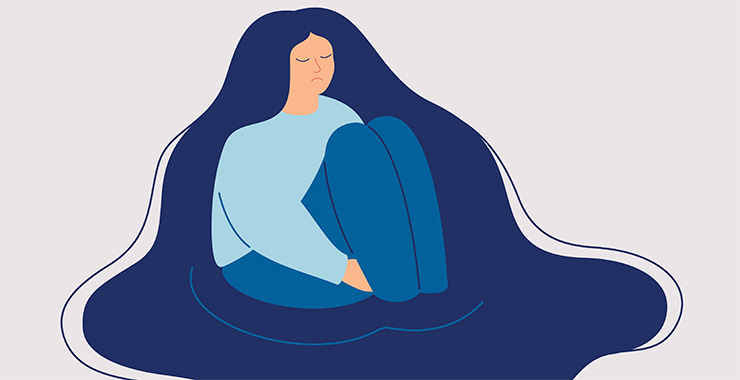
For women and their partners coping with pregnancy loss, the sense of isolation can be acute and emotionally debilitating.
Unlike with other losses, there are often no funerals or other rituals to gather with loved ones as the bereaved parents strive to process the tumult of their emotions. Their feelings might range from shame and guilt—that they somehow caused the miscarriage or stillbirth—to sadness over a future forever lost for their child and themselves, said Julie Bindeman, PsyD, a reproductive psychologist in Rockville, Maryland. Meanwhile, they must navigate a culture that’s often phobic about crying and grief and might view the loss of a pregnancy as less significant than other types of deaths, she said.
“The idea that continues to be pervasive to a degree is that the less time that you have spent with the [developing] baby, the less emotional attachment a person should have to it, and thus a shorter grieving period [is needed],” said Bindeman, a former cochair of the Committee on Reproductive Issues for APA Division 35 (Society for the Psychology of Women). “And yet what people tend not to understand is that oftentimes a pregnancy is a realization of a dream that might have started in a person’s childhood.”
Moreover, given that a miscarriage can be difficult to distinguish from an abortion, the potential stakes for those who are grieving can extend beyond the emotional following the Supreme Court’s Dobbs decision and related state laws criminalizing abortion, said Bindeman, echoing a point also made by other psychologists. “Now to have to deal with fear that you might be charged for a crime,” she said. “That’s a totally different ballpark.”
Between 10% and 20% of known pregnancies end in miscarriageopens in new window, according to the March of Dimes. Stillbirth, defined as a pregnancy loss at 20 weeks of gestation or later, occurs in roughly 1 out of every 160 U.S. pregnanciesopens in new window. These bereaved parents, particularly the mother, might live with perinatal grief that persists for years, even after the subsequent delivery of another baby, including symptoms of depression, anxiety, and trauma (Markin, R. D., Psychotherapy, Vol. 54, No. 4, 2017opens in new window). Yet researchers are only now starting to delve into how clinicians can better understand and support the individuals involved as they attempt to process the reproductive trauma and often disenfranchised grief.
How well women and their partners cope depends on various factors, including their attachment style, how they ruminate over the loss, to what extent they disclose the loss to others, and in turn how those friends and family respond, according to reproductive psychologists and researchers. (Pregnancies occur primarily but not exclusively in individuals who identify as women.) Individuals who are in same-sex relationships or who are not part of a couple might face additional challenges and stigma, depending upon the extent to which their loved ones and broader community supported their pregnancy dreams.
[Related: Healing the wounds of pregnancy loss]
Amid the isolation, a psychologist might be among the first people with whom the individuals involved speak freely, said psychologist Rayna D. Markin, PhDopens in new window, an associate professor in counseling at Villanova University and the author of Psychotherapy for Pregnancy Loss: Applying Relationship Science to Clinical Practiceopens in new window (Oxford University Press, 2024). Psychologists can provide a safe and trusting relationship, along with normalization and validation of their perinatal grief, and through psychotherapy help them over time to process and grow in the wake of the traumatic loss, she said.
That therapeutic process involves “emotional holding,” Markin said. “I hear a lot of really devastating and shocking stories of loss. It’s about the therapist being able to tolerate and join the patient in their experience of loss, which often involves sitting with the horrors of the loss without seeming overwhelmed or withdrawing. It requires being able to really hang in there with the patient.”