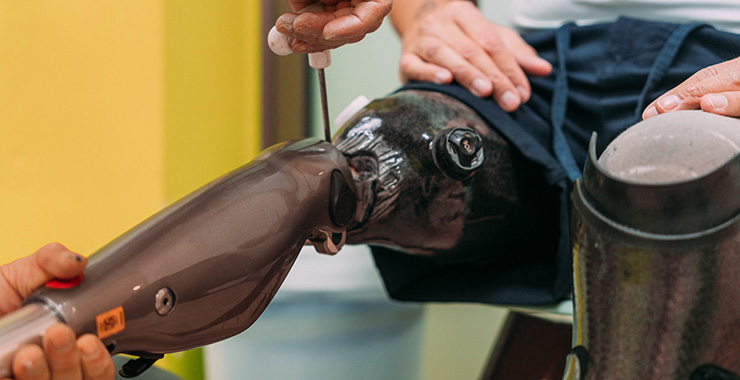
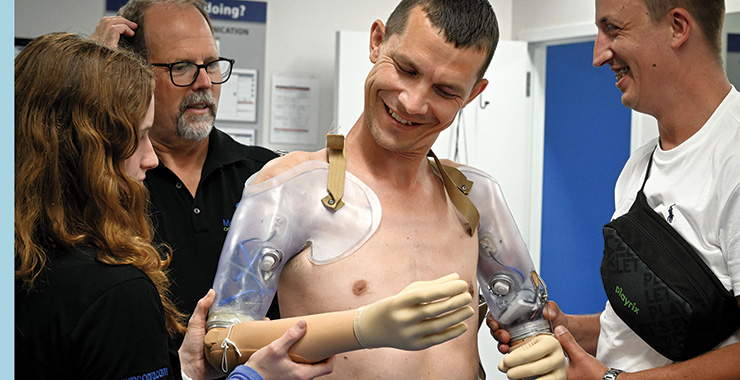
There is plenty of technological and neurological work yet to be done to make prostheses that feel like natural body parts and that come to be fully integrated into a person’s sense of self. Some of today’s most advanced prosthetics that stimulate neurons in the brain to mimic real sensations, for example, involve only a small number of the brain’s many billions of cells, Hatsopoulos said. We have, in other words, likely only scratched the surface of the kind of sensation that people have in their natural limbs. The goal of full restoration is still a significant way off.
Longevity is another challenge, Hatsopoulos said. Eventually, electrodes and other components wear out and need to be replaced. That raises ethical and philosophical questions. What happens, Valle asks, if you come to view a prosthesis as part of your personal identity and then it, too, breaks?
That’s not the only unanswered question raised by rapid advances in prostheses. In a comprehensive review of studies on neuroprostheses, researchers from the Netherlands identified 169 ethical implications (van Velthoven, E. A. M., et al., Journal of Neural Engineering, Vol. 19, No. 026055, 2022opens in new window). For instance, implantation of electrodes into the brain carries health risks, and there are long-term uncertainties about safety. Other questions concern autonomy, the relationship between people and machines, and threats to communities, like Deaf culture. In addition, although many studies mention a goal of improving well-being and life satisfaction with neuroprosthetic devices that restore hearing or speech, devices don’t always work perfectly, and they can end up causing suffering when results don’t match expectations.
Hearing aids, in particular, face barriers to acceptance that include lack of awareness. Even though 1 in 8 U.S. adults has problems with hearing, which affects more than two thirds of people older than 70, more than 90% of people couldn’t identify what a normal range of hearing is in a survey of 1,250 adults ages 50 to 80 (Carlson, M. L., et al., Otology & Neurotology, Vol. 43, No. 3, 2022opens in new window). Most adults don’t know that there are long-term health consequences (such as cognitive decline) to untreated hearing loss or that there are treatments that can help.
As technological advances continue, rehabilitation psychologists remain an essential part of an interdisciplinary team of prosthetists, physical therapists, engineers, and others who can work together to help people learn to use and embody prostheses, Scherer said. Rehab psychologists make good managers of rehabilitation teams, she added, but they are in short supply. Even though APA Division 22 (Rehabilitation Psychology) was formed in 1958, fewer than 1% of psychologists today self-report a specialty in rehabilitation psychology, according to recent APA data, and just 4% hold an American Board of Professional Psychology certification in the specialty.
Many rehabilitation patients get help from psychologists not trained in rehab psychology, found an analysis of postdoctoral rehabilitation psychology training in the United States and Canada (Stiers, W., & Stucky, K., Rehabilitation Psychology, Vol. 67, No. 3, 2022opens in new window). Solutions will need to include more outreach and advocacy to expand the pipeline and visibility of the profession, concluded researchers in a 2020 report on the state of the field which was the first of its kind (Baker, L. N., et al., Rehabilitation Psychology, Vol. 67, No. 2, 2020opens in new window).
“A rehabilitation psychologist is focused on coping, adaptation, maximizing functioning, enhancing quality of life, helping people find employment, helping them achieve what they want to do,” Scherer said. “There are not enough of them.”
If prostheses eventually reach the point where they can truly mimic or improve sensation and performance, there will be yet more issues to grapple with, Hatsopoulos said. Should prosthetics be reserved for those with paralysis, for example, or should they become available as performance enhancers for people with ordinary abilities or to make high-performing athletes even more competitive? “When the time comes when you can actually enhance people’s capabilities, even people without spinal cord injury,” he said, “there are definitely ethical considerations.”