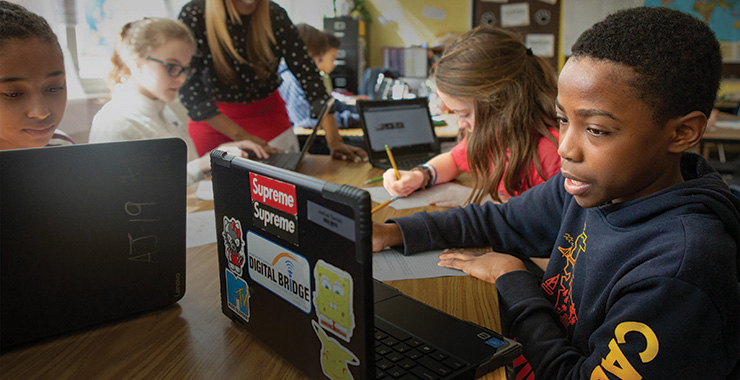
At least 21 state legislatures have taken steps to reform K–12 media and information literacy educationopens in new window, with California, Delaware, Illinois, and New Jersey passing comprehensive reforms (U.S. Media Literacy Policy Report, Media Literacy Now, 2024opens in new window). The largely bipartisan efforts are a response to challenges that most school curriculums do not yet address or teach—skills like sorting out what is true or false online, identifying when content is produced by artificial intelligence (AI), and how to use social media safely.
“We’ve all seen how the spread of online misinformation and disinformation is growing and that it has real-world consequences,” said Assemblymember Marc Berman, JD, an attorney who represents California’s 23rd District and spearheaded the state’s digital literacy education law. “I can’t force adults to go back to school and take media literacy, but at a minimum, we can make sure that our young people are getting the skills they need for today’s world.”
People of all ages are susceptible to misinformation, but youth—who spend an average of 4 to 6 hours per day online—say they need helpopens in new window. In one survey of young adults in Canada, 84% were unsure they could distinguish fact from fiction on social media (Youth Science Survey, Canada Foundation for Innovation, 2021opens in new window). In a study led by educational psychologist Sam Wineburg, PhD, 82% of middle school students could not tell the difference between an online news story and an advertisement (Evaluating Information: The Cornerstone of Civic Online Reasoning, Stanford Digital Repository, 2016opens in new window).
“It’s those kinds of findings that have gotten the attention of legislators,” said Wineburg, who is an emeritus professor at Stanford University and cofounder of the Digital Inquiry Groupopens in new window (DIG), a nonprofit that creates free research-backed digital literacy tools for educators.
“Increasingly, as young people’s apps of choice are TikTok and YouTube, the adults have woken up to the fact that quality information is to civic understanding what clean air and water are to civic health,” Wineburg said.
The most comprehensive programs, which are now being developed and tested for K–12 audiences, also aim to teach students how to locate and assess the source of online information and to think critically about how generative AI produces content. They also teach students about digital citizenship, which involves engaging respectfully with others online.
Psychologists are a key part of those efforts. In its 2023 Health Advisory on Social Media Use in Adolescence, APA recommended psychologically informed media literacy training for youth, guidance echoed by U.S. Surgeon General Vivek H. Murthy. What is needed now is ongoing research on what works, as well as strong collaboration with journalists, educators, and policymakers to swiftly put research insights into practice.
This year, APA also released an updated scientific roundup focused on the risks of social media content, features, and functions. The report also provides concrete recommendations for minimizing psychological harm, including tips for monitoring use.
“To me, this is really one of the most important things we can be doing right now as psychologists, given how misinformation has made science political in ways that are really frightening,” said Susan Nolan, PhD, a professor of psychology at Seton Hall University in New Jersey who studies and advocates for scientific literacy.
 APA’s Magination Press book True or False? The Science of Perception, Misinformation, and Disinformation for preteens and young teens explores what psychological science shows about how false perceptions and beliefs are developed and spread. The book also covers how difficult it can be to correct misinformation once it is spreading, how artificial intelligence (AI) and social media can spread incorrect information fast, and why some people twist information on purpose. And it teaches readers ways to debunk misinformation and think critically and factually about the world.