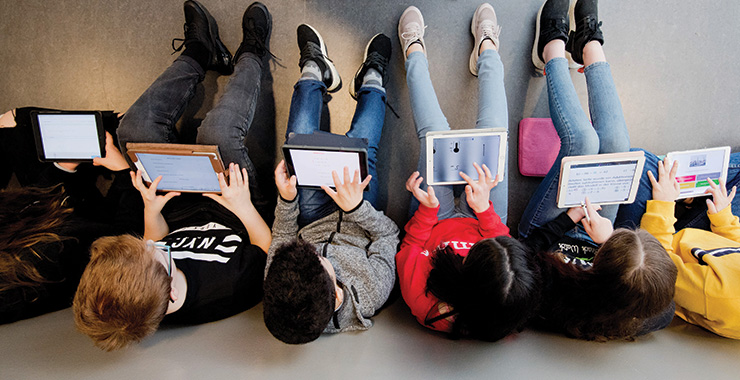
Many of the critical-thinking skills that help youth sort fact from fiction on social media can also help them critically consume information generated by artificial intelligence (AI) tools such as ChatGPT. Schools are picking up on that, with 60% of districts from the American School District Panel saying they planned to provide training on AI to teachers during the 2023–24 school year (Using artificial intelligence tools in K–12 classrooms, RAND, 2024opens in new window).
“Leaders are definitely aware of the force of AI in our world right now and the necessity for education to grapple with that,” said Chelsea Waite, a principal investigator at the Center on Reinventing Public Education (CPRE) at Arizona State University’s Mary Lou Fulton Teachers College. “But CPRE research finds that they want more guidance and aren’t really getting it.”
Despite the dearth of state-level guidance, some innovative schools are forging ahead with new approaches. At Howard University Mathematics and Science Middle School in Washington, D.C., eighth-grade math students learn about machine learning algorithms and how they can perpetuate bias. Students also learn best practices in using ChatGPT to enhance their outlines and book reports in English and language arts classes.
“From a school perspective, we need to make sure that our young people understand all the technology that’s available to them and are able to safely use it,” said Kathryn Procope, EdD, executive director at Howard University Middle School.
[Related: Teaching students critical thinking skills to combat misinformation]
Such approaches should rely on today’s technologies but teach general skills that will apply when newer tools are developed, said Susan Nolan, PhD, a professor of psychology at Seton Hall University in New Jersey who studies and advocates for scientific literacy. For example, generative AI tools often deliver information in an authoritative way that can be highly persuasive for users who do not have much background knowledge on a given subject. Students can learn to question that tone and seek supporting evidence, whether they are using ChatGPT or another program.
“All of these initiatives should be technology agnostic, because we need these skills no matter what the technology is, and we don’t know what’s coming down the road,” Nolan said.
In a report on youth and AI led by the Hopelab, Common Sense Media, and the Center for Digital Thriving, teens say adults need to learn more about AI so they can do a better job of providing support. Teens say they use AI for help with schoolwork (including—but not limited to—cheating), but also to find answers to questions they are afraid to ask adults. They also report using generative AI for companionship, to explore their sexuality, and to manipulate others (Teen and young adult perspectives on generative AI, 2024 [PDF, 1.86MB]opens in new window).