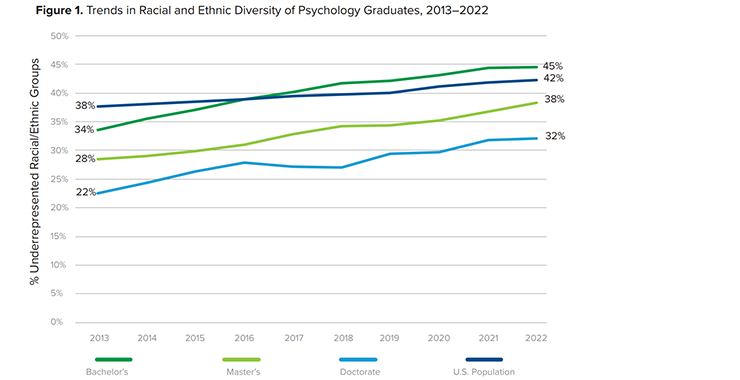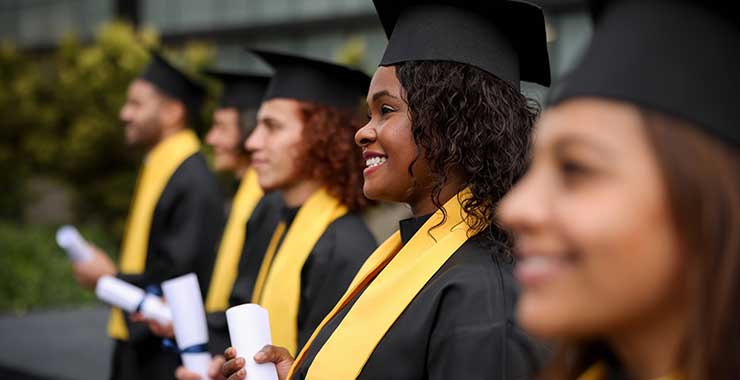
Racial/ethnic diversity in psychology degrees awarded between 2013 and 2022 increased over time across all degree levels.1, 2 Starting in 2017, the population of graduates earning psychology bachelor’s degrees became more racially and ethnically diverse than the broader U.S. population. In 2022, about 45% of psychology bachelor’s graduates were from underrepresented racial and ethnic groups, greater than the 42% in the U.S. population. However, the percentage of graduates from underrepresented racial and ethnic groups at the master’s- and doctorate-degree levels remained below that of the U.S. population. In 2022, individuals from underrepresented racial and ethnic groups earned about 38% of psychology master’s degrees and 32% of psychology doctorate degrees. Across all degree levels, these groups’ rates of representation increased by about 10 percentage points between 2013 and 2022.
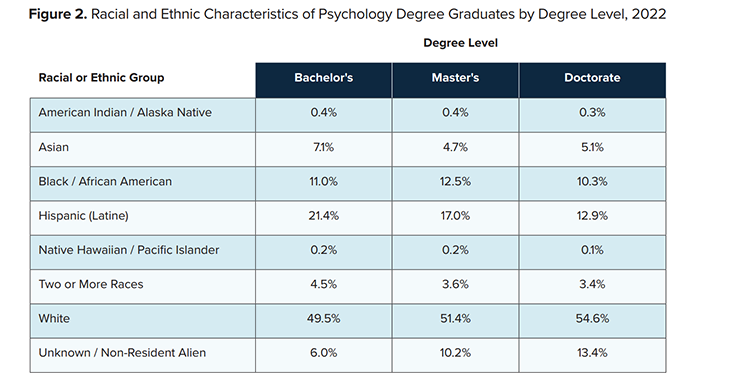
In 2022, Indigenous individuals (Native Hawaiian / Pacific Islander; American Indian / Alaska Native) had the lowest representation of any marginalized racial or ethnic group among psychology degrees awarded, whereas Hispanic (Latine) individuals had the highest representation of any marginalized racial or ethnic group.2 Hispanic (Latine) individuals also had larger percentages at lower degree levels, but their representation decreased as degree level increased.
The findings suggest that although racial and ethnic diversity in psychology graduates has increased, there are opportunities for improvement. Addressing potential barriers in educational pathways may foster and sustain progress in racial and ethnic diversity in the field of psychology.